What You'll Find in This Article
When I first moved to Jeju, I noticed something that surprised me. My neighbors, not just the older ones, but sometimes the younger generation too, would call a shaman to bless a new car, or to ask what was making their child sick when the doctors couldn’t find anything. In Seoul, shamanism felt like something from my grandmother’s time. Here in Jeju, it’s still part of daily life.
I grew up knowing about shamanism, of course. Most Koreans do. But living in Jeju made me understand why it survived here when it faded in so many other places. This island’s relationship with the spiritual world is different. It had to be. When your mother and grandmother dive into cold, dark water every day to feed the family, you need something to hold onto.
This is the first of three articles about Jeju shamanism. We’ll start with the basics: what it is, who the 18,000 gods are, and what the shamans actually do.
How Jeju’s Ancient Shamanism Survived Persecution
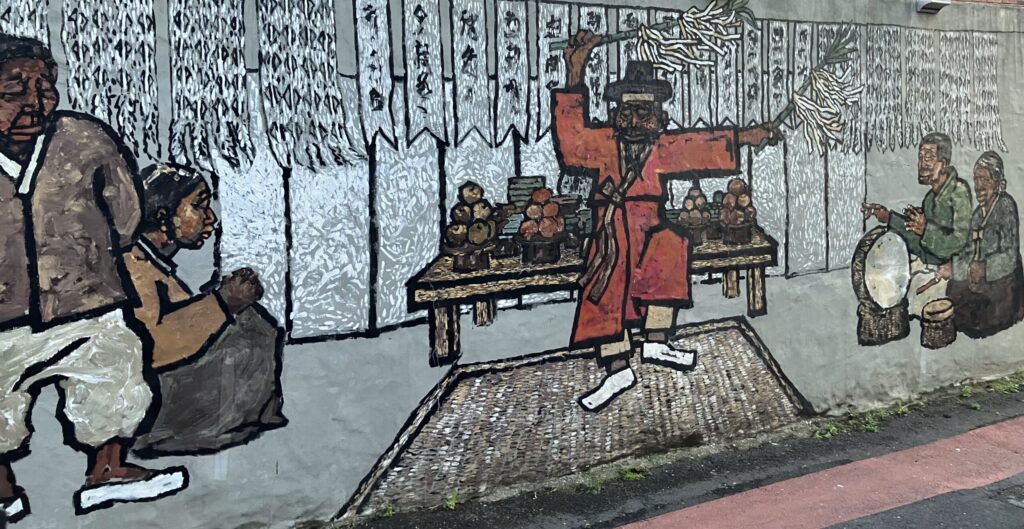
On the first day of the second lunar month, usually sometime in February, something extraordinary happens across Jeju Island. Elderly women in colorful traditional clothing gather at coastal shrines. Shamans in elaborate costumes begin drumming and chanting. Haenyeo (women divers) prepare food offerings. The air fills with incense smoke and the sound of bells.
They’re welcoming Yeongdeung Halmang: the goddess of the Wind, who controls the ocean’s moods and determines whether the sea will yield abundance or death.
This is shamanism. Not as a relic studied by anthropologists, not as a performance staged for tourists, but as living religious practice that shapes how Jeju people understand the world, navigate misfortune, and maintain connection with forces larger than themselves.
Jeju is often called ‘the island of 18,000 gods.’ About 18,000 deities, mostly grandmother and grandfather spirits, each with names, stories, domains, and personalities. And unlike most of Korea where shamanism has been pushed to the margins, on Jeju it remains deeply embedded in daily life. Old and young alike still call shamans to bless new houses, to divine the cause of illness, to send off the spirits of the dead. Shamanism here isn’t dying — it’s adapting, persisting, and still embedded in daily life.
What Is Jeju Shamanism?
Korean shamanism, called Muism (무속) or Sinism (신교), is Korea’s indigenous spiritual tradition, predating Confucianism and Christianity by thousands of years. At its core is a simple premise: the world is populated by gods and spirits who influence human affairs, and humans can communicate with these beings through ritual specialists called shamans.
On mainland Korea, female shamans are called mudang (무당) and male shamans are called baksu mudang (박수무당). On Jeju, they’re called simbang (심방), a term that has been exclusive to Jeju practitioners since the early 19th century.
Jeju’s shamanism developed distinctly from the mainland’s tradition because of the island’s geographic isolation, harsh environment, and unique economic structure. While mainland shamanism was suppressed by Neo-Confucian ideology and marginalized by Buddhist and Christian missionaries, Jeju’s version remained integrated into village life because it served practical, urgent needs: protecting divers who descended 20 meters on a single breath, ensuring fishermen returned safely from typhoon-prone waters, and making sense of a volcanic landscape that could be beautiful one moment and lethal the next.
The 18,000 Gods
The most striking feature of Jeju shamanism is its pantheon. There are approximately 18,000 gods and goddesses that are specific to Jeju. Each village has its own gods, tied specifically to that location. The deity might be someone who once lived in the village and performed heroic deeds, or an ancestral founder, or a spirit associated with a particular natural feature: a large tree, a rock formation, a spring. There are approximately 200 active shrines (당, dang) scattered across Jeju, each serving as a house for these local deities.
Major deities include:
Seolmundae Halmang: The creator goddess. A giant so tall she could reach the ocean with her toe while lying on Hallasan Mountain. She created Jeju by piling dirt into a mound in the ocean, and the 360+ oreum (smaller volcanic cones) are dirt that fell from her skirt as she shaped the island.
Yeongdeung Halmang: Grandmother Wind, the goddess who controls weather and ocean conditions. She arrives on Jeju on the first day of the second lunar month, stays for two weeks sowing seeds of seaweed and seafood in the ocean and grain on land, then departs. While present, she can stir dangerous seas, but she also circulates water that allows seaweed to grow. She’s simultaneously a threat and a blessing.
Yongwang (Dragon King): The god of the sea who lives in an underwater palace. Fishermen and haenyeo pray to him for protection and abundance.
Bonhyangdang: A sacred place where a deity is worshipped. There is one in each village, serving as a shrine for the village’s guardian deity.
Chilseong (Seven Stars): Also known as Ursa Major or the Big Dipper, in Jeju Shamanism the Seven Star Gods are combined with the mainland’s household deity to take the form of a snake deity. This deity protects the wealth of a family or community.
Jishin (Earth God): Foundation god who must be honored when building houses or moving graves. The worship of a deity that personifies the supernatural power believed to reside in the land.
Jowang (Kitchen God): This deity is believed to protect the household from misfortune and ensure the prosperity of the family business.
Beyond these major figures are thousands of minor deities associated with specific mountains, streams, rocks, trees, and locations. There are gods of illness, gods of trade, gods of seasons. There are ancestral spirits of dead shamans who assist living shamans during rituals.
The complexity is staggering. Every spiritual need, be it protection while diving, success in fishing, safe childbirth, recovery from illness, good harvest, or prevention of typhoon damage, has a corresponding deity or cluster of deities who must be properly honored.
The Simbang: Spiritual Mediators
Simbang are the ritual specialists who mediate between humans and the spirit world. Unlike mainland mudang who often become possessed by spirits during rituals, Jeju simbang work differently. They don’t channel gods directly into their bodies. Instead, they use sacred implements called mengdu (맹두) – brass knives, bells, and divination tools – which are believed to incarnate the spirits of gods and previous shamans.
The mengdu are simultaneously symbols and qualifications. A novice shaman cannot practice independently until they acquire their own mengdu, typically inherited from their parent or teacher. The implements embody lineage. Each set carries the spirits of all previous owners, creating a chain of shamanic authority stretching back generations.
Jeju’s shamanic tradition is hereditary in a way mainland shamanism isn’t. While mainland mudang are typically ‘called’ to the profession through spiritual crisis (sinbyeong, or ‘spirit sickness’), Jeju simbang more often inherit the role through family bloodlines. However, this isn’t absolute. Some simbang do experience sinbyeong – severe illness, misfortune, or psychological distress that can only be cured by accepting the shamanic calling.
What They Do
Simbang perform multiple functions:
Divination: Using their mengdu and other methods to determine the cause of misfortune, illness, or family problems. They interpret signs and messages from the gods.
Gut rituals: Elaborate ceremonies involving music, dance, storytelling, and offerings to honor gods, console spirits, and secure blessings.
Oral historians: Simbang memorize and recite village myths (bon-puri), preserving the origin stories of gods and the history of their community. Each ritual includes recitation of relevant myths.
Conflict mediators: Before major village rituals, all community conflicts are expected to be resolved to ensure the gods’ benevolence. Simbang often facilitate this process.
Healers: Many illnesses, particularly psychological or chronic conditions, are attributed to spiritual causes. Simbang perform healing rituals, sometimes involving exorcism of troublesome spirits.
A Gut ritual can take many forms. Small private Gut might last a few hours: blessing a new house, ensuring a child’s recovery from illness, sending a deceased family member’s spirit to the afterlife. Large village Gut can last days, involving dozens of participants, extensive food preparation, multiple shamans working together, and elaborate performances.
The largest Jeju Gut rituals, now rarely performed in full, traditionally took fourteen days to complete and included recitation of the entire corpus of Jeju shamanic mythology.
Gender and Practice
Jeju’s matrifocal culture, where women held economic power and female deities were prominent, meant that shamanism integrated naturally into the fabric of society rather than being marginalized as ‘women’s superstition’ as it was on the mainland under Neo-Confucian ideology.
The most famous modern simbang, however, was Ahn Sa-in (1912-1990), a male shaman who was designated as the holder of Intangible Cultural Property for the Chilmeoridang YeongdeungGut ritual in 1980. His recognition by the South Korean government marked a turning point. Shamanism began to be understood not as backward superstition but as valuable cultural heritage.
Male Shamans on Jeju
As the case of Ahn Sa-in shows, a distinctive feature of Jeju shamanism is the prominent role of male shamans, called baksu (박수) or baksu mudang (박수무당). While shamanism across Korea is overwhelmingly female-dominated (estimates suggest 90%+ of mainland shamans are women), Jeju has a significantly higher proportion of male practitioners.
On the mainland, male shamans are often marginalized within the shamanic community itself, relegated to lesser status or considered less authentic than female mudang. Many perform only simplified rituals or work as assistants. The Korean term for male shaman, baksu, even carries slightly pejorative connotations in some contexts.
But on Jeju, male simbang hold equal status. They perform the same rituals, possess the same mengdu, memorize the same bon-puri myths, and command the same respect as female simbang. Some of Jeju’s most renowned shamans have been men. In fact, Jeju shamanic mythology includes a prince, not a princess, as the ancestor of all shamans, contrasting with mainland traditions that emphasize female divine ancestors.
Why the difference? Several factors:
Hereditary transmission: Because Jeju shamanism passes through family bloodlines rather than spirit possession alone, sons can inherit the role from fathers just as daughters can from mothers. The profession becomes family business rather than gendered calling.
Economic structure: On the mainland under Confucian patriarchy, men had many higher-status economic options. Shamanism was relegated to women who had fewer alternatives. On Jeju, where women dominated the economy through diving and shamanism was integrated into village life rather than marginalized, becoming a simbang wasn’t necessarily low-status. It was a respected profession that men could enter without shame.
Less Confucian influence: Jeju’s geographic isolation meant Neo-Confucian gender ideologies never took hold as firmly. The rigid gendering of spiritual roles that happened on the mainland simply didn’t apply with the same force.
Practical need: Some rituals require significant physical stamina: ceremonies lasting many hours, carrying heavy ritual implements, performing strenuous dances. Having both male and female shamans expanded the pool of practitioners who could handle demanding ceremonies.
Male and female simbang on Jeju don’t typically specialize in different types of rituals, though individual shamans may develop reputations for particular expertise (healing, divination, specific ceremonial types). The division of labor is based more on individual skill and training than gender.
This gender parity in shamanic practice reflects Jeju’s broader cultural patterns. In a society where women were primary breadwinners (haenyeo) and held significant economic power, and where mythology featured powerful female creator goddesses alongside male deities, spiritual authority wasn’t exclusively gendered. Men and women could both serve as mediators between human and divine worlds.
So that’s the foundation: 18,000 gods, the simbang who communicate with them, and a tradition where both men and women serve as spiritual mediators. Part 2 looks at how Jeju shamanism diverged from the mainland — and why that divergence explains so much about why it survived here.
