What You'll Find in This Article
When I lead tours to the haenyeo villages, visitors often ask about the spiritual side of diving. They’ve read that haenyeo pray before they go into the water. They want to know if that’s still true.
It is. And understanding why requires understanding what it means to do work where your mother, your grandmother, your daughter could die any day. The haenyeo didn’t keep shamanism alive because they were superstitious. They kept it alive because they needed it.
This final article looks at that connection between the haenyeo and the shamans, the waves of persecution that tried to destroy this tradition, and what’s happening now as the haenyeo generation ages.
Chilmeoridang Yeongdeunggut: UNESCO Heritage
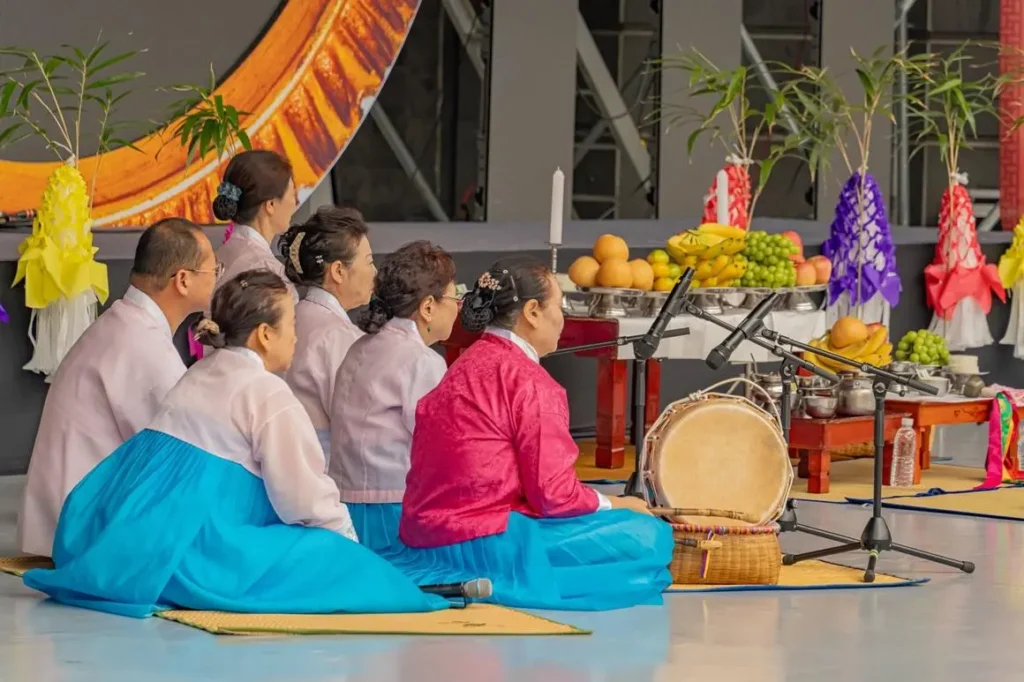
The most significant Gut on Jeju is the Chilmeoridang Yeongdeunggut, inscribed on UNESCO’s Representative List of the Intangible Cultural Heritage of Humanity in 2009. It’s the only Gut ritual to receive this recognition, and it perfectly encapsulates why Jeju shamanism matters.
When it happens: The ritual begins on the first day of the second lunar month (usually February) and concludes on the fourteenth day. This timing marks the transition from winter to spring.
Where: Chilmeoridang shrine in Geonip-dong, Jeju City. Similar Yeongdeunggut rituals happen throughout Jeju, but Chilmeoridang’s version is the most elaborate and serves as the model.
Who participates: The ritual is technically performed by simbang, but the real ‘owners’ are the dangol – haenyeo (women divers) and ship owners who prepare food offerings and sponsor the ceremony. Without the haenyeo’s participation, this ritual wouldn’t exist.
Why it matters: Yeongdeunggut is fundamentally about survival. Haenyeo start diving in their teens and continue into their 70s or 80s, descending 10-20 meters without oxygen equipment, holding their breath for 2+ minutes, harvesting seafood from the ocean floor. The mortality rate historically was significant: drowning, hypothermia, heart attacks underwater. The Haenyeo believe that Yeongdeung Halmang directly controls whether they live or die and it’s life-or-death spiritual insurance.
The Ritual Structure
Yeongdeunggut unfolds over two weeks in multiple stages:
Day 1: Yeongdeung Welcome Rite:
Chogam-je (Calling the Gods): The simbang summon Yeongdeung Halmang, village guardian deities, the Dragon King, and ancestral spirits to the ritual space.
Prayers for Good Catch: Haenyeo and fishermen present offerings – rice cakes, fruit, fish, alcohol – and make specific requests. ‘Grant us safety as we dive. Fill the ocean with abalone and sea urchin. Calm the waters when we are working.’
Three-Act Play: Dramatic performances retelling the myths of ancestral gods and village founders, entertaining the deities while teaching younger generations the stories.
Days 2-13 – Daily Rituals:
Smaller ceremonies each day honoring different deities, maintaining the gods’ presence, continuous offerings of food and drink.
Day 14 – Yeongdeung Farewell Rite:
Chumul Gongyeon (Offering Ceremony): Final offerings of drinks and rice cakes to all gods who attended.
Yowang Maji (Welcoming the Dragon King): Special ceremony honoring Yongwang, asking him to ensure abundant catch and protect divers.
Ssidrim (Seed Offering): Fortune-telling to predict the year’s harvest and fishing. The ritual involves repeatedly throwing seeds in a container high into the air and catching them. Following this seed-throwing ritual, a fortune-telling ceremony using the seeds takes place to predict the abundance of the fishing harvest.
Yeonggam Nori (Elder Men’s Play): Village senior men launch a straw boat into the sea, carrying away bad fortune.
Dosin (Sending Gods Back): The simbang respectfully send all gods and spirits back to their realms. Yeongdeung Halmang departs on the fifteenth day as spring arrives, taking with her the winter’s harshness and leaving behind the promise of abundance.
Throughout the ritual, music is constant: drums, gongs, cymbals creating rhythmic soundscapes. Simbang sing and chant bon-puri narratives, their voices carrying stories that are hundreds or thousands of years old. Participants dance. Sometimes solemn, sometimes ecstatic. Food is shared communally. The boundary between sacred and social blurs; ritual becomes celebration, prayer becomes party.
This is shamanism as lived religion. Not meditation or theological contemplation, but embodied, communal, sensory immersion in relationship with the divine.
Shamanism and the Haenyeo Are Spiritual Economics
The persistence of shamanism on Jeju is directly linked to the haenyeo – women who dive without oxygen to harvest seafood. From the 17th century onward, haenyeo became Jeju’s primary economic force, supporting entire families and villages with their catches. Their work was – and remains -extraordinarily dangerous.
Every time a haenyeo entered the water, she risked death. Diving 10-20 meters deep in cold water, holding her breath for over two minutes, navigating currents and sharp rocks. The margin for error was razor-thin. Heart attacks, drowning due to entanglement, hypothermia, encounters with dangerous sea creatures: these were real risks.
In this context, shamanism wasn’t superstition. It was necessity. If your mother, sister, daughter was going underwater every day to feed the family, you needed spiritual insurance. You needed to believe someone was watching over her. You needed rituals that could influence whether she came back alive.
The Haenyeo-Shaman Alliance
Haenyeo are the primary sponsors and participants in Jeju’s shamanic rituals. Every March, haenyeo in Gimnyeong hold a memorial service for the King of the Sea. Before diving season begins, they gather at coastal shrines to make offerings and request protection. When a haenyeo dies at sea, her fellow divers sponsor elaborate Gut rituals to send her spirit safely to the afterlife and console her grieving family.
The term dangol used for ritual sponsors literally means the community of believers who maintain a dang shrine. On Jeju, dangol are overwhelmingly haenyeo. They prepare food offerings, fund ceremonies, and ensure simbang can continue their work. Without haenyeo economic support, many rituals would have disappeared.
This creates a reciprocal system: Haenyeo support shamanism financially and through participation. Shamanism provides haenyeo with spiritual protection, psychological comfort, and communal solidarity. The two institutions reinforce each other.
As the haenyeo population declines, from tens of thousands in the mid-20th century to just a few thousand today, with most in their 60s-80s, Jeju shamanism faces an existential threat. Younger generations don’t dive, don’t face the same daily brush with mortality, don’t feel the visceral need for spiritual mediation with ocean forces. The economic base and the lived context that kept shamanism vital are eroding.
Bulteok Democracy
There’s a Jeju saying: ‘Bulteok Democracy.’ The bulteok is the stone fireplace area where haenyeo gather before and after diving to warm up, change clothes, and talk. It’s where they discuss village affairs, reach consensus on important decisions, and resolve conflicts.
Every haenyeo in a bulteok has the right to participate in debates, voice opinions, and vote on decisions. This egalitarian structure, where economic power (women) translated directly into political voice, was radical in a Korea still dominated by Confucian patriarchy.
Shamanism fit naturally into this system. The goddess who controlled the ocean wasn’t some distant patriarch. She was Yeongdeung Halmang, Grandmother Wind, a female elder who could be bargained with, appeased, honored. The spiritual world mirrored the social structure: powerful women making life-or-death decisions, female deities with real agency, men and women working together but women holding critical economic and spiritual authority.
Persecution, Suppression, and Stubborn Survival
The Long War Against Shamanism
For most of Korean history, shamanism was the target of systematic suppression. The Joseon Dynasty (1392-1897), deeply committed to Neo-Confucian ideology, viewed shamanism as ‘licentious sacrifice’ and shamans as frauds exploiting superstitious peasants. Records from the 15th-19th centuries describe shamans being officially banned, their rituals forbidden, their tools confiscated.
But Jeju was different. Geographic isolation meant that Joseon authorities had limited ability to enforce bans. More importantly, the practical necessity of shamanism – protecting divers and fishermen – meant that even government officials quietly participated in or tolerated rituals. A Joseon-era record noted: ‘As there is the custom of valuing licentious sacrifices, rites are held to honor the gods of forests, ponds, hills, trees and stones.’ Translation: ‘We disapprove, but they’re doing it anyway.’
The more serious attacks came later.
Japanese Colonial Suppression (1910-1945)
During the Japanese colonial period, shamanism was targeted as part of the broader effort to erase Korean culture. Colonial authorities viewed shamanic rituals as backwards, noisy, and potentially subversive … sites where Korean identity and resistance could be maintained.
Shamans were pressured to adopt Japanese names, learn Japanese, and integrate their practices into Shinto. Many refused. Those who complied were despised by other shamans and the community. When authorities tried to display Korean shamanic deities alongside Japanese Shinto gods, the attempt failed. The differences were too fundamental to synthesize.
Shamanism went underground but didn’t disappear. Rituals were held in secret, at night, in private homes. The oral tradition continued: myths were still memorized, Gut rituals still performed, just hidden from authorities.
Post-War Modernization Campaigns (1960s-1980s)
The most aggressive persecution came after the Korean War. In the 1960s-70s under Park Jung-hee’s military dictatorship, South Korea pursued rapid industrialization and modernization. Traditional practices like shamanism, folk beliefs, and village rituals were declared ‘enemies of modernity’ and ‘feudal superstitions’ that held the nation back.
The government launched campaigns to ‘eradicate superstition.’ Shamans were forced to undergo public renunciations of their beliefs, formally declaring shamanism false and pledging to stop practicing. They had to surrender their mengdu, the sacred implements that were their qualification and spiritual connection, to government officials who destroyed them.
Imagine being told your religion is illegal, that your profession makes you a criminal, that the implements passed down through generations must be confiscated and destroyed. Imagine being forced to stand in a public square and declare that your life’s work is fraudulent.
Many simbang went through these humiliating ceremonies. Then they went home and continued practicing in secret.
Why It Survived
Jeju shamanism survived for several reasons:
- Practical necessity
As long as haenyeo were diving and fishermen were going to sea, there was existential need for spiritual protection. You can ban something all you want. If people are facing death daily, they’ll find ways to maintain rituals that offer comfort and hope.
- Community integration
Shamanism wasn’t fringe practice maintained by outcasts. It was embedded in village social structure. Almost every village had a simbang, a dang shrine, regular communal rituals. Even people who didn’t personally believe strongly participated because it was how community solidarity was maintained.
- Oral tradition resilience
You can destroy mengdu. You can ban public rituals. But you can’t erase memories. Simbang continued memorizing bon-puri myths, teaching them to apprentices in private. The knowledge didn’t require institutions or texts, it lived in human minds and could be transmitted secretly.
- The 4.3 massacre
Ironically, Jeju’s worst trauma strengthened shamanism’s hold. During the 1948-1954 suppression when 30,000+ civilians were killed, survivors couldn’t openly mourn or memorialize the dead. Speaking about 4.3 was criminalized as ‘communist propaganda.’ Shamanic rituals became one of the few safe ways to honor ancestors and process grief. Gut ceremonies ostensibly for fishing safety or seasonal blessings would secretly include prayers for 4.3 victims. Shamanism absorbed and held collective trauma when official channels were closed.
- Policy reversal
In the 1980s-90s, South Korea’s attitude shifted. Democracy movements challenged authoritarian narratives. Academics began studying shamanism as valuable cultural heritage rather than backwards superstition. In 1980, shaman Ahn Sa-in was designated as holder of Intangible Cultural Property for Yeongdeunggut, an official government recognition that shamanism was worth preserving. The 2009 UNESCO inscription of Chilmeoridang Yeongdeunggut as Intangible Cultural Heritage of Humanity completed the transformation: what had been criminalized became celebrated.
Shamanism Today: Living Tradition or Museum Piece?
Almost every larger village still has an active simbang. Approximately 200 dang shrines remain operational. About 40,000 shamans practice across Korea; Jeju has a disproportionately high concentration relative to population.
Who calls on them? Primarily older generations in their 60s, 70s, and 80s who grew up when shamanism was normal and necessary. But not exclusively. Younger Jeju residents still consult simbang for certain purposes:
Blessing new houses or businesses
Blessing new cars (to prevent accidents)
Seeking help for chronic illness or psychological problems that medical doctors can’t resolve
Performing Gut for deceased family members to ensure proper transition to afterlife
Seeking advice on important life decisions such as career changes, relationships, and financial moves
The difference between older and younger practitioners: older folks approach shamanism as comprehensive worldview and regular practice; younger people treat it more pragmatically, something like ‘I don’t necessarily believe in all this, but when my child won’t stop crying or my business is failing, it doesn’t hurt to try.’
The rituals themselves continue largely unchanged. Yeongdeunggut in February, village danggut throughout the year, private household Gut as needed. The forms are stable even as the meanings shift.
The Heritage Paradox
There’s tension between shamanism as living religion and shamanism as cultural heritage. UNESCO recognition brought funding, attention, preservation efforts. All positive. But it also created pressure to perform rituals for documentation, tourism, education rather than genuine spiritual need.
Some Gut ceremonies now happen as public performances attended by tourists, scholars, photographers. The ritual form is preserved, but something intangible is lost when the audience includes people holding cameras rather than people seeking blessings. The distinction between sacred ceremony and cultural performance blurs.
That said, most shamanic practice on Jeju still happens privately, away from tourism circuits. The Gut ceremonies at village dang shrines, the household rituals, the consultations between simbang and clients seeking guidance. These continue as genuine religious practice, not performance.
The larger Yeongdeunggut ceremonies at Chilmeoridang do attract observers, but they’re still fundamentally haenyeo rituals, funded and organized by dangol who participate because they believe, not because it’s heritage performance.
The Next Generation Problem
The existential question: what happens when the haenyeo generation dies?
Currently, most active haenyeo are 60-85 years old. Very few young women are becoming haenyeo. The work is brutal, dangerous, and poverty wages compared to what education and urban jobs offer. Within 20-30 years, the haenyeo population will be decimated.
When haenyeo disappear, so does the economic base and existential context that kept shamanism vital. Yeongdeunggut ceremonies might continue as heritage performance, but without real dangol who dive daily and need spiritual protection, the ritual becomes hollow.
Similarly, simbang face succession problems. While shamanic knowledge is theoretically hereditary, fewer young people want to become simbang. Learning the full corpus of bon-puri myths, mastering divination techniques, acquiring mengdu. It’s years of training for a profession that carries social stigma and uncertain income.
Some simbang have no apprentices. When they die, their knowledge dies with them. Several bon-puri myths are already no longer performed because the shamans who knew them have passed away without teaching anyone.
The largest Gut rituals are seldom performed in full anymore. Partial versions happen, abbreviated for practical and economic reasons. The tradition is eroding even as it’s being celebrated as heritage.
Paths Forward
That said, don’t write Jeju shamanism’s obituary yet. It has survived waves of persecution that should have killed it. It adapted to modernization, democracy movements, tourism, globalization. It might adapt to the 21st century too.
Some encouraging signs:
Academic documentation: Extensive recording and transcription of bon-puri, ritual procedures, shamanic knowledge. Even if oral transmission fails, written records preserve the tradition for future reconstruction.
Government support: Financial backing for designated simbang, maintenance of dang shrines, funding for major rituals.
Cultural pride: Younger Jeju residents increasingly view shamanism as distinctive heritage worth preserving, even if they don’t practice personally.
Ritual innovation: Since the late 1980s, Gut rituals have been held to commemorate 4.3 massacre victims, public lamentations for those killed, using shamanic forms to process collective trauma and reclaim suppressed history. This shows shamanism adapting to new social needs.
What seems likely: shamanism won’t disappear but will transform. It may become more explicitly heritage performance, less daily practice. Certain key rituals (Yeongdeunggut) will be maintained with institutional support even as smaller village Gut fade. Academic and governmental investment will preserve knowledge even as organic transmission weakens. This isn’t ideal – living tradition reduced to museum exhibit – but it’s better than total erasure.
What Jeju Shamanism Teaches
Western notions of religion often emphasize individual salvation, theological doctrine, transcendent otherworldly focus. Jeju shamanism is gloriously unconcerned with any of that.
The gods don’t care about your theological correctness. They care whether you make offerings, show respect, participate in rituals, and maintain community harmony. Salvation isn’t the goal. Instead, it’s safety, prosperity, health, and good fishing. The afterlife matters, but not as much as this life, this harvest, this dive.
This pragmatic spirituality, where the divine is invoked to solve concrete problems and success is measured by tangible outcomes, offers alternative model to salvation-focused religions. The sacred isn’t separate from the mundane; it’s thoroughly embedded in it.
Women’s Spiritual Authority
In a Korean context historically dominated by Confucian patriarchy, where women were excluded from formal religious and political institutions, Jeju shamanism offered something radical: spiritual systems where women held primary authority.
The most powerful deities are female, such as Seolmundae Halmang the creator and Yeongdeung Halmang who controls the seas. The primary economic actors are female – haenyeo. Many of the most respected simbang are female, even if the most famous is male.
This isn’t incidental. It reflects a social structure where women’s economic power (diving was far more lucrative than farming or fishing) translated into spiritual and social authority.
The matrifocal elements of Jeju culture, where women were breadwinners, property passed through female lines, and household decisions were made by women, found spiritual expression in shamanism. The religion reflected and reinforced women’s authority in ways Confucianism never did.
Indigenous Knowledge Preservation
The bon-puri myths recited during Gut ceremonies aren’t just religious texts. They’re oral history, environmental knowledge, social memory, and cultural identity encoded in narrative form.
Creation narratives explain Jeju’s volcanic landscape. Stories about Yeongdeung Halmang encode meteorological knowledge. When winds shift, what weather patterns mean. Myths about village founders preserve genealogies and settlement history. Tales of gods punishing wrongdoers articulate moral codes.
Simbang function as living libraries. Human repositories of knowledge that would otherwise be lost. In societies without widespread literacy, oral tradition performed critical archival functions. Jeju shamanism represents one of the last intact systems of this kind in modern Korea.
When simbang die without passing on their knowledge, centuries of accumulated wisdom dies with them. The current generation of simbang holds irreplaceable information about Jeju history, ecology, social structures, and spiritual worldviews.
Community Cohesion
Village Gut ceremonies aren’t just religious events. They’re occasions for community gathering, conflict resolution, mutual aid, and collective identity reinforcement.
Before major rituals, villages are expected to resolve internal conflicts so gods won’t be offended by disharmony. This creates social pressure toward reconciliation. During rituals, everyone participates: preparing food, making offerings, dancing, sharing meals. Class distinctions blur. The bulteok democracy model, where haenyeo made collective decisions, extended into shamanic practice.
In an era of social atomization where traditional community structures are collapsing, shamanic rituals offer rare spaces for genuine communal experience. They’re not just spiritually meaningful, they’re socially functional.
The Egalitarian Divine
The 18,000 gods of Jeju aren’t distant cosmic authorities. They’re neighbors, ancestors, grandparents. The grandmother and grandfather spirits who populate the pantheon are approachable, negotiable, sometimes cranky, occasionally generous. You can bargain with them. You can complain to them when they fail to deliver. The relationship is reciprocal. Humans make offerings, gods provide protection. If gods don’t hold up their end, humans can legitimately withhold offerings.
This casual familiarity with the divine – treating gods like respected relatives rather than incomprehensible powers – creates spiritual democracy. The barrier between human and sacred is permeable. Ordinary people can speak directly to gods through simbang mediation, no ecclesiastical hierarchy required.
There’s something profoundly humanizing about a religion where the goddess of the wind is called ‘Grandmother’ and is imagined as a somewhat temperamental elder who needs to be flattered and fed but who ultimately cares about the wellbeing of divers and fishermen because they’re her people.
Visiting the Sacred
If you visit Jeju, you’ll walk through a landscape densely populated by the sacred. That oreum (volcanic cone) you’re hiking has a guardian deity. That coastal shrine where offerings of fruit and rice cakes sit on weathered stones is a dang, home to local gods. That elderly woman you see in traditional clothing might be a haenyeo heading to make offerings before diving, or a simbang preparing for a ritual.
Most tourists won’t recognize these layers. They’ll see beautiful landscapes, interesting architecture, colorful cultural performances. They won’t realize they’re walking through one of Asia’s most intact indigenous spiritual traditions.
If you want to engage more deeply:
Includes sections on how shamanic rituals helped process collective trauma after the massacre. Shows how spirituality intersected with political violence and memory.
Chilmeoridang Shrine
In Geonip-dong, Jeju City. The site of the UNESCO-recognized Yeongdeunggut. If you visit in February (second lunar month), you might witness actual ceremonies. Even outside ritual times, the shrine itself is architecturally interesting and carries palpable spiritual atmosphere.
Village dang shrines
Throughout Jeju along hiking trails and in villages. Small stone structures with offerings. Treat them respectfully. These are active sacred sites, not tourist curiosities.
Jeju Haenyeo Museum
Includes information about the spiritual practices and beliefs of haenyeo, including their relationship with shamanism and Yeongdeung Halmang.
The Jeju Olleh Trail
Multiple routes pass dang shrines and oreum with spiritual significance. Especially Routes 18-20 along the northeast coast where haenyeo culture remains strong.
If you encounter rituals in progress, observe respectfully from a distance. Don’t photograph shamans without permission. Don’t touch offerings or sacred objects. Remember these aren’t performances, they’re genuine religious ceremonies where people are engaging with forces they believe control life, death, prosperity, and safety.
The persistence of Jeju shamanism in the face of centuries of suppression, modernization, and cultural transformation is remarkable. By all historical logic, it shouldn’t exist. It should have disappeared decades ago.
But it endures because it served, and still serves, real human needs: making sense of an uncontrollable world, maintaining community bonds, preserving cultural memory, and offering hope that there are forces beyond ourselves who might, if properly honored, keep us safe when we descend into cold water or face storms on the horizon.
The island of 18,000 gods hasn’t lost its magic. The gods are still there. In the wind, in the waves, in the stones stacked carefully by the roadside, in the offerings left at coastal shrines before dawn. You just have to know how to look.
When I walk past the dang shrine near my home, I sometimes see fresh offerings: tangerines, rice cakes, a bottle of soju. Someone was there that morning, talking to the village god. It’s a small thing, easy to miss. But it tells me this tradition is still breathing.
Whether it will still be breathing in fifty years, I don’t know. But for now, if you come to Jeju and pay attention, you can see it for yourself.
