Reproducir episodio
Resumen del episodio
Ed champions the five-day markets (오일장) as the antidote to touristy Dongmun and Olle markets — fresh produce, fair prices, no crowds, and an authentic window into local Jeju life.
Sora explains how these rotating markets date back to the Goryeo dynasty, with vendors traveling between villages on a 5-day cycle (dates ending in 2 and 7, or 3 and 8, etc.).
Their favorites:
- Sehwa (near Haenyeo Museum, statue commemorating anti-Japanese resistance)
- Seongsan (shooting location for Our Blues)
- Hallim (famous gimbap lady with a waiting list)
- Seogwipo (lots of food options).
Check dates before you go — they’re only open one day then gone for four.
Puntos clave
- Five-day markets (오일장): Rotate on fixed dates (e.g., 2nd, 7th, 12th, 17th, 22nd, 27th of each month)
- Much more authentic than touristy Dongmun/Olle markets — fresh produce, local vendors, fair prices
- Vendors are mostly grandmas/grandpas; arrive early (6-7am), leave by 3-4pm regardless of official hours
Ed and Sora’s Favorites:
- Sehwa Market: Near Haenyeo Museum in the northeast, statue commemorating anti-Japanese resistance — combine with museum visit
- Hallim Market: Sora’s favorite in the northwest; famous gimbap lady (book first, stroll for an hour, then pick up)
- Seogwipo Market: In the South. Lots of food options. Watch grandmas bargaining in Jeju dialect; sit and eat while observing local life
- Goseong Market: Near Seongsan in the East, small, K-drama “Our Blues” filming location
Must-try foods:
- 빈떡 (bintteok, Jeju-only buckwheat crepes)
- 꽈배기 (kkwabaegi, twisted donuts)
- 호떡 (hotteok)
- 떡볶이 (tteokbokki)
- 순대 (sundae, blood sausage — not ice cream!)
- 뻥튀기 (ppong-twigi, puffed rice discs)
- 짜장면 (jajangmyeon)
Coreano práctico con Sora Ssaem (쌤)
Review of previous phrases for market use:
- 이거 얼마예요? (igeo eolmayeyo?) — How much is this?
- 이거 주세요 (igeo juseyo) — Please give me this
- 감사합니다 (gamsahamnida) — Thank you
- 맛있어요 (mashisseoyo) — It’s delicious
- 안녕히 계세요 (annyeonghi gyeseyo) — Goodbye (to someone staying)
Sora’s tip: Get straight to the point, but always say 감사합니다, 안녕히 계세요 when leaving.
Próximos pasos
- Plan your Jeju trip at vamosajeju.com/trip
- Suscríbase a la serie de 14 correos electrónicos en Vamos a Jeju.com/comenzar
- Sigue a Vamos a Jeju en Instagram, TikTok, or YouTube.
- Comparte el episodio con tus amigos para ayudar a que el podcast crezca.
- Visita vamosajeju.com para artículos, videos y recursos
Transcripción del episodio
What Is a 5-Day Market?
Soraya (00:19) Hello everyone. Welcome to our podcast, Vamos a Jeju. And today we’re gonna talk about five day markets. The market that happens only a day and then disappear for four days. And actually, I don’t really go to those markets. I go to the modern supermarket often to do the grocery. But I know my buddy Ed, he really loves this place, the five day markets. So we have Ed here today.
Ed (00:49) Hello, Chingu. So I feel a little bit offended on behalf of all the five-day markets in Jeju and Korea. What do you mean you prefer to go to grocery stores? The food and fruits are also fresh in the five-day market. It is just full of local people, rarely any tourists. I mean, it’s got all the best of touristy markets like Gwangjang Market in Seoul but without the crowds, without the price and without people trying to rip you off. Like what’s there not to love?
Soraya (01:23) I love the place, but it’s every five days. So it’s not always on the weekends. So if I work on the weekday, I can’t go. And also it finished very early. Because usually the vendors are grandma and grandpa. So they start like early morning, like six, seven AM and then finish like before four or five PM.
Ed (01:48) So the five day market concept in Jeju and also the rest of Korea is, it is not really meant to be a tourist attraction. But I feel like if you are in Jeju and if the timing works, you should really check it out.
If you were to go to the two big markets, the daily markets, the touristy markets in Jeju, that would be Dongmun Market in Jeju City and the Olle Mail market, the Olle daily market in Seogwipo City in the South. Those are really touristy. It doesn’t feel authentic. So if you’re just looking for the touristy experience, that’s fine. But if you want to get some fresh produce or better yet like eat at one of the food places where you can actually sit down in front of the boss and all the food. That’s such a great experience and it really adds depth and flavor to your Jeju trip. So I think even though Sora doesn’t really want to go because the timing doesn’t work out, if you’re there…
Soraya (02:38) I want to go. I want to go.
Ed (02:57) If you are listening in from like Australia or Canada or United States, the five day market is very similar to a farmer’s market where the people who grow the foods, the plants and vegetables and even the meats, I guess they actually take the produce to the five day market to sell the stuff. But it’s not just about produce or meats or anything like that. It’s also like snacks and other even household goods. You can even buy like those what’s very in trend now, you know, the Halmoni, the grandmother vest. You can buy like almost anything.
I’m not saying that a tourist has to buy all this. I’m just saying that there’s a really full range of stuff. You’re going to buy fresh fish that came off a boat that very morning. Everything is really fresh. Everything is very authentic and it’s going to be a very fair price.
Ed (03:53) The five-day market is actually very interesting because the same vendors will go to various markets in different towns. And that all has historical reasoning to that. And I guess this is a good time for me to hand off to the Korean person to explain why the five-day market concept is.
Soraya (04:13) I was checking the historical fact and it’s because of the distance because back in the day people needed to walk right to go to another market. So based on the distance, it becomes like five days each. So actually, it was started from like Goryeo dynasty before Joseon dynasty. And it become like normalized for five days in the late Joseon period, like after 15th century. So these market days open on a fixed date.
In Jeju we have nine five day markets. And for example, the Jeju City five days market, they open on every second of, second of March, second of April, and then second, and then seventh. And then it’s going to be 12, 17, 22, 27, like this.
Ed (05:12) We are going to have a blog post about this and also we’ll be calling out the different locations of the five day markets, the nine five day markets and the timings and all that and what dates are open. And for that go to vamosajeju.com/market.
And, Sora, earlier you mentioned that some of these markets close pretty early in the day. And I do see that some of them are closed at two o’clock, but there’s some that open as late as eight o’clock. I’m talking specifically about the one near Jeju city. It’s open like from eight to eight. That’s 12 hours. That’s a full day.
Soraya (05:35) No. Yeah, but this is official time. But actually the grandma, grandpa, they come earlier than eight o’clock. They prepare from six a.m. And then of course after three, four p.m. if there’s not many visitors, they will start closing soon. So you never know what time they close.
Ed (05:51) I see. So the official time just speaks to the time that the facility is open. It does not mean that the individual operators, the grandma and grandpas are going to be there. Got it. Okay. Understood.
Soraya (06:17) Yeah, they want to go back home early.
Ed (06:26) Yes, I would too if I was them.
Hallim 5-Day Market
Ed (06:26) If you wanted to go have a great experience, a great authentic cultural experience at a five day market, it is imperative that you check the, not just the opening times, but also the dates. But not all the five day markets are equal. Some are much bigger and some actually have historical importance to them. Let’s kind of talk about some of these markets that we’ve been to. Why don’t you start since you’re the person who lives in Jeju?
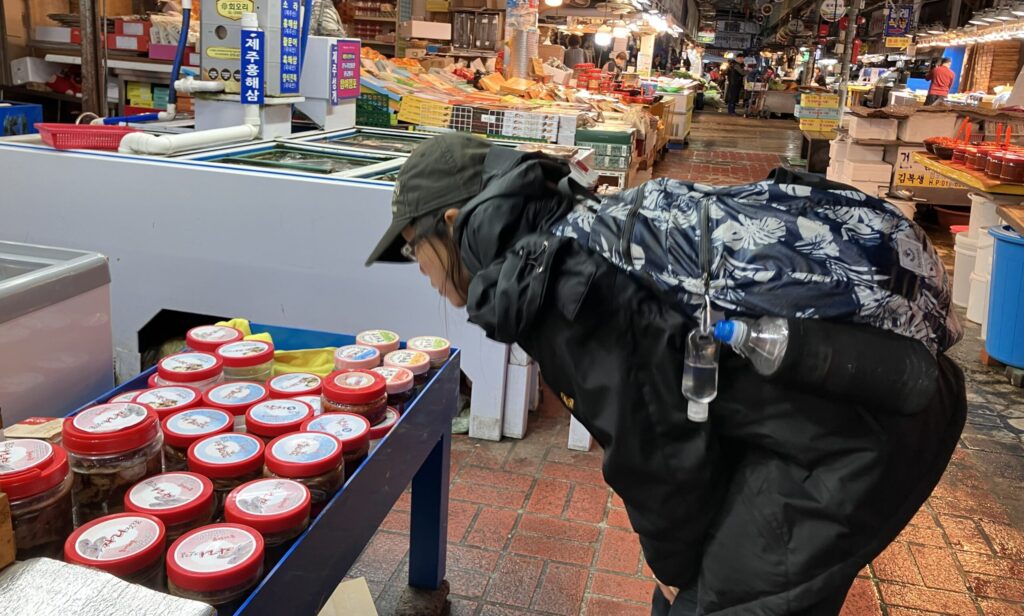
Soraya (06:57) So one of my favorite five days market is Hallim which is located in the western part of Jeju because I was living near that five days market for a month and we used to, we live like 10 minutes from that five days market. Of course they have like fresh vegetables, fruits and I always go there and then buy fruits and then send it to my mom in Seoul and then she was always so happy with the quality of the fruits. Yeah. And we had like lots of fresh seafood as well and like many grandmas selling their own veggies which is really good and some snacks but the most delicious one was actually gimbap there. So actually one vendor she’s selling gimbap and we always had waiting list. So I need to go to the gimbap lady first, and then book my gimbap. And then I do like one hour strolling, and then finally I can get my gimbap. So that was my favorite part there.
Ed (08:13) Gotcha. I think most people who are familiar with Korea will know what a gimbap is, but just in case someone doesn’t know, Sora, what is a gimbap?
Soraya (08:19) It can be a snack or a light meal. It’s the seaweed at the bottom and then we put rice and lots of veggies and you can put tuna or kimchi or any topping inside and then roll it. It’s kind of similar to California roll but we have lots of different things inside. And then roll it. And it is a signature light meal for a picnic.
Ed (08:48) Gotcha. It’s also very handy when you’re climbing mountains.
Soraya (08:57) Mm-hmm. Yeah.
Sehwa 5-Day Market
Ed (08:59) Some of these five day markets like the parking lot is usually very packed. It’s hard to find parking if you’re driving so another reason to take the bus. But yes, there will be parking, it’s just a matter of how far away you’re going to park to get there. So for me, Hallim was a great five day market. However, the one that I really enjoyed because I was doing the Olleh Trail and all that was the one in Sehwa. Sehwa is a coastal town on the northeast side of the island. It is the closest one to the Haenyeo Museum, which we talked about in episode four of our show.
And it is actually a very important one in Jeju history because it is the location where the Haenyeos organized and resisted the Japanese occupation. The market is great. The stalls are great. The food is great. But in front of it, you see a statue of the Haenyeo that commemorates the effort to resist the Japanese.
What I like to do is if I’m traveling with family or friends, we are visiting the Haenyeo Museum and walking around Sumbisuri Gil, I try to time it for a day that the Sehwa Five-Day Market is open so that we have the complete view of the Haenyeo experience from Sehwa.
Soraya (10:24) Actually, the Haenyeo Museum and then the Sehwa Five Days Market, they are nearby. And you’re talking about the history of resisting. And the reason why we built Haenyeo Museum there in Sehwa, because it was the starting point of resisting the Japanese occupation. So it was started from Sehwa village and actually like Hado which is right next to Sehwa, Hado, that has like strong haenyeo union. So from there they were the strong force to start those kind of movements.
Ed (11:05) So for those reasons, I really like the Sehwa 5-day market. How about you Sora? Is there another market that you think is worth sharing with our audience?
Seongsan and Seogwipo City 5-Day Markets
Soraya (11:15) Another one in the east side near Seongsan Sunrise Peak, Seongsan Ilchulbong. There’s a small small five days market which is called Goseong Oil Market. And this one is not big but if you have watched K-drama Our Blues, that was actually filmed in this market.
Ed (11:32) Yes. Seongsan.
Soraya (11:39) Yeah, yeah, it’s a small like really authentic market. So if you want to feel real villagers life, then you can go this one. And of course, you can go to Seongsan sunrise peak. But if you have like same date for the five days market, I recommend to combine this together.
Ed (11:49) The other one that I’ve been to is in Seogwipo City. There are all these different places, but you can just like walk around, eat, sit, you know, and just watch the locals buy. It’s interesting to me to hear the Halmonis like yell at each other. They’re bargaining and they’re ah, and I think it’s in Jeju dialect because I don’t really understand all of it. But you understand the meaning and the intent and it’s a great experience.
Ed (12:29) For me to be sitting down just eating something and watching Jeju people live their regular lives and so to me like the Seogwipo city 5 day market was really great.
Soraya (12:40) The grandmas, they are not fighting. They’re just talking, bargaining. You know that.
Ed (12:44) Well, I gather that maybe they’re a little bit deaf and so they have to speak very loudly.
Foods to Try
Ed (12:49) That’s a great overview of our favourite 5 day markets Sora. Let’s switch things up a little bit to the yummy foods that we can get at these markets.
Soraya (13:01) You have tried Bintteok right? Bintteok, that’s only for Jeju. You can’t find it in the mainland Korea. Bintteok which is like buckwheat crepes with the seasoned radish filling. It’s kind of mild and savory, but it is something you cannot find in mainland Korea. It’s Jeju traditional specialty. So I’d recommend this one. And then other stuff, it’s similar to mainland Korea, as you mentioned, like hotteok.
And one of my favorite is kkwabaegi, like twisted fried dough donuts. Yeah, this one is really good, like twisted fried donut with the sugar on it.
Ed (13:43) It is kind of like a Korean churro.
Soraya (13:52) Yes, yes, right, right, similar, right. Also like hot dog? Hot dog is same in English, right? Hot dog. No, what was that? What was that?
Ed (13:54) Hot dog? Oh, it’s different. It’s… So hot dog is called a corn dog in English. So listeners, if you go to Korea and you ask for a hot dog, you’re not going to get a sausage in the middle of a bread. You’re going to get a corn dog.
Soraya (14:04) Corn dog, corn dog. Right, right. Hot dog.
Ed (14:21) You mentioned the kwabaegi but usually kwabaegi they also sell chapssal donuts and they also sell like a croquet right?
Soraya (14:27) Mm-hmm, mm-hmm, right, together with, yes, yes. And also they always sell the steamed corn as well.
Another my favorite is tteokbokki of course the spicy rice cake and then sundae. So some foreigners they don’t like to have this kind of stuff because sundae is like Korean blood sausage. So for me, it’s good, but some of them they don’t want to try.
Ed (14:47) I just want to warn people that if you see Sundae written in English, it is spelled the same as sundae, which is an ice cream.
Soraya (15:03) I don’t know.
Ed (15:12) If you see on the internet and it says best sundae in town, like best sundae in Jeju, yeah it is not ice cream. They’re not talking about ice cream. Okay, and then… What is this? Bbong Twigi.
Soraya (15:21) What? You haven’t tried this one? Bbong twigi? So it’s like a right circle one. Yeah I don’t know how to explain but it’s from rice.
Ed (15:32) Yeah, it’s the circle, it’s the circle like a disc. That’s why it’s called… It is a puffed rice cake. If you have ever had like puffed rice, then imagine it even more puffy, but it’s always in a circular disc. And it’s very fun to watch them make it because they put the mixture of the rice with some sugar and they put it into a little machine and under pressure, the machine shoots out with a loud pop.
Soraya (15:56) Yep.
Ed (16:00) And the disc comes out, it’s flying, it is so fun to watch and usually when we were at the market they would give us like free samples.
Soraya (16:09) Right, right. And then we usually do this with those circle discs, we make hearts.
Ed (16:13) Hatsu, Hatsu, yeah.
Soraya (16:16) With your mouth. It’s one of the games like from the squid game.
Ed (16:20) Yeah. We have other things like actual food food, which is like I know I mentioned gimbap, but there are other kinds of food too, right?
Soraya (16:26) There’s like many different food and it’s really really cheaper than the regular restaurant. Like for example I went to Jeju city five days market and jajangmyeon there was I think it was five thousand won like half price of the regular restaurant. So jajangmyeon is actually like black noodles.
Ed (16:50) Really good price. A great price.
Soraya (16:54) And it is really savory. Like bacon.
Ed (16:56) Black bean is the… it is noodles in a black bean sauce.
Soraya (17:01) It is really good. And another one, my favorite is cold soy milk noodles. Soy milk? It’s not really soy milk, but like cold soy milk.
Ed (17:12) Yeah it’s kind of a soy drink you know. That one I had once and I did not like it. I did not like it.
Soraya (17:18) Really? You have to try the best one. I’ll bring you to the best restaurant next time.
Ed (17:29) I like my noodles hot. So even naengmyeon, I am not a fan of. Like I want my noodles hot. So just like I like my Americano hot, I like my noodles hot.
Soraya (17:34) Yeah? Huh.
Coreano práctico con Sora Ssaem (쌤)
Ed (17:41) So we talked about a whole bunch of foods and we talked about the different markets and we even highlighted a few special ones and I guess the next step really is to help our listeners order all these yummy foods at the five-day markets. And this is where we go to our next segment, Handy Korean with Sora Ssaem.
Soraya (18:02) Wow.
Ed (18:14) Sora I kind of usually ask you what we’re gonna teach our listeners but today I have a special request. Today I think I would like for you to review all the stuff we’ve learned in the previous episodes and package them so that it is useful for when our listeners go to a five-day market. Can you do that for us?
Soraya (18:38) It’s not going to be everything, but let’s pack something that you might need in the market. So we have been doing many vocabulary until episode 15. So let’s just review some of them today. So first of all, in the market, sometimes the prices are not clear. So you would need to ask the price. So maybe you remember like “this thing” and then “how much.” So you put this together like 이거 얼마예요 (igeo eolmayeyo)? And then they will answer some number. Or if you don’t understand, you can use your cell phone. And then you can ask them, 이거 주세요 (igeo juseyo). Please give me this thing. And after all this buying, you can say thank you. Right? Do you remember?
Ed (19:40) Thank you. 감사합니다 (gamsahamnida).
Soraya (19:46) Right. Perfect. 감사합니다. And then if we visited a restaurant, you’re going to say like, this is delicious. How do you say this is delicious?
Ed (19:51) 맛있어요 (mashisseoyo). Or if you’re trying to say it to yourself, it’s 맛있다 (mashitta).
I’m surprised Sora that you didn’t start with something like saying hello to the Halmoni.
Soraya (20:02) I think we don’t really say hello to the vendor. Yeah we just skip to the point.
Ed (20:08) Wow. Okay. Wow so Korean, so Korean! But you know I guess that’s how people know that I’m a foreigner because I’m always like, 안녕하세요 사장님 (Annyeonghaseyo, Sajangnim). Like I always try and greet them so this is how they know I’m a foreigner. Oh my gosh okay I need to be less polite.
Soraya (20:26) We don’t say that, yeah. I think so. You know Koreans are always very, very efficient.
Ed (20:41) 빨리빨리 (Pali Pali).
Soraya (20:41) Just get to the point. Yeah, I think that’s Korean. Yeah, get to the point. Okay. So, I mean, it’s good that you greet them. But for me, I don’t really say that. Yeah. I just realized now that I don’t do that. I mean, anyway, you can do it if you want, but then they will know that you are not from Korea.
Ed (21:08) Yeah, it’s gonna be pretty obvious pretty quickly.
Soraya (21:10) But really Koreans appreciate that foreigners trying to speak in Korean and they really love that and they think it’s really cute.
Ed (21:19) Okay. So what else do our listeners need to practice saying when they go to a five day market?
Soraya (21:26) I don’t say 안녕하세요, but I say 안녕히 계세요 (annyeonghi gyeseyo). Goodbye. So usually after buying something or eating something when I leave I say 감사합니다, 안녕히 계세요. These two together. So 감사합니다, 안녕히 계세요.
Ed (21:47) Mm-hmm, right.
Soraya (21:50) So let’s review all of this and we’ll say this all together and then we can wrap up.
Ed (21:57) Okay. So as always, Sora’s putting me in the hot seat, and I will rise to the occasion. So, the first phrase that Sora recapped for us today is asking, Hey, how much is this? And I’m just gonna say 안녕하세요 because I’m a very polite foreigner and I’ll say 안녕하세요 이거 얼마예요? Then they will probably tell me some number and I’ll go like huh? 네? And then they may just put up fingers or put it on my phone’s calculator and I’ll say yes this please and it’ll be 이거 주세요.
Soraya (22:35) Mm-hmm.
Ed (22:35) And then when they give it to me, I’ll be like 감사합니다. And then if I’m actually eating a hot dog or if I’m eating some snack, I can say 맛있어요. Or I can also say 맛있다 because it’s just this thing. It’s just very flexible. And I can also say, if I’m just saying it to myself, but if I say it loud enough, even though I’m saying it to myself, the shop owner hears me and knows that I liked it. So yeah.
Soraya (22:52) De acuerdo.
Ed (23:06) That’s another way to say, 맛있다 versus 맛있어요. And then finally, I can also say 감사합니다, 안녕히 계세요. Because I’m the person leaving and they are the person staying, I will say 안녕히 계세요. And remember the trick that we had from the first episode, it sounds like “onion.”
Soraya (23:17) The audience.
Ed (23:27) So it’s a very oniony smell, I guess. And then just walk away and bow. It’s gonna work just fine. Koreans mumble all the time. And the fact that they know you’re a visitor already gives you like awesome brownie points.
Soraya (23:46) That’s a perfect advice.
Ed (23:49) If you wanted to see all the phrases that we covered, just check out our show notes. And if today’s conversation has got you thinking that you really want to check out the five day markets in Jeju, here are two things to do. Number one, you’re going to go to vamosajeju.com/market for the blog post that we’re going to have with this, including all the markets, the timing, the days and the locations. That’s one. Number two, you can also sign up for our 14 day email series.
Soraya (24:23) So to get that email series send straight to your inbox just sign up at vamosajeju.com/start and for the latest update follow us vamosajeju on Instagram, TikTok and Facebook group.
Ed (24:38) If you’ve enjoyed the episodes that we’ve presented to you so far, if you could please make sure you give us a five star rating on the platform that you’re listening to this show on. And then also, if you could leave us a review and finally to please tell one friend, at least one friend about our show. That will really help people to discover us as well. And with that, I guess all that’s left for us to do is to say…
Soraya (25:05) ¡Adiós!
Ed (25:06) ¡Adiós!
