
Reproducir episodio
Resumen del episodio
Ed has been waiting 20 episodes to talk about his favorite thing in Jeju: the 437-kilometer Jeju Olleh Trail.
This episode covers everything a potential hiker needs to know, from the meaning of “Olleh” (a Jeju dialect word for the narrow pathway between a traditional house and the village road) to the passport stamping system, the blue (clockwise) and orange (counterclockwise) trail markers, and how to get the completion certificate at the Seogwipo headquarters.
Ed shares his top three favorite courses and Sora teases a future guided Olleh tour for English speakers.
Puntos clave
- 27 routes totaling 437 km; most people do one trail (5-8 hours) or half a trail, not the whole thing
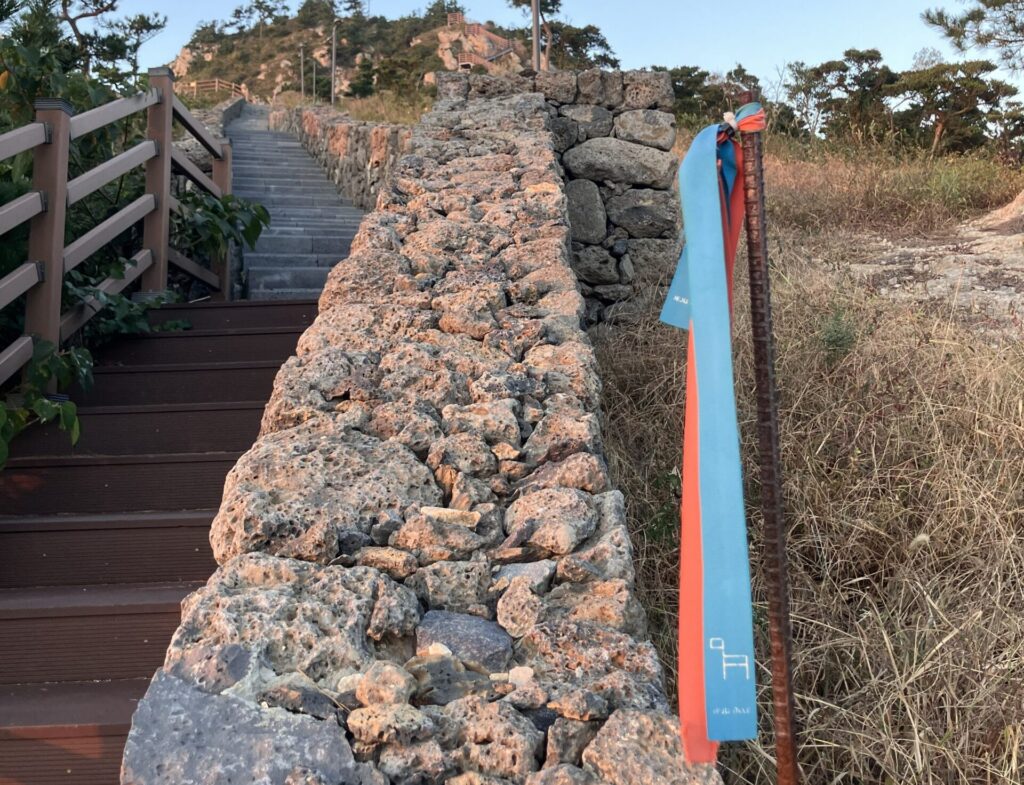
- No registration required to walk; just follow the blue and orange ribbons with the Ganse horse symbol
- Optional passport system: buy a booklet at any Olleh visitor center; stamp at the start, midpoint, and end of each trail; endpoint of one trail is the start of the next
- Blue arrows = clockwise direction; orange arrows = counterclockwise
- Completion certificate and pin awarded at Jeju Olleh Foundation HQ in Seogwipo (warning: they make you ring a bell and read an award speech)
- Who should try it: people who like walking, have time, are comfortable navigating buses (some routes have buses only every 2 hours), and are okay staying in local pensions
- Ed’s top 3 courses: Course 21 (Haenyeo Museum through Sumbisori Gil, farmlands, Hado Beach, Jimibong); Course 8/9 (Gunsan Oreum descent through horse trail tunnel to a Mediterranean-style port); Course 1 (ending at Gwangchigi Beach with sunset or sunrise views of Seongsan Ilchulbong)
- Sora is developing a 1-2 week guided Olleh tour in English; contact soraya@vamosajeju.com
- Blog post: vamosajeju.com/olleh
Próximos pasos
- Plan your Jeju trip http://vamosajeju.com/comfortat vamosajeju.com/trip
- Suscríbase a la serie de 14 correos electrónicos en Vamos a Jeju.com/comenzar
- Sigue a Vamos a Jeju en Instagram, TikTok, or YouTube.
- Comparte el episodio con tus amigos para ayudar a que el podcast crezca.
- Visita vamosajeju.com para artículos, videos y recursos
- Leave a one-sentence review to help others discover the show
- Related Reading: La ruta Jeju Olleh: todo lo que necesitas saber
Transcripción del episodio
What Is the Jeju Olleh Trail?
Sora (00:19) Hello everyone. Welcome to our podcast, Vamos a Jeju. So last time we talked about hike for people who hate hiking. And today we’re going to talk about hikes for people who really really love hiking. I know someone. He is here with me, my co-host Ed. Hi Ed!
Ed (00:39) Hey, Chingu! Well, I’ve been waiting for like 20 episodes. I wanted to do this one of first few episodes, but I was like, yeah, no one’s really gonna want to hike 437 kilometers. And so I had to wait and wait and wait. So finally the day is here. It’s time for us to talk about the Jeju Olleh trail.
What do you know of the trail? I know it’s kind of weird asking you since you’re the one who lives in Jeju, but can you tell our audience what the Jeju Olleh trail is all about?
Sora (01:10) Yeah, actually I haven’t finished. I mean, of course I have tried some of the trail, but I didn’t finish. I haven’t finished like someone crazy for a month walking 437 kilometer.
So for the people who live in Jeju, I think not many Jeju people finished all the trail because it’s always there. We can just go there tomorrow or the next weekend. So we have no pressure to finish this like in a short term. But actually lots of like Korean, especially seniors, they want to finish this trail. So sometimes people from mainland, they come to Jeju every weekend to do different routes, different trail, and then they finish for a very long time. But since it’s a very long route, it’s really rewarding for them. It’s kind of one challenge you can finish in your life.
Ed (02:12) I like how you just called me old by saying that seniors fly out to Jeju to do the Olleh Trail. Thanks a lot for nothing Sora.
I realized that 437 kilometers sounds like a very big number, but I just want to say that most people don’t complete it. When you complete it, you’re considered a through hiker. And the vast majority of people who walk the trails are not through hikers. And that’s perfectly cool. I mean, the objective is not to finish it like I did. It is just to enjoy the nature, to understand Jeju on a much deeper level. And really it’s not difficult. So it’s very pleasant. So if you just do one trail, it takes about five, six, seven hours and you can just do half a trail.
Or you can even do a mini trail and a mini trail is not actually a real thing. It is a thing that I created for my family when we go visit in December. And actually that’s going to be the topic of our next episode, which is all about mini-Olleh trails for people who hate hiking. But for today’s episode, we are actually going to be talking about the Olleh trail system and we’re going to be talking about the Olleh trail itself. So Sora, why have you not completed the Olleh trail?
Sora (03:26) Why? Because first of all, I’m working. I need to work. I can’t go to… I can’t… time and stay long for one month anyway. And as I mentioned, when you have something right next to you, I can have it anytime I want. So I can do it later. I can do it next summer. I can do it next year.
Ed (03:47) Right. So I like how you also called me an unemployed bum. Thank you for that as well. So Ed’s an old unemployed bum is basically the summary of today’s episode. All right, Annyeong everybody. We’re done.
Sora (03:56) Hahahaha. And Ed, why did you start doing that? What makes you to walk all these trails?
Ed (04:14) I think the biggest motivation for me was that I had arrived the first time in Jeju with my wife Michele and we had a car, so we drove around and then I saw these blue and orange ribbons, like in many places. And I was like, what are these? And the ribbons had like a little horse icon on them and it says Olleh. And I was just very confused what it was, but having seen that multiple times, I slowly, slowly realized that this is actually a trail. And then as I did more research later on, it’s like, okay, there’s a whole trail and my gosh, it’s like a pretty big trail. It’s 437 kilometers. It takes you all over the island. I was like, okay, I’m going to do this. I already like hiking. I like Korea. I like Jeju because it reminds me of Hawaii and I figured that I was going to do this and maybe I’ll learn something about myself and maybe I’ll learn something about Jeju and happily both were true.
So I guess before we go any further, we should probably help people understand the ins and outs of the Jeju Olleh trail. And I mentioned earlier that the colors were, there was a blue and an orange ribbons and there was a little icon as a horse. Did you know what the horse is? Sora?
Sora (05:28) It’s a small like Jeju horse, isn’t it? It’s a symbol of the Olleh Trail. So whenever you go to Olleh Trail, you’re gonna see like small blue horse-like shape that is the symbol. You just need to find the ribbon and then follow them. So it’s quite easy to do the trail.
The Meaning of Olleh & The Trail System
Ed (05:48) Yeah, you just follow the ribbons. They’ll be hanging from poles or from trees, and yeah basically it’s going to be like your breadcrumbs that will lead you to the next part so you don’t even have to worry about navigation.
And so you mentioned earlier that there were 27 routes and that takes you all over the island. You’re walking over Oreums, you’re walking along beaches, you’re walking into the Gotjawal forest, you’re walking into fishing villages and farmlands. Yeah, you just basically are going everywhere. That was a really great experience for me because when I just walk, I just put on my earbuds, listen to a podcast or listen to my Korean lessons and just keep walking.
So one thing I was wondering, Sora, is like, what does Olleh mean? Because in Spanish, it means, my God, yes, Ole! But I’m sure it’s a different meaning, right?
Sora (06:40) So actually the word Olleh comes from Jeju dialect. It’s not Spanish. So in Jeju dialect you know in the past we had like many traditional houses in Jeju and between the traditional house and then the main village road, there’s narrow pathway connecting those two houses and the main village road. So these kind of small pathway was called Olleh in Jeju dialect. That’s why we put their name as Olleh.
And then let’s talk about the system of Olleh trail, like how you register. I mean, you need something to get the certificates after 437 kilometers walking. So can you explain us how to get this certification? What do you need?
Ed (07:34) Yeah, I’d just like to push back a little bit Sora. First of all, you do not need to register for anything. You can just walk it. You don’t need to use the system. You can just follow the ribbons and just walk. Just treat it, if you want to just treat it as an easy signpost that will guide you to a fantastic walk. It may be much longer than you plan it to be, but if you want to, you can just follow the ribbons and just have a nice walk for half a day or full day. That is enjoyable, beautiful and great.
Sora (08:00) I see, of course, it is beautiful walk. You don’t need any reward. I mean, it is rewarding to walk. But the thing is, people like me, Koreans, I want some documents after I finish. You know what I mean, like me.
Ed (08:23) I know exactly what you mean because I have that paper too. I did finish it but for me I’m a completionist. I like to finish things and so once I get started for me there was no question I was gonna finish it. The paper wasn’t so important to me because when I climbed Hallasan and I came down I didn’t even bother to print the certificate. It was just not important at all.
And so coming back to the system, if you choose to actually follow the system then the first thing you’re gonna do is you’re gonna want to pop into one of the many visitor centers, the Olleh visitor centers around the island and that’s where you will buy one of the passports. And this is not an actual passport, it is just a place for you to collect your stamps. And these books are kind of like a pocket size, they’re kind of small. They come in two colors. And the colors are going to be the blue and the orange of the Jeju Olleh trail. Sora, do you know what these colors mean?
Sora (09:21) So the blue is representation of the sea, the ocean of Jeju, and then the orange color is of course the Jeju tangerine.
Ed (09:33) And so you will have the passports, the little booklet and in that booklet you’re going to find like some information about the trail. It will show you the maps of the trail. And then most importantly, it is where you’re going to stamp each time you reach a checkpoint. And each trail has three checkpoints, a beginning, a midpoint and an endpoint. And coincidentally, not coincidentally, the endpoint of one trail is the starting point of the next trail. So you actually, if you’re doing a long hike you actually stamp twice. So at the end of course 17 you will stamp on 17 and then you flip the page and then you stamp on 18. So that is the system.
You’re allowed to miss a few of the midpoint stamps because sometimes people get lost because they weren’t paying attention to the ribbons. There’s no time limit as to when you need to finish the whole trail, if you choose to do the entire trail. For me, I did most of it in three weeks and then I came back six months later to finish the Chujado segment which was on an island that’s quite far away from Jeju Island itself. That’s like three and a half hours by ferry. But the rest of it is going to be on Jeju Island or on the islands near to Jeju Island.
So again, that is only if you want to be a through hiker. I think most people who even want to try this will probably do one trail or half a trail or a mini trail that I invented.
One other thing is that the colors that Sora talked about, the orange for the tangerines and the blue for the sea slash ocean, also means the direction of the course. So if you look at Jeju Island, if you walk in a clockwise direction, so you start from Jeju city and you go clockwise, that is going to be the blue color. So when you look, while the ribbons are going to have two colors together, if you are looking for directions and signposts you want to find the blue signs that point you in the right direction. So if you come to an intersection or different paths there will almost always be an arrow that is in the color of the path you’re taking. So if you’re going clockwise around Jeju, you follow the blue arrows and the blue signs. If you’re counterclockwise or anti-clockwise, you will follow the orange signs or the orange signposts.
Completing the Trail & The Certificate Ceremony
Ed (10:51) So I guess that’s the nutshell of it. And then when you complete all of it and every single trail is stamped, then you can actually go to the headquarters of the Jeju Olleh Foundation which is in Seogwipo City, not in Jeju City, Seogwipo City in the south. I presented my passport and they give you a little badge and then a certificate.
And I was really excited for the badge. But then before they gave me anything, they made me stand in front of a sign and I had to ring a bell like three times. There’s a bell, like ding, ding. I was like so… then people were looking at me and I wasn’t expecting it. I just thought it would be a quiet thing and then a gentleman was reading to me like it’s an award ceremony and he was reading to me in Korean. I could understand what he was saying, but it was so awkward. I was like I don’t need any of this. I just want my little badge.
Sora (12:54) I just need badge and paper.
Ed (12:57) What? I don’t even want the paper! I just wanted the little pin! Just the little pin! So… So embarrassing!
Sora (13:05) By the way, I actually didn’t know the meaning of the color arrows. Yeah, I didn’t know that. It’s like, ooh, it’s a really useful tips.
Ed (13:10) So that is pretty much the Jeju Olleh trail system.
I thought it might be helpful for us to spend a few minutes to talk about whom we would recommend the Jeju Olleh Trail to. Do you have any thoughts to start with?
Sora (13:28) Of course someone who really loves hiking I recommend. But the thing is Olleh trail is not really like high difficult trekking. So if you just love walking around, it’s good for you. I think it’s beautiful walk around Jeju Island. So if you love walking, hiking, it’s good.
What do you think? To whom do you recommend Olleh Trail and to whom you don’t recommend this?
Who Should Attempt the Olleh Trail?
Ed (13:53) Wow, that’s a huge question. I think we need to think about this from a few different perspectives. Let’s start with the easy ones. The easy filter is logistical and operational. It’s like, do you even have time? The number of visitors to Jeju who actually have time to even attempt one Olleh course which is like, depends on the course, could be between six hours to eight hours. That’s a huge commitment. So just the sheer fact of that, you need some time to be able to accomplish this. That already filters out a lot of people. So you got to have time to be able to do this. Like you mentioned Sora, you need to like hiking. You also need to have time.
And then the third component, it kind of splits into two parts. One part, the first part is if you’re alone, whether you’re comfortable being by yourself, whether you are comfortable speaking or communicating with people who don’t speak Korean, because some of the trails will take you to places where I promise you these people speak no English. And even if, even if like me, you know some Korean, that’s not going to help you very much either because a lot of the older folks there speak a Jeju dialect, Jeju Mal.
So for the people who are going to be hiking alone, the question you need to ask yourself is, are you comfortable being on your own and whether you’re comfortable doing some basic navigation because you’re not going to be driving a car. You could rent a car except that when you walk from one course from the trailhead to the ending, you’re going to be very far away from your car.
So realistically, you actually need to learn how to take the bus in Jeju, including some of the small green local buses that maybe come once every two hours. So you need to be able to figure all that stuff out. I did it, but I’m a bit of a data nerd. But if you go to our website, we’ve got an article on taking buses in Jeju and it’s at vamosajeju.com/bus.
And the third thing is if you’re going to be doing more than one trail, you’re going to have to find a place to stay. And sometimes those stays can be in a pension, which is basically staying in a house that is owned by a granny or a grandpa whose maybe children have moved to Seoul already and so you’re going to be staying in those places. So those are for people who are going to be alone.
If you are not comfortable going alone, there are group tours that are hosted by the Jeju Olleh Trail Foundation. But the problem for visitors is that that’s almost always gonna be in Korean. So it’s not really a deal breaker. You can just follow folks. The website is in English. You can sign up and then just follow them.
But it would be so cool if there was somebody who could do this guided tour in English.
Sora (16:36) Yeah, I was actually thinking about opening a tour, like longer period, like one week or two week, walking Olleh trail all together. And then later you can finish the rest of Olleh trail or you can do another activity. So yeah, I’m working on like this kind of tour. So if you are interested, you can send me an email so I can give you more information.
Ed (17:04) And what’s that email?
Sora (17:05) Again, Soraya @ vamosajeju.com. So S-O-R-A-Y-A at vamosajeju.com.
Ed (17:14) So I really wish that you had this already set up before I went on my Olleh trail. But having said that, no regrets. I really enjoyed being on my own. And yeah, I like navigating myself. I like exploring things. I like discovering things for myself. Yeah, no regrets, but having said that, if you were running this kind of a course, I would definitely have gone with you instead.
Sora (17:38) So you have finished 27 different courses and do you have any favorite course among those?
Ed's Top Three Favorite Courses
Ed (17:45) Oof, it’s like asking me to choose which is my favorite child and the answer will be all of them. But for the Olleh trail…
Sora (17:49) Hmm, difficult.
Ed (17:54) It is very difficult, but can I choose three?
Sora (17:57) Yeah, let’s say top three.
Ed (17:59) Okay, top three. My favorite one is going to be the easiest one and that is course 21 and that takes folks from the Haenyeo Museum and then it overlaps with the Haenyeo Sumbisori Gil and it takes you through the farmlands and then it goes through Hado Beach and it takes you over to Jimibong. And then into a town where I saw the haenyeos coming back from their morning session.
Relatively speaking, that was a pretty short walk, I think I would say about five hours and yeah, it was great coastal views. You have an Oreum in there. There’s those haenyeos, which was a surprise. And as well as walking through the Sumbisori Gil it was just fantastic. So that to me was my favorite because of all those reasons.
Second is going to the exact opposite, another one of my favorite courses is actually the one where I had me climbing up Gunsan Oreum. And because I was going counterclockwise for that one, so I was going the orange trail. I actually came from through forest and climbed and climbed and climbed. It was pretty difficult. It wasn’t Hallasan difficult, but it was not easy. And then when I got out there, I was like, wow, this is so beautiful. And then I was so proud of myself until like I saw all these people walking up from like a car park just like five minutes away. So oh well that wasn’t great but still it was, you know, I did it the hard way.
And then the coming down the trail is pretty long and it takes you through a trail where they used to be a trail for the Ganse horses and that one was pretty steep. But it was a nice trail and then it opens up. It’s like going through a tunnel of leaves, a small tunnel of leaves. And then when you come down to the bottom, it opens up into a port.
Sora (20:03) Mm-hmm. Mm-hmm.
Ed (20:03) And so that one has a nice, nice little port and you will see like there’s this building, there’s a hotel that looks like a hotel with a blue roof from like Greece, from the Mediterranean. And that’s the beginning of the trail number nine. And that’s where you actually stamp your book. But I want to say that when you turn around you see these beautiful majestic cliffs in the distance and if you want to you can actually walk on the lava rock for like 10, 15, 20 minutes and you find little tide pools and stuff like that. It is fantastic and in the area there’s also like nice cafes pretty close to where that Greek looking building is. So that is my second favorite trail.
Sora (20:47) The Greek building is pizza place. I remember. It’s not a hotel. It’s Napoli Pizza.
Ed (20:50) It’s not a hotel.
And then the third one, the third one is actually one that you like also. It is basically the trail number one that ends in Gwangchigi beach. It takes you past the town of Seongsan Ilchulbong and yeah, and it goes all the way up along the coast and takes you through a few Oreums too. So that one’s also very very fantastic. If you time it just right you either have the sun setting and then you see the horses being ridden on or if you go in the morning you will catch the sunrise over Ilchulbong. So that’s another one that I really enjoy but honestly I love them all.
Sora (21:44) Right. I think I really enjoyed the trail number one as well. It’s beautiful, beautiful, right. I think it is better than going up to the Seongsan Sunrise Peak.
Ed (21:43) Really? How so?
Sora (21:44) How so, because I mean if you go up, you’re gonna see like all this panoramic view. But for me, I enjoy, I like more the wall of the peak and then ocean together and then like sun setting. For me, it was more like, it gets me emotional.
Resources & Next Steps
Ed (22:03) So hiking the Olleh Trail is actually a lot more details and planning and logistics. And so we have created a blog post to capture all the things that you’re going to need to consider, including all the different routes and all that. And so you can find this resource on vamosajeju.com/olleh. I just want to be clear that Olleh is spelled O-L-L-E-H. vamosajeju.com/olleh.
So today we talked about the Jeju Olleh trail and we talked about some of the system and who should go and who should avoid it as well as some of my favorite courses and maybe those will be the courses that Sora will do if she chooses to do a tour.
And finally, I want to just point out that in the next episode, we are going to dive into the mini Olleh trails. These are not official trails, but these are trails that I designed for my family, for people who don’t like hiking. And again, it’ll be like, know, fairly easy, fairly short, beautiful views and easy to take a bus to and back so that there’s no backtracking.
And if you are impatient and you want to see that right now you can go to vamosajeju.com/hike. We will add that to the hikes for people who hate hiking blog post.
Sora (23:26) So today we’ve been covering like so many places to walk around around Jeju Island and you know that we have Jeju trip planner recently and we put all these location in our trip planner. So if you’re interested in walking around you can visit vamosajeju.com/trip and then select activity, Olleh trail and then other activity you want and put your email, then we will send you all this itinerary with KakaoMap link location GPS. Yeah, just enjoy our trip planner on Jeju.
And one more thing, did you know it’s very easy to share our show with your friends on Apple Podcast? Just tap on the horizontal three dots on the top right corner and tap on the share show icon. If you are using Spotify, you can find the three horizontal dots near the top right under our show arts and you will see the share icon.
Ed (24:32) Y con eso, solo nos queda decir... ¡Annyeong!
Sora (24:36) ¡Adiós!
