What You'll Find in This Article
Everyone knows sakura. Japan has done an extraordinary job of marketing cherry blossoms to the world, and honestly, good for them. But Jeju has its own cherry blossom, and it is not the same exact flower.
The Jeju king cherry blossom (왕벚꽃, wang beot-kkot) is native to the island, discovered in the early 1900s, and some say, even more spectacular than those on mainland Korea and Japan. Better yet, you don’t have the crowds and inflated prices of cherry blossom season in hotspot places like Kyoto in Japan.
While cherry blossoms will be every where on the island during the season, here are five specific places worth planning your trip around, plus one local secret that most visitors never find.
1. Jeonnongno King Cherry Blossom Street (전농로)
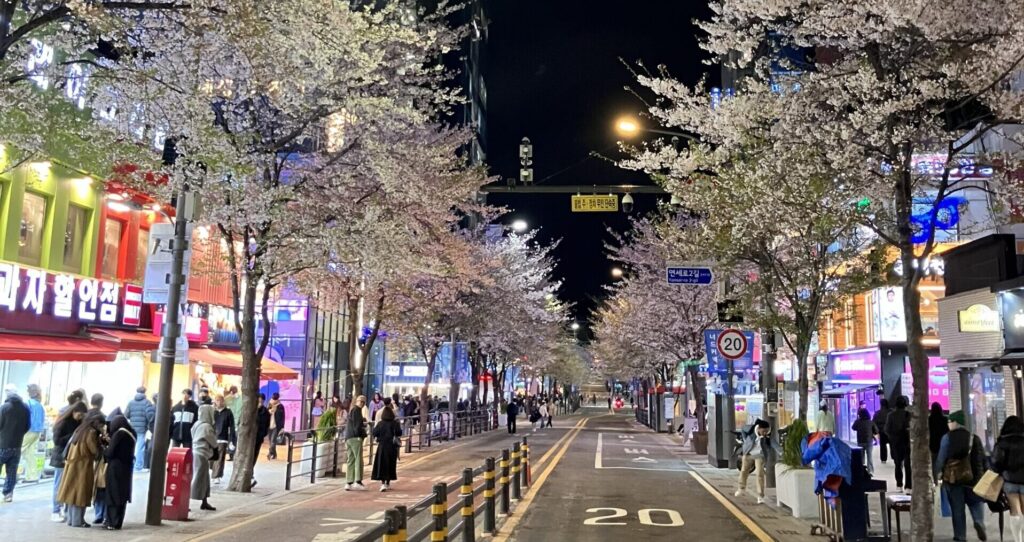
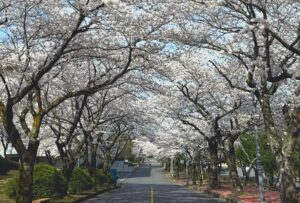
This is the place to start. Jeonnongno is a street in Jeju City lined with king cherry blossom trees on both sides. Because the road is narrow and the trees are planted close together, the branches arc out over the roadway and touch in the middle. When they bloom, you walk through a tunnel of white and pale pink. You do not get that effect on wider roads. This is the real deal.
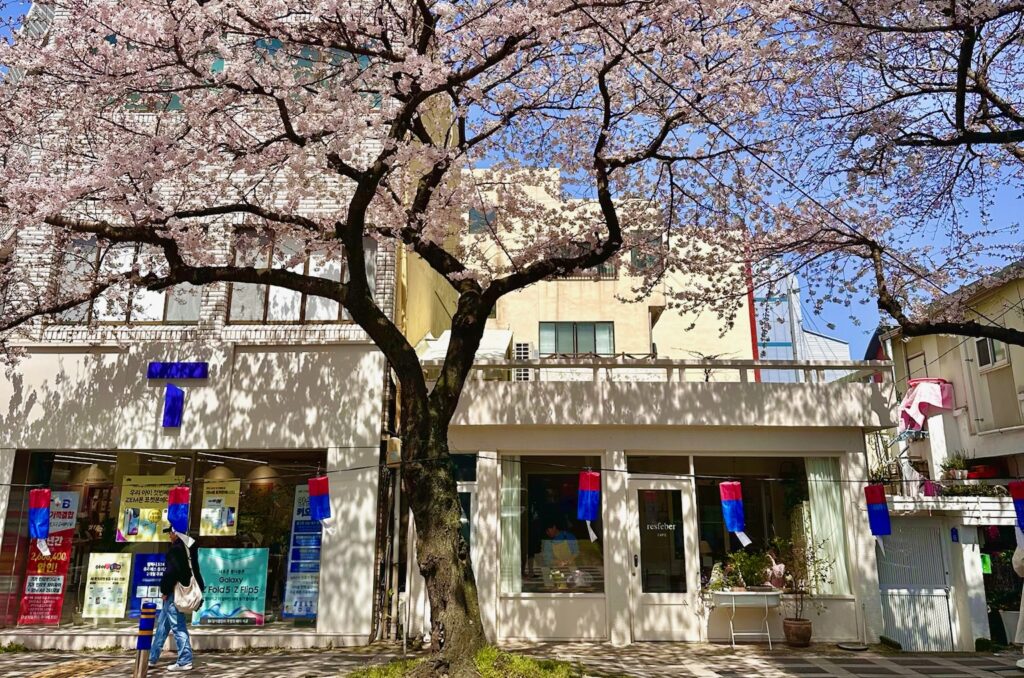
BTW: Even if you arrive too early or too late for the blossoms, Jeonnongno has something else going for it. The surrounding neighborhood is a mural district. Residents have let their outer walls be painted with scenes of Jeju life: the haenyeo 해녀 diving, Hallasan 한라산 in the distance, Jeju deer, the native horse called the Ganse 간세, and a lot more. The murals cover multiple blocks, and if you take your time and look for all of them, you’re easily spending two to three hours here. There are also cafes, small restaurants, and souvenir shops if you need to stop and rest your feet. This neighborhood is worth visiting regardless of the season.
2. Noksan Road (녹산로)
This one requires a car. Noksan Road is about an hour’s drive southeast of Jeju City, and the payoff is one of the most photographed stretches of road on the island. The king cherry blossoms line the road on both sides, and unlike Jeonnongno, here they grow alongside canola flowers. The contrast of white blossoms and yellow fields against the backdrop of Jeju’s wind turbines is legitimately beautiful.
Real talk: there are no facilities directly on the road. You can pull over, get out, and walk around, but you are in the middle of the countryside. Some cafes are nearby. Come here to take photos, breathe some clean air, and then move on.
Good news if you miss the blossoms: canola flowers bloom from roughly February through May, so the yellow fields will be there for a much longer window. Add the windmills and you still have a scene worth the drive. From here, it’s only another 10 to 20 minutes to Seongeup Folk Village, or you can swing by Snoopy Garden on the way back toward Jeju City.
3. Jeju National University Campus
This one is for the traveler who wants to see cherry blossoms without the tourist infrastructure. The university campus has a large concentration of cherry blossom trees and is primarily used by locals for picnicking during bloom season. You are welcome to walk the campus, sit on the grass, bring your own food, and just exist alongside students and families from Jeju.
If the timing is off and the blossoms are gone, the campus is still a pleasant walk through a garden-like setting with other trees and flowers. There are also cheap and good restaurants and cafes right outside the main entrance.
Pro tip: The campus is not far from Gwaneumsa Temple (관음사), which served as a filming location for the K-drama Extraordinary Attorney Woo, as well as a forest scene from Crash Landing on You. The Gwaneumsa trailhead for Hallasan is also nearby, and even if you are not climbing the mountain, the approach gives you a striking view of the peak.
4. Samseonghyeol (삼성혈)
Samseonghyeol is a small, walled historic site right in the center of Jeju City, a short walk from City Hall. The grounds are considered the mythological birthplace of the three founding clans of the ancient Tamna Kingdom. The trees on the property are very old, and the grounds have been protected for a long time. When the cherry blossoms bloom here, they are larger and more established than what you find on a typical road.
Entry costs around 4,000 won (roughly $3). It is not a lot, but it does mean fewer people inside than at free outdoor spots.
What to do before or after: Right in front of Samseonghyeol is what locals call the noodle street (국수거리, guksu geo-ri), where you can eat different kinds of noodles, including gogi guksu 고기국수, Jeju’s signature pork broth noodle soup. And a short walk from there is the Jeju Natural History and Science Museum (제주자연사박물관), which is worth an hour of your time and costs only 2,000 won. The museum covers both Jeju’s natural history and the development of the city from the Tamna era forward.
5. Cheonjiyeon Waterfall (천지연폭포), Seogwipo
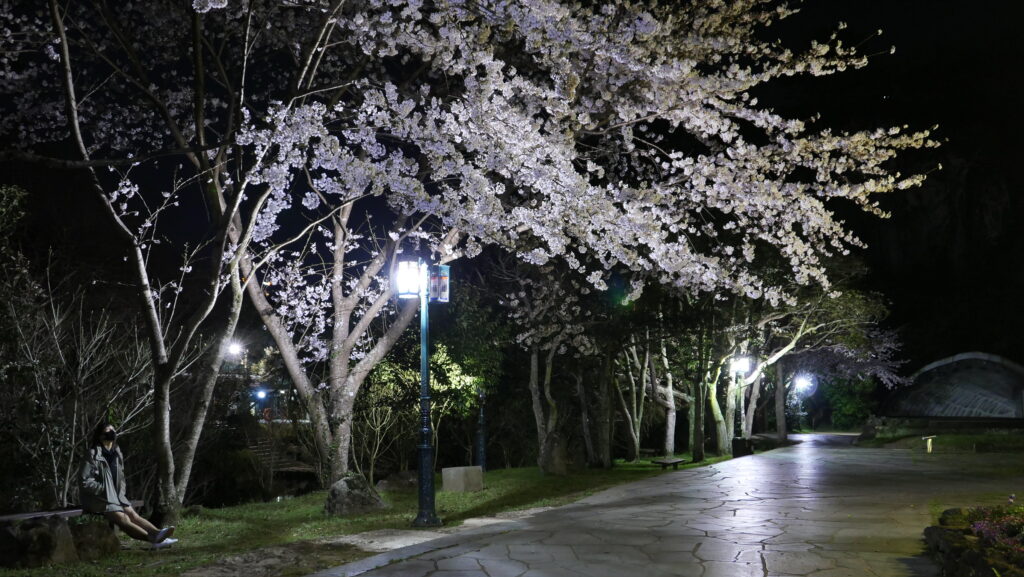
Yes, this waterfall appears on the tourist trap list. The falls themselves are small, and on a dry day in peak season with crowds, the entry fee does not fully justify the payoff. But during cherry blossom season, the strolling trail leading to the waterfall is completely canopied in blossoms, and the park keeps the lights on until 10 PM. A night walk through illuminated cherry blossoms along a waterfall trail is a different experience entirely.
Entry is 2,000 won. Go at night. Adjust your expectations for the waterfall itself.
6. The Local Secret: Sarabong Oreum (사라봉)
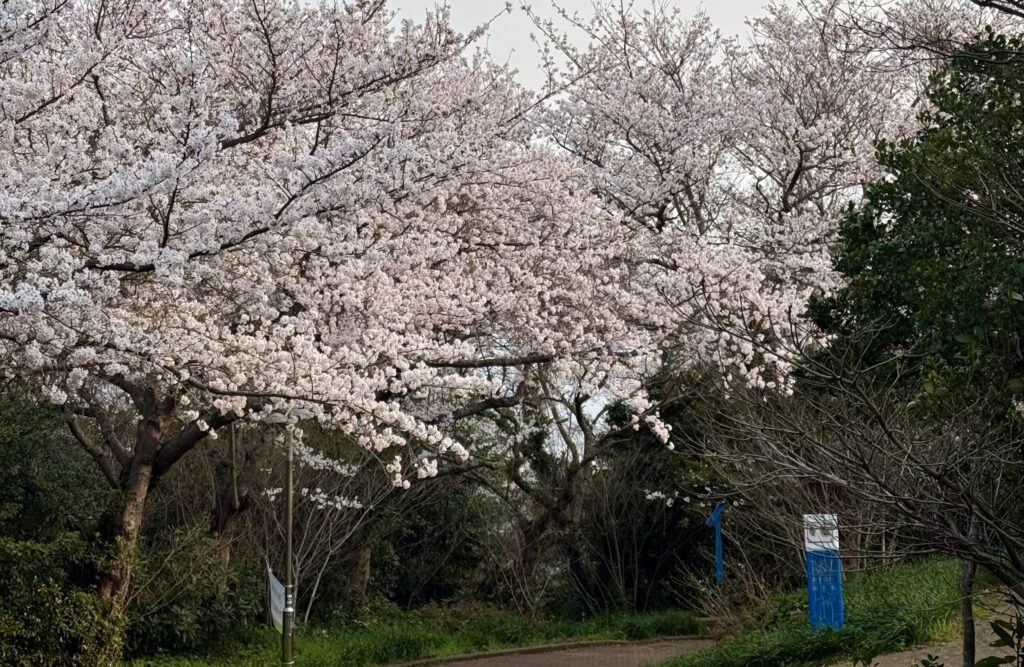
Most visitors going to Jeju City for cherry blossoms head straight to Jeonnongno. Locals know to also go to Sarabong, the small volcanic cone that sits near the harbor. The 15-minute climb to the top passes through cherry blossom trees, and unlike the street below, the atmosphere up there is entirely local: elderly residents doing their morning exercise, kindergartners on school picnics, and on a clear day, a full view of the old city and the harbor with the ferries heading to the mainland.
There are no tour groups. There is no entry fee. You may well be the only non-local there. If the tunnel effect of Jeonnongno is what you are after, go there first. But if you want cherry blossoms alongside actual Jeju life rather than other tourists, climb Sarabong.
A Note on Timing
King cherry blossoms on Jeju typically bloom for only 5 to 7 days from late March to mid-April, depending on the year and the weather. Canola flowers have a much longer window, from late February through May, so if you combine cherry blossom spots with canola viewing, you have a more forgiving schedule.
A Final Thought
Japan will always win on cherry blossom marketing. That is fine. What Jeju has that Japan does not is a native king cherry blossom that nobody outside Korea has heard of, a local who will tell you to skip the tourist street and climb a volcanic cone instead, and a waterfall trail that is worth visiting specifically after dark. That is a different kind of cherry blossom trip, and for most people who make it, a better one.
