What You'll Find in This Article
You land at Jeju International Airport excited for your vacation. The plane taxis to the gate. You step into the terminal, collect your luggage, maybe stop at a cafe for coffee. You’re thinking about beaches, volcanic cones, K-drama filming locations, black pork BBQ.
What you probably don’t know is that the airport is one of the island’s largest massacre site.
And almost no tourists know this, nor did I when I came to Jeju for the very first time.
But between 2007-2009, during airport expansion construction, workers discovered the remains of as many as 400 men, women, and yes, children. Most had been executed by firing squad between 1948-1949.
Their bodies had been dumped in mass graves, knowledge of their fates suppressed then forgotten for 60 years.
All that time, millions of tourists unknowingly walked over their remains until their discovery and subsequent disinterment in somber ceremonies, attended to by their descendants.
But this is where the conversation about dark tourism on Jeju begins, and not with whether you should visit sites of tragedy. Because if you flew to Jeju, you already did, whether you know it or not.
Jeju’s landscape is saturated with the planned death and destruction of its people and villages over a 6-year period of terror that has euphemistically been called the 4.3 Incident. Other sources called the period an uprising and massacre, which comes close to the truth.
Dark tourism refers to travel to sites historically associated with death and tragedy, and Jeju is a dark tourism destination whether it markets itself that way or not.
That’s because the tragedy took place all over the island, from foothills and caves of Hallasan, to the pretty waterfalls, and to the towns and villages on the coast.
The 4.3 Massacre: Korea's Hidden Genocide
Between April 3, 1948 and 1954, the South Korean military and police forces, then under the rule of the post World War 2 US military government, killed an estimated 25,000-30,000 civilians on Jeju Island. That’s about a tenth of the island’s population at the time.
The violence included:
- Mass executions at beaches, fields, and cliffs
- Entire villages burned with families trapped inside
- Cave massacres, where people hiding from military forces were shot or sealed inside to starve
- Scorched earth policy, where everything further than 5 km of the coast was destroyed, anyone found outside coastal zone killed on sight
- Children killed alongside adults, including documented cases of infants smashed against rocks
For 40 years (1950-1990), speaking about 4.3 was criminalized. Survivors couldn’t mourn publicly, mark graves, or even openly tell their children what happened. The massacre was erased from official history, classified as ‘communist propaganda.’ It wasn’t until 2003, some fifty-five years later, that the South Korean government acknowledged what happened and issued an official apology.
The scale of violence, the systematic nature of the killing, and the decades of enforced silence make 4.3 one of the most significant but lesser-known atrocities of the 20th century.
Approximately 600 historical sites across Jeju are related to 4.3. Some have been memorialized; most remain unmarked.
The Sites
The below is by no means a complete list. It merely represents the few places that I visited personally while hiking the Jeju Olleh Trail.
For a more complete list of the 4.3 sites and the tragic history of Jeju in the 1950s, I commend to you the Jeju 4.3 Peace Foundation.
Jeju 4.3 Peace Park (제주4·3평화공원)
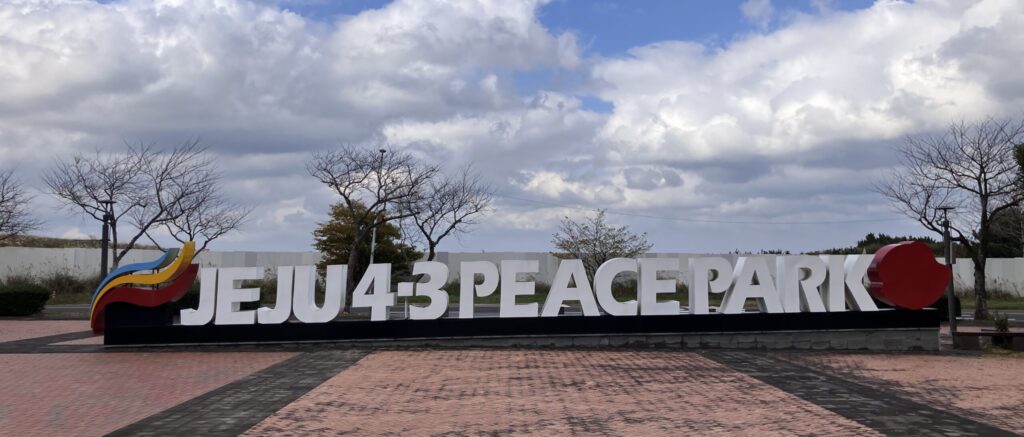
On the day I visited here, it was a cold, wet, and windy day in November. I recalled it being fitting conditions for the dark and gloomy subject the park commemorates.
This 40-hectare memorial complex is Jeju’s primary 4.3 site. Opened in 2008, it includes:
- Memorial Hall: Museum with exhibits, survivor testimonies, photographs, documents. Traces the history from liberation (1945) through the massacre through the forty-year silence through truth-seeking. Well-designed, respectful, devastating.
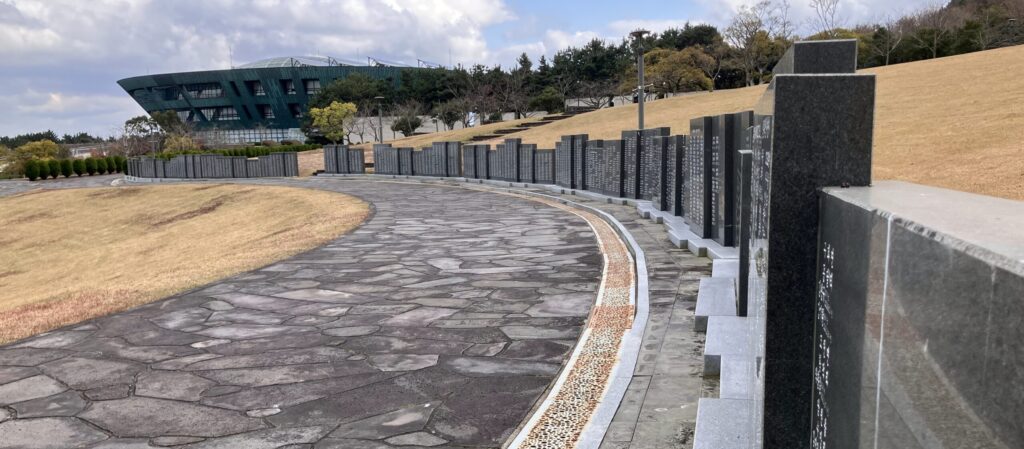
- The Monument: 15,718 names of confirmed victims engraved on stone walls (updated from original 14,373 as more deaths were verified). Each name represents a person, documenting age, village, how they died. Walking past wall after wall of names is overwhelming.
- Remembrance Hall: Where memorial services are held. Families come to remember, especially on April 3rd anniversary.
- Archives and Research Center: Ongoing work documenting testimonies, locating mass graves, identifying remains.
It’s educational without being sensationalist. It doesn’t glorify or sanitize. It centers on victims and survivors. The design is contemplative and encourages reflection rather than spectacle. There’s no gift shop selling 4.3 merchandise.
It’s a fundamentally serious place, which was appreciated even by the busload of high school students who arrived just after me. They went from raucous to subdued when they got to the middle of the exhibits, all without being hushed by their chaperone.
- Location: 430 Myeongnim-ro, Jeju City
- Hours: 9 AM – 6 PM (closed Mondays)
- Admission: Free
- Time needed: 2-3 hours minimum
Jeju International Airport (제주국제공항)
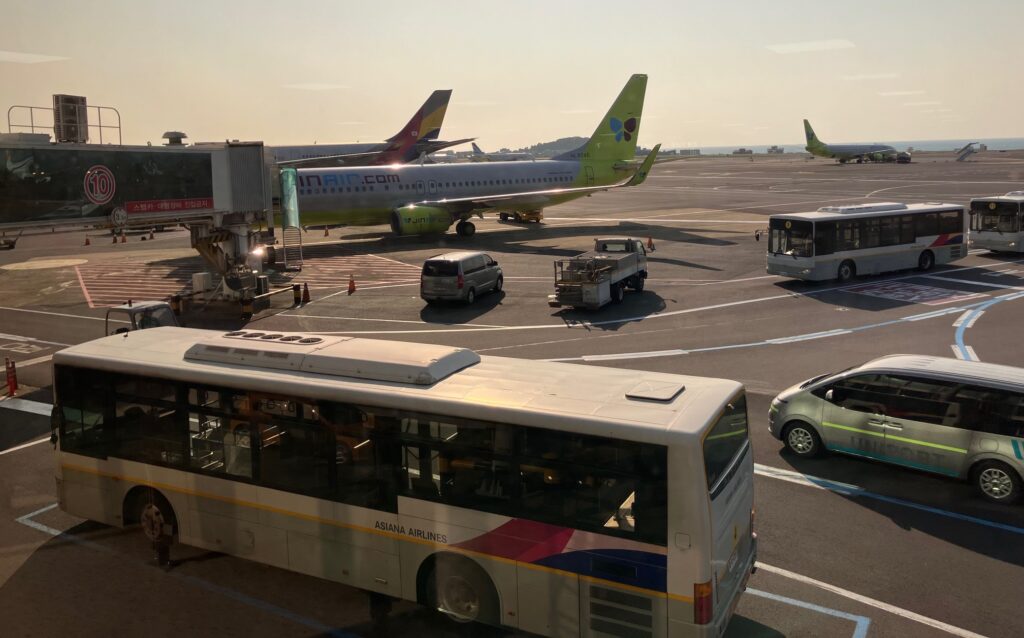
Yes, we’ve already talked about the airport being the site of Jeju’s biggest mass burial site.
There is at least one memorial that I accidentally stumbled upon while walking the Jeju Olleh Trail’s Airport trail. This is a spur route of Jeju Olleh Trail 17 that hugs the northern perimeter of the airport.
I had decided to take a break near the Yongdam Sports Park, and noticed a structure near to the park’s basketball court.
That turned out to be a memorial to the people who had been murdered.
I couldn’t help but note the irony.
Unlike in Auschwitz in Poland or the 9/11 Memorial in New York City, where the tragedy is the reason for the visit, at the Jeju International Airport, it’s invisible.
Maybe that’s for the better.
The Alcohol Factory Internment Camp 4.3 History Museum (주정공장수용소 4•3역사관)
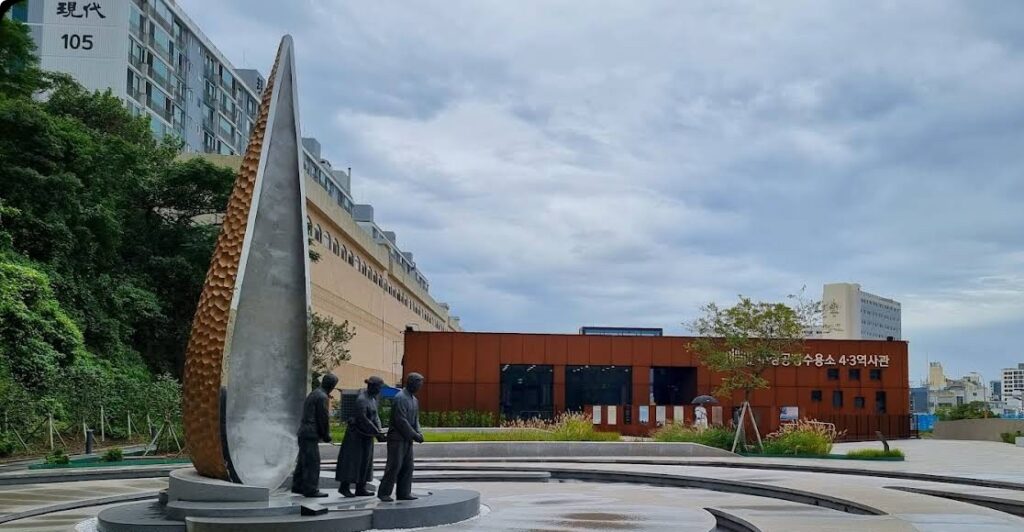
On the Jeju Olleh Trail 18, I noticed a gripping art installation just across the Jeju Harbor. It featured a giant teardrop as its centerpiece.
My curiosity was piqued, and since it was a hot sunny Spring day, I thought a break was in order.
Turns out, I had stumbled on a former concentration camp that was the hub for misery, torture, and death.
The sobering content of the small museum made me forget my fatigue in short order.
This former distillery shows how everyday industrial infrastructure was weaponized for state terror during 4.3.
The Oriental Development Company established this distillery in 1934 during Japanese colonial rule, where Jeju workers were exploited throughout the occupation. After liberation in 1945, it continued operating as an industrial facility responsible for local livelihoods, producing sweet potato alcohol that was part of the island’s economy.
Then in spring 1949, the warehouse was converted into a civilian detention camp. People arrested during “pacification activities” were imprisoned here in conditions never meant for human habitation.
Many died from severe torture, starvation, and disease, severely beaten and left to rot in an industrial warehouse.
Some detainees were released. Most were transferred to prisons elsewhere in Korea and disappeared shortly after the Korean War began in June 1950.
Others held here were taken to the coast off Sarabong (where the pier to the modern Jeju cruise terminal now sits) and drowned in the sea, dumped into the ocean to eliminate potential “communist sympathizers.” This was the largest detention site on the island.
Like the airport built on mass graves, this is another site where tourism infrastructure overlaps with massacre history, a reminder that you cannot separate “vacation Jeju” from “4.3 Jeju.” They occupy the same physical space.
- Location: 940-13 Geonip-dong, Jeju City (opposite the ferry terminal)
- Hours: Check current operating hours before visiting
- Admission: Free.
- Time needed: 1-2 hours
Seodal Oreum Memorial (섯알오름 예비검속 희생자추모비)
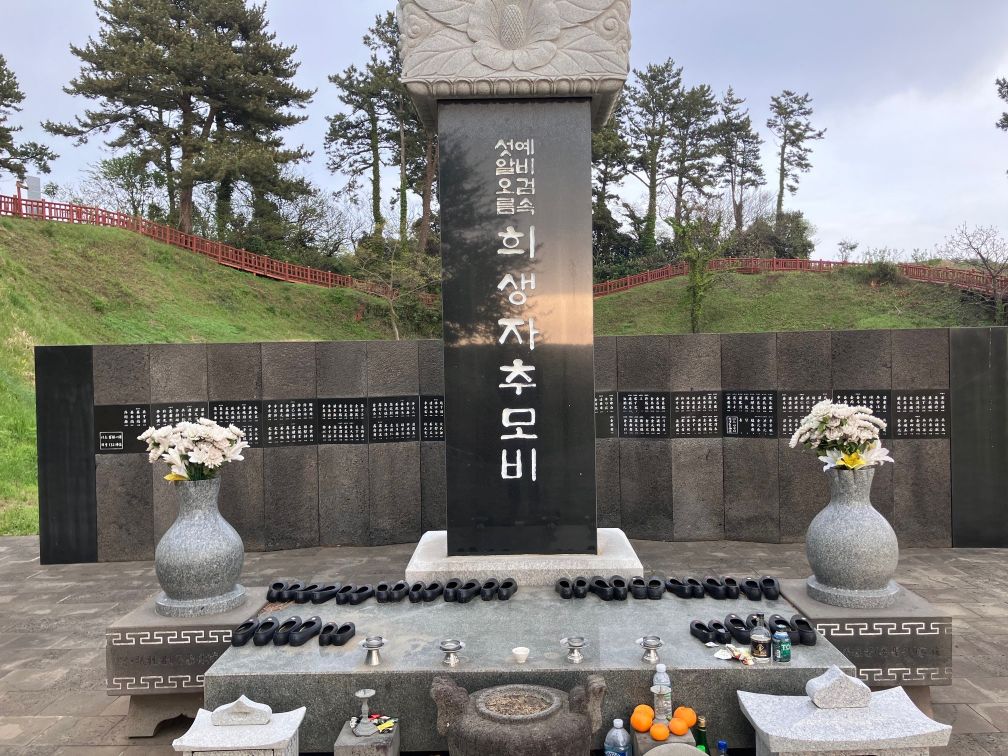
I remember this site vividly.
I was hiking Jeju Olleh Trail 10, and late in the afternoon, as I left behind some old Japanese World War 2 anti-aircraft positions, I noticed the memorial.
But what caught my eye was a group of elderly Koreans, who had just left drinks and tangerines at the foot of the memorial.
Not wanting to intrude, I waited a bit, before approaching the structure.
There I saw the shoes. Laid out ever so neatly. I didn’t realize what those signified, but instinctively knew that the topic would be heavy.
It would be weeks later that I researched and learned that this memorial commemorates one of the most systematic killings of 4.3, the preemptive detention massacres of 1950.
When the Korean War broke out on June 25, 1950, people who were deemed sympathetic to the 4.3 uprising were rounded up all over Jeju.
Around 350 villagers from the Southwestern region of Jeju were detained and held in police stations in Moseulpo and Hanrim. Families were allowed visits, creating a false sense that detainees would eventually be released.
It was not to be.
On July 16, 1950, 20 people were executed at this site on the southern slope of Seodal Oreum.
A month later, on August 20 in the middle of the night, another 60 from Hanrim police station were brought here and shot. Barely a few hours later, another 130 from Moseulpo police station were executed.
All were dumped into mass graves here.
And the shoes at the memorial? Those were to pay tribute to the dead, who dropped shoes from the trucks as they were transported, hoping families could follow the trail to find their bodies.
In 2000-2001, remains were exhumed, and 132 victims are now enshrined at the memorial.
Location: Along Olle Route 10, near the mid-point between Hwasun and Moseulpo
Accessible: Yes, directly on the Olle Trail
Altteureu Airfield (알뜨르 비행장)
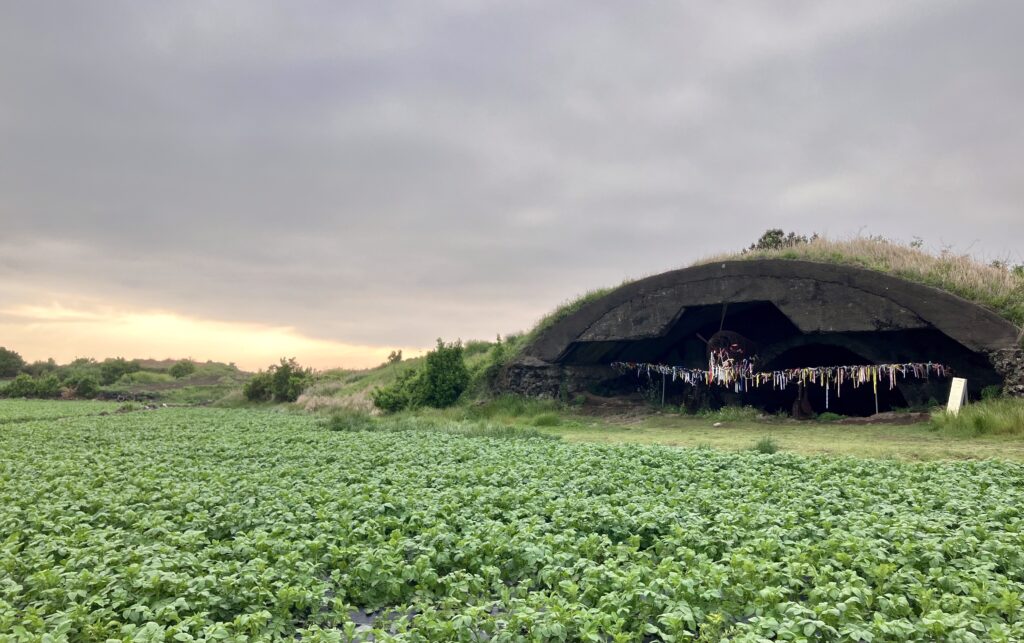
This massive airfield was built during Japanese occupation, sending air attacks to Nanjing during the invasion of China.
After the war, it was used as a staging area for military operations during 4.3.
The name means “vast plain below” in Jeju language, seemingly an ordinary, even poetic name for a site of systematic violence.
The airfield served as a base from which scorched-earth operations were launched into the mid-mountain villages.
Today, hikers like me on the Jeju Olle Trail 10 walk through this area, mostly unaware of its role in the massacre. The Trail 10 mid-point is located here, and it is just a few minutes from the Seodal Oreum Memorial.
Jeju 4.3 Songsan-eup Victims Memorial Park
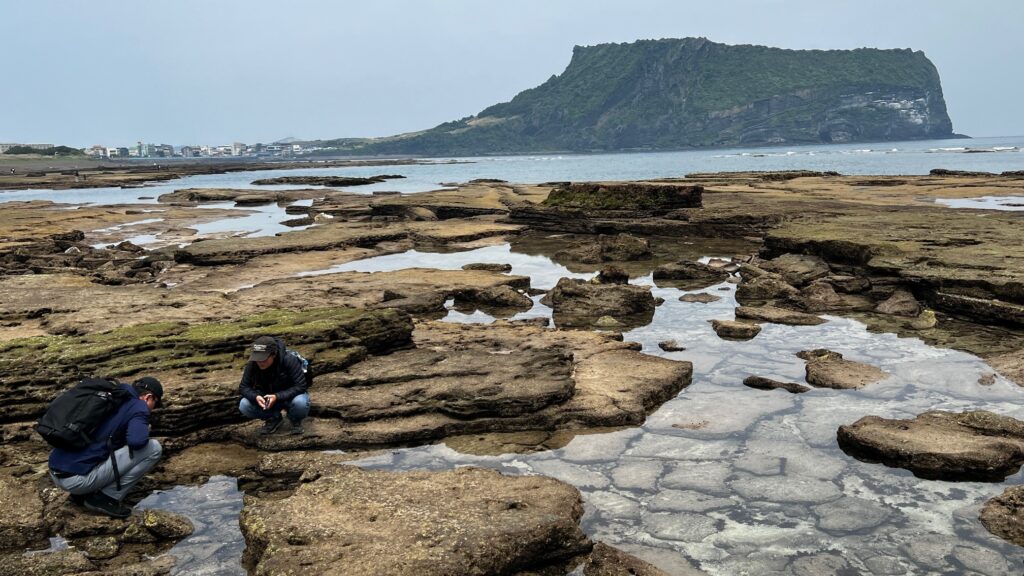
The Gwangchigi Beach (광치기 해변) is a pretty beach where tourists ride horses. During lowtide, it is especially picturesque when the rocky seafloor is exposed while the majestic Songsan Sunrise Peak sits in the background.
Hikers like me pass it when hiking the Jeju Olleh Trail 1.
However, it was also a place where villagers from the surrounding villages in Seongsan-myeon and Gujwa-myeon were detained and eventually, killed.
Additionally, the Teojinmok April 3 Massacre memorial sits just off the the northern tip of the beach.
Should You Visit 4.3 Sites?
Short answer: If you’re spending more than 2-3 days on Jeju, yes, you should visit Jeju 4.3 Peace Park. It’s important, well-done, and will significantly deepen your understanding of the island.
Longer answer: Consider your own capacity. Dark tourism sites can be emotionally heavy. It’s not for everyone.
But if you can handle it, there’s real value in engaging with difficult history.
Tourism and Responsibility
Here’s what I want you to take away: Dark tourism on Jeju isn’t optional. You’re already doing it whether you realize it or not. You landed at a massacre site. You’re traveling through landscapes where villages were burned, people were killed, trauma was buried for generations.
You’re already engaging with dark history by being here. The only choice is whether you do it consciously.
You can walk over mass graves without knowing, take beautiful photos of beaches where hundreds were executed, hike through destroyed village sites without understanding what happened.
Or you can learn, acknowledge, reflect, and let that knowledge deepen rather than diminish your experience.
Knowing about 4.3 doesn’t make Jeju depressing. The beauty of the beaches, the scale of Hallasan, the haenyeo still working the water — none of it is diminished by what happened here. It’s deepened by it.
For me, understanding 4.3 doesn’t make Jeju depressing. Instead, it makes it real.
The ground you walk on remembers. Whether you do is up to you.
