Play Episode
Episode Summary
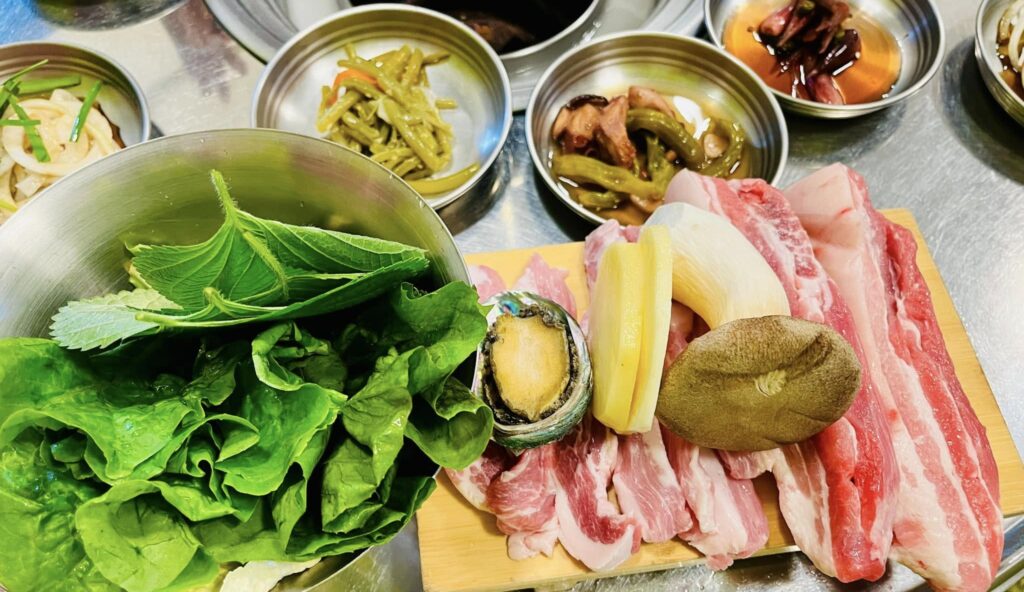
Forget the tourist-trap Black Pork Street—this episode reveals how locals actually enjoy Korean BBQ: at a butcher shop barbecue. The concept is simple but initially intimidating: you walk into a butcher shop, pick your meat from the refrigerated display, weigh and pay for it at the counter, then head upstairs to grill it yourself at a restaurant table (with a small table-setting fee for unlimited side dishes, lettuce wraps, and sauces). Ed and Soraya walk through the whole experience, from choosing cuts (samgyeopsal, ogyeopsal, moksal for pork; galbisal for beef) to understanding the unspoken hierarchy of who does the grilling (hint: the youngest person). They explain nunchi (눈치)—the Korean concept of “reading the room”—and why self-service is preferred over attentive wait staff. Plus: why Koreans cut meat with scissors while cooking (the opposite of Western steak technique), where to stash your jacket to avoid BBQ smell, and the smoke-venting pipes above every table.
Key Takeaways
Butcher shop BBQ process: Pick meat from refrigerator display → weigh at counter → pay → go upstairs to restaurant → pay ~3,000 won (~$2) table-setting fee → grill it yourself
Common pork cuts: Samgyeopsal (삼겹살, 3-layer pork belly), Ogyeopsal (오겹살, 5-layer with skin), Moksal (목살, neck meat with less fat)
Common beef cuts: Galbisal (갈비살, rib meat), Buchesal (부채살, flat iron steak), and others—but beef is much more expensive than pork
Hanwoo (한우) vs imported: Korean beef is significantly more expensive than Australian/American imports
Grilling hierarchy: The youngest person (maknae) typically grills first; the most senior person rarely grills
Nunchi (눈치): “Reading the room”—Koreans prefer self-service to avoid burdening staff (and being bothered by staff). Start with small portions and refill as needed.
Meat scissors: Koreans cut meat while grilling (opposite of Western technique)—increases surface area, cooks faster, ensures no pink/red remains
Smoke pipe: Every table has overhead ventilation to suck up smoke
Hidden compartment: Many chairs have storage underneath the seat—lift it to stash your jacket and avoid BBQ smell
Pro tip: If intimidated, observe what locals do, ask questions (Koreans are kind to foreigners), and start with small portions
Next Steps
- Plan your Jeju trip http://vamosajeju.com/comfortat vamosajeju.com/trip
- Sign up for the 14-part email series at vamosajeju.com/start
- Follow Vamos a Jeju on Instagram, TikTok, or YouTube.
- Share the episode with friends to help the podcast grow
- Visit vamosajeju.com for articles, videos, and resources
- Leave a one-sentence review to help others discover the show
- Related Reading: Six Food Experiences You’ll Cherish Long After You Leave Jeju
Episode Transcript
What is Butcher Shop Barbecue?
Soraya (00:19)
Hello! So today we’re gonna start the food series in Jeju, Ed’s favorite things to do while traveling. So you remember that in the previous episode, we were talking about the black pork streets, which is really famous in Jeju. And it can be a tourist trap if you go like these kinds of places.
Ed (00:25)
Yay!
Soraya (00:44)
But there is actually another way to enjoy this chewy, juicy black pork, which is the butcher shop barbecue. Have you tried this butcher shop barbecue before,
Ed (00:57)
I was just about to ask you, what is a butcher shop barbecue?
Soraya (01:02)
You know what is butcher shop, right? So butcher shop, barbecue is like butcher shop and then restaurant together. you go in and you’re going to see like refrigerator full of the meat and then the scale. So you just need to choose the meat you like.
Soraya (01:23)
and then go to the counter with the scale and then weigh them and then pay for the meat. And usually you go up to second floor, which is the restaurant, and then the restaurant will set up the table for you. And then you just grill it there in the restaurant yourself.
Ed (01:40)
Okay, so parts of that sounds very familiar to me, The part that I guess is new to me, in fact I’ve not done it before, is walking up to a butcher and then picking your meats and then cooking it right away. That part is new and I have to say, even though I speak some Korean, that sounds a bit intimidating.
Ed (02:00)
Yeah, so maybe you can talk us through what that whole experience is like because to me that might be confusing.
Soraya (02:09)
It can be confusing at first, but once you try this and then get the idea, it’s going to be very comfortable doing it.
Ed (02:22)
So like for a non-Korean speaker, you even know what meats to pick? And also, do you know how much to pay for it? Like, I guess the whole thing sounds so foreign to me that it is, if it does, like I said, feels intimidating. And I am very familiar with Korea and I speak some Korean and even then I feel like, Ooh, this sounds a bit scary.
Choosing Your Meat — Pork vs Beef
Soraya (02:44)
You should really try with me. Anyway, to choose a good meat, I think it’s like worldwide same knowledge. So when you see the meat, you can see the freshness. you just pick something looks like very fresh. Koreans, we eat more pork than beef. for the pork first, of course, like Samgyeopsal. think even though you don’t know about Korean meat, you have heard of Samgyeopsal or O-Gyeopsal. So Samgyeopsal is three layered meat, O-Gyeopsal, five layered meat, let’s say Moksal, the neck.
Ed (03:10)
Three layer.
Soraya (03:25)
that one like less fat those kind of
Ed (03:27)
And for people listening who are like from not from Korea, which is everybody, the Samgyeopsal and the Ohgyeopsal, you can think of it as like the same cut of meat that they make bacon from.
Soraya (03:42)
Right, But ogyeopsal actually have like five layers and that like including the skin. So you can actually see the black fur in it.
Ed (03:48)
Right. and I still think it’s gross.
Soraya (03:54)
And then for some Koreans, really, really love it. And then we can actually order only the skin. And we think it’s very delicious because Koreans really like the chewy texture. the skin has lots of collagen, so it’s good for your skin.
Ed (04:10)
Right. And, but you got to cook that quite a long time, right?
Soraya (04:14)
for the beef, we don’t really do like sirloin, tenderloin. We just put like, I’m not sure how to call it in English. Galbisal, Buchesal.
Ed (04:25)
Yeah, so kalbi is rib so it’s rib meat.
Soraya (04:28)
Kalbi is rib meat
Ed (04:29)
Kalbi is rib and then Sal is meat. So I guess it’s rib meat.
Soraya (04:35)
Wait a It’s rib meat.
Ed (04:48)
Flat iron steak. Okay, what is it in Korean?
Soraya (04:59)
Galbisal, buchesal, salsisal, tosisal, chimasal, like many different.
Ed (05:05)
Okay. All right. but beef is usually more expensive, right?
Soraya (05:10)
Yeah, as you know, in Korea beef is a lot more expensive than pork. So we eat beef in a special occasion
Ed (05:20)
in the last episode, we talked about how most people from Jeju just eat regular pork. But then with beef, I’ve also seen like a… Or… Which is like Korean… Korean… Korean, yeah. Korean versus like…
Soraya (05:29)
Hano, Hano, Han, Hano.
Ed (05:37)
imported like i guess hannu is more expensive than
Soraya (05:40)
Hanu is a lot more expensive than imported beef like from Australia or America. We usually import beef from those two countries.
Ed (05:51)
And the hanwoo, like does it taste a lot better?
Soraya (05:58)
I think so, because I’m not a big fan of beef.
Ed (06:03)
value for money. me to pay a lot of money for Korean beef, it would have to be like much, much better than regular beef. And I guess one day I’ll try and I’ll let you know, but I’m definitely a huge fan of value for money.
Soraya (06:07)
Mm-hmm. Yeah, yeah. then i think you will like the pork better usually we pay right after choosing the meat. You pay for the meat and then you go up to the restaurant and there’s a fee for like table setting, usually like 3000 for one person. So you can have like lots of lettuce, like many different paste sauce and the grilling set up.
Ed (06:41)
Right. And, and, That’s like about, $2 or so. So two dollars for the table setting to get the side dishes and the wraps and stuff like that. It does not include the meat that you’ve already paid for separately. And so if you want more meat I guess it’s easier to go back downstairs and point.
Soraya (06:55)
I think it’s easy, to go back down stir.
Ed (07:02)
And then point and go, 이거 주세요. Gotcha.
Soraya (07:06)
scale and then pay.
Ed (07:08)
Yeah, gotcha, gotcha. Okay, The next question I have for you Sora is why is it that people have to cook the meats themselves like in some K barbecue restaurants I’ve been to like the staff actually cook for you.
Why Cook It Yourself? — Korean Self-Service Culture
Soraya (07:10)
I mean for Korean barbecue usually it was like self cooking but nowadays we are having more Korean barbecue place with staff cooking because it’s changing so like some people they like to have someone to do it for them but I think in the past like usually we have like self-cooking for those Korean barbecue places I guess in Korea people like to share everything together and then get all together and then one or two will grill and then talk and then like follow your pace for eating, talking, drinking. Because usually this place people drink a lot.
Ed (08:05)
Right. Yes, I’ve noticed. I think the youngest person, the maknae, starts the cooking first and then once that person gets tired, hands off to the next youngest person and then the oldest or the most senior person in hierarchy almost never does the cooking. Is that right or am I misinterpreting the…
Soraya (08:14)
I think so. think it’s true. Because usually like in Korean society we have the invisible hierarchy. You know that, right? And like for Koreans we all know that hierarchy but we don’t say it. So when we go to eat like in Korean barbecue we know who will do it. Even though we never say it, we know.
Ed (08:50)
Right. one thing that my older son, who’s like 33 years old already, he’s always asked me, why the heck will we go to a Korean barbecue where I have to pay to myself? I just do that at home. And I was like, yeah, but it’s not the same. But I wasn’t able to explain it to him. how would you describe that? self-service is actually not a bad thing.
Soraya (09:15)
I think it’s about Korean society. for us, we don’t like to get too much attention. So for example, when I do the tours for Korean groups outside Korea, when we go to restaurant, the waiters come to you and ask you are you okay? Everything is good. And they like to clean your dishes fast, right? That’s the manner. But for Korean, they feel kind of uncomfortable that waiters come to you they don’t like they clean the dishes very fast. They feel like they feel pressure to leave. So I think in Korean culture, we are like, we are good. You don’t have to give us like lots of attention. So I guess it’s like a different role. So the staff, they are focusing on, like fire for the barbecue or like serving stuff.
Ed (10:14)
one thing I noticed about Koreans wanting to have like more autonomy or control over like their eating situation is that there’s a lot of self-service bars too. So like maybe the staff will bring you the first round of pan-chan, side dishes, but then everything else is going to be
Ed (10:33)
if you want to refill off your kimchi or other side dishes, you got to actually get up and go get it. And in many places you have to go get your own water as well. And so
Ed (10:43)
There’s this whole culture of self-service and I actually like that. I don’t like having wait staff in my face the whole time. It’s like, I’m good, leave me alone. and on the flip side, they also don’t try and pressure you to leave. However, when it’s run by older people, they will go like, yeah, it’s time for you to go. If you hang out for too long. So
Soraya (11:03)
No.
Ed (11:06)
yes, if the owners are old and they run a place when it’s getting crowded and you have no nunchi (눈치) like you’re still there, they will say time to go. get a time to get out here. So yeah. So yeah, at least all about nunchi (눈치)
Soraya (11:18)
for the self-service bar as well, we don’t want to ask the waiter to refill the side dishes many times. It’s kind of like, feel guilty. I feel sorry for them. So for me, it’s better me going there and then get my stuff by myself.
Ed (11:43)
We should probably say what nunchi is
Ed (11:48)
The way I’ve learned to think of nunchi in my brain is like, hey, read the room, like get a sense of what’s happening. So I read the room. So if you have an ability to read the room, then it’s like, you don’t want to bother the staff for every single little refill of your water So to avoid
Soraya (11:54)
Yes, exactly.
Ed (12:07)
burdening the staff, you go do it yourself. So have some nunchi and just get your own stuff. And so that ties back into cooking your own food because you don’t want to bother the staff for every single little thing. So have some nunchi, read the room and cook your own food. And on top of that, you get to bond and talk with your family or friends as well.
Soraya (12:22)
So I think nunchi in the restaurant, like this Korean barbecue, I guess there’s two meaning Like, I don’t want to bother the waiter and I don’t want the waiter bother me. You got it?
Ed (12:41)
Yeah, yeah, nunchi goes both ways, you know, like I read the room both ways. Yeah, totally.
Soraya (12:44)
Yes.
Ed (12:47)
Okay, so we talk about nunchi and being able to read the room, but I guess not all Koreans have nunchi because when I went to Ilpoom Sundubu, one of my favorite restaurants, where there’s like a huge buffet bar,
Practical Tips & Korean BBQ Secrets
Ed (13:05)
and you can take all kinds of side dishes. There’s a huge sign that says, take only what you can eat in Korean. this is not a tourist place. This is like only Koreans go there mostly. And so that suggests to me that there have been Koreans who have taken so much buffet food that… that they had leftovers and therefore the sign. So that tells me that, hey, know, nunchi is not an automatic thing for maybe you can, for travelers and visitors who want to kind of have more nunchi and to be able to read the room, give us some advice or tips on how we can approach this in a butcher shop barbecue.
Soraya (13:32)
It is not. So I think the best thing is just ask a question if you need. Because Koreans are usually kind to foreigners. So you can just ask a question. Or if you are too intimidated to ask a question, just observe. Just check what locals do. And then you can just follow. what they do. That’s how you read the room. And the other thing, you can just start with small portion. You can always add more side dish it’s better to get small portion and then refill many times. No one’s gonna say something for like 10 times refill.
Ed (14:24)
so we talked about getting a small amount of side dishes and then just getting more refills and also we talked about observing other customers and seeing what they do. What else? What other practical advice do we have for our listeners?
Soraya (14:39)
If it’s your first time grilling the barbecue, you might not be perfect. And it’s okay, Because this is a time to enjoy and try a new thing. So just try, you know, small bits and then you get used to how to grill like perfectly for your taste. So just enjoy.
Ed (15:00)
So I was waiting for you to say something but you never got round to it and that is this concept, of a meat scissors.
Soraya (15:04)
What? right, I forgot.
Ed (15:09)
It’s a very Korean thing and in the West, it is very gauche as in it is very uncool to cut your meat while you’re cooking it. when they cook a steak, it is one big piece. And the whole point is you want to maintain the juiciness of it. And so you, when you cook steak in the West, you will sear it on one side. When it’s formed a little crust, then you flip it and you sear the other side. And that way you keep the juices inside. And even after you’re done cooking, you will actually set it aside to rest for like five, 10 minutes, waiting for the temperature of the meat to cool down. That way when you cut it, when it’s ready to eat, the juiciness doesn’t come pouring out so quickly because it’s now cooled down. That’s the Western idea of cooking meat.
Ed (15:59)
or barbecue. In Korea, it’s the exact opposite. In Korea, when you’re cooking it, you are actually cutting it while you’re cooking it. if you’re from a country that’s used to like big size steaks, you go like, what are these people doing? They are ruining, they are destroying the steak. Do you have any thoughts as to the idea of cutting your steak while you’re cooking it, why it works?
Soraya (16:23)
I’m not sure but Koreans usually don’t like to have like one big steak. Yeah, we like to cook properly but for Korean beef even if you cook it, it’s still very tender. and juicy.
Ed (16:38)
Okay. And I think Koreans and East Asians in general, guess, they don’t like to see red blood and stuff in the food, right? Yeah. Whereas like in the West it’s like, I want my steak done medium rare or rare. that’s another cultural difference too.
Ed (16:58)
for us to cook the meat properly in Korea and cook it quicker, you want to cut it. When you cut you increased the surface area to cook at and then people aren’t waiting around for like 15 minutes to eat. It’s like much faster.
Ed (17:12)
On top of that, you get rid of any of the redness and the blood and all that kind of stuff. So yeah, that’s another cultural divide. And on top of that, the quality of the meats are usually very good. And so it will be very flavorful. It’ll be very tasty.
Soraya (17:26)
Yeah, for the scissors, because for me it’s so normal. So I forgot to talk about this. It’s obvious, of course.
Ed (17:33)
Yes. And you also forgot to talk about this amazing thing that pulls down to absorb the smoke.
Soraya (17:41)
yes yes yes we always have one like smoke pipe above the table so you don’t get like much smoke from the fire
Ed (17:44)
Yes Yep. Yep. Right. And even though the smoke is a lot of smoke is sucked up, there’s still a lot of smells from the cooking. And so if you’re coming in with your jacket or your clothes or your whatever, oftentimes the chair that you sit on, if you can lift it and there’s a hidden compartment, hidden for travelers, not for Koreans, hidden where you can put your clothes and everything and then you
Ed (18:14)
close the seat back up and now you sit on the seat so that compartment is I want to say kind of airtight and so at least the smells of the cooking doesn’t get into everything of course in the clothes you’re wearing but at least not in your jacket or and other stuff like that so that’s something else to look out for the more you know
Soraya (18:22)
Right. And also like lots
Ed (18:32)
And so, yeah, the scissors is your friend, my friend, when you go to a Korean barbecue. And to me, the most iconic part of a Korean barbecue, whether it’s at a butcher shop or not, it’s not the meats. It’s not the grill, it’s not about the smoke venting machine, it’s actually the pair of scissors. The scissors to me is the most representative part of Korean barbecue.
