What You'll Find in This Article
Welcome to Vamos a Jeju!
Over the next 28 days (we’re sending you an email every other day), we’re going to show you exactly why Jeju Island should be on your Korea itinerary, and how to experience it like a DIY traveler, not just a tourist.
Each email will give you:
- Something spectacular to experience (a must-see, or a must-do, maybe both)
- Practical DIY travel tips (how to actually make it happen)
- A useful Korean phrase or two (so you can navigate it yourself)
Let’s start with one of the most accessible iconic sight on Jeju: Seongsan Ilchubong.
PART 1: Why You Shouldn’t Miss This
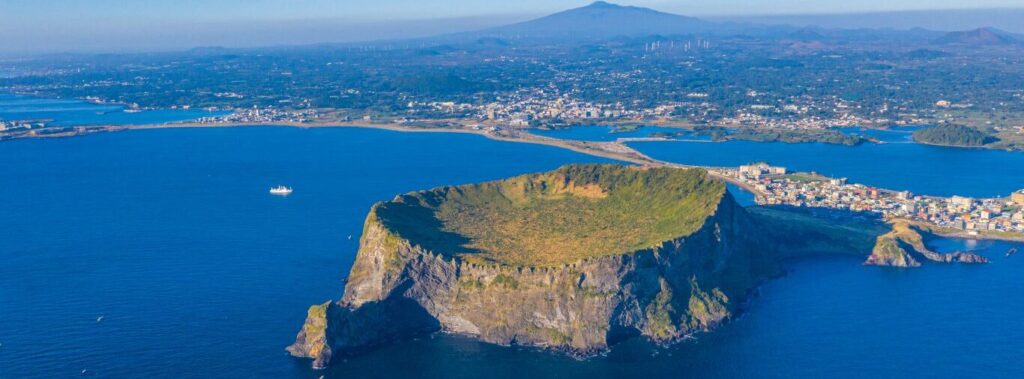
Seongsan Ilchulbong (성산일출봉) – Sunrise Peak
Hallasan—the dormant shield volcano at the center of Jeju—is the island’s ultimate symbol. It created much of Jeju. It dominates every view. It’s South Korea’s tallest mountain at 1,950 meters (6,435 feet).
But Hallasan requires serious hiking (4-10 hours depending on your route) and physical fitness. Not everyone can do it. Not everyone wants to.
That’s where Seongsan Ilchulbong comes in. It’s nowhere as massive as Hallasan, but it sure looks hefty. It’s pronounced “Song-Sarn Ill-choo-bong”, btw.
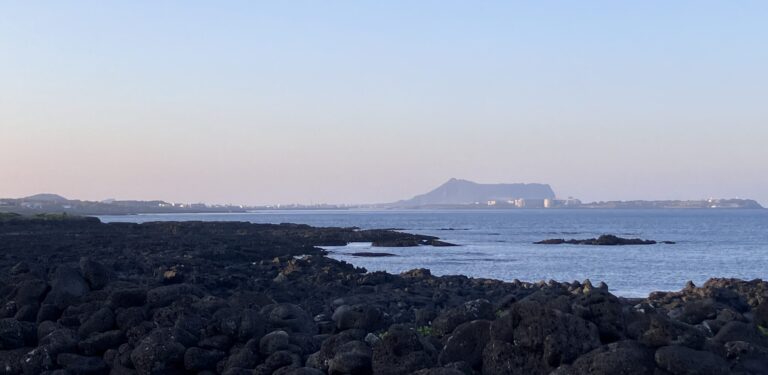
Imagine a volcanic crater rising 179 meters (590 ft) straight out of the ocean. That’s Seongsan Ilchulbong—a UNESCO World Heritage Site formed by an underwater volcanic turmoil thousands of years ago.
Seongsan gives you the dramatic volcanic experience—standing on a crater rim, seeing the geological power that created this island—without requiring summit-level fitness. It’s accessible to almost anyone who can handle stairs.
This is one of the most visually striking volcanic formations on Earth. The crater is 570 meters in diameter, and from the top, you get 360° views of the east coast, the ocean, and the surrounding countryside.
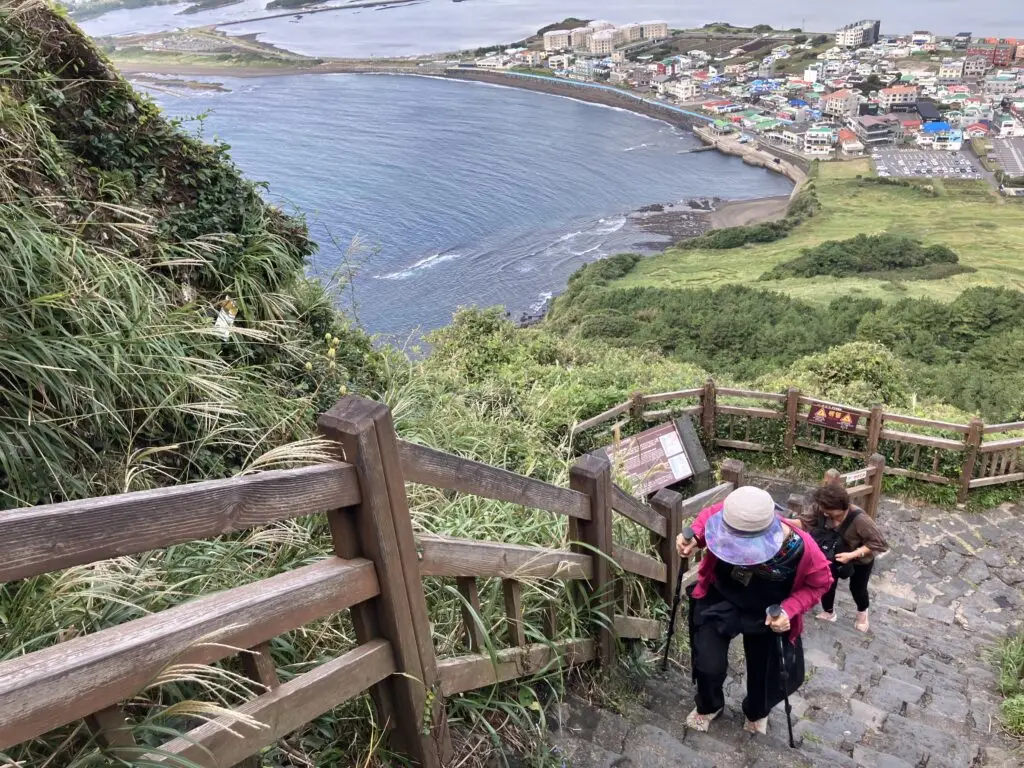
What makes it unforgettable: The climb takes 20-30 minutes up a well-maintained path with stairs. It’s not technically difficult, but it can be a workout for some. Your reward? Standing on the rim of a volcanic crater looking down into the crater and out across the ocean.
Bonus experience (don’t skip this): At the base of Seongsan, in the early afternoon, you can watch Haenyeo diving demonstrations. These are women in their 60s-80s who free-dive to harvest seafood.
This may be a show for tourists, but these Haenyeos are the real deal. They’re actual practitioners of a profession dating back centuries. But most Haenyeo are elderly, and few young women are taking up the practice.
So, you’re witnessing a living tradition that might not exist in 20 years.
When to go: It’s called “Sunrise Peak” for a reason—sunrise is spectacular. But honestly? It’s impressive any time of day. If you’re not a morning person, then, late try afternoon, when the light is beautiful. Plus, you’ll avoid the worst crowds.
How long: Plan for 1.5-2 hours total (climb up, time at summit, climb down, maybe catch the Haenyeo demonstration)
PART 2: How to Make it Happen
Getting There by Bus
Download Kakao Map or Naver Map to check bus routes and real-time schedules. But just know that the last buses tend to leave Seongsan at around 9 pm. You don’t want to have to take a taxi back to the cities – it’ll be expensive.
From Jeju City:
There are both regular Blue buses and Red express buses connecting Jeju City with Seongsan Ilchubong.
- Journey time: approximately 1 hour 15 minutes
- Cost: approximately ₩1,200 (less than a US Dollar) for the regular bus, approximately ₩4,500 for the Express.
From Seogwipo City:
- Journey time: approximately 50 minutes
- ₩1,200
When at Seongsan Town:
I usually dislike it when people give me directions and end with, “You can’t miss it” (because I almost always miss it).
But in this case, if you get to the village during the day, you really can’t miss Seongsan Ilchubong, because the peak is the tallest, biggest thing around.
Just walk towards the behemoth, past the massive parking lot, and follow the trail to the ticket booth.
Entrance fee: ₩5,000 for adults (approximately $3.50 USD) to the summit, free to beach and haenyeo show
Hours: Varies by season, but generally opens at dawn (for sunrise viewers) and closes slightly after sunset.
Facilities: The parking lot I mentioned has restrooms and lots of stores selling everything from souvenirs to snacks. But after you pay to actually enter the park, you leave all these behind. Just before the real ascent, you will run into a small mart on the left, and a restroom opposite it.
The climb:
- Well-maintained path, comprising stone steps and wooden stairs
- Part way up the climb, the path splits into one-way up, one-way down.
- Guardrails and handholds on the way up and down.
- Lights come on for those who choose to descend after sunset.
- Can get slippery when wet—watch your step after rain
- Bring water (especially in summer), a hat or umbrella if you plan to linger at the peak since there is no shelter
Weather reality check:
Jeju’s weather changes quickly.
Even if the forecast says sunny, bring a light rain jacket. The summit can be windy even when the base is calm. Pack layers.
Also, note that umbrellas don’t do well at the top if there is strong wind. Ask me how I know!
After the Climb
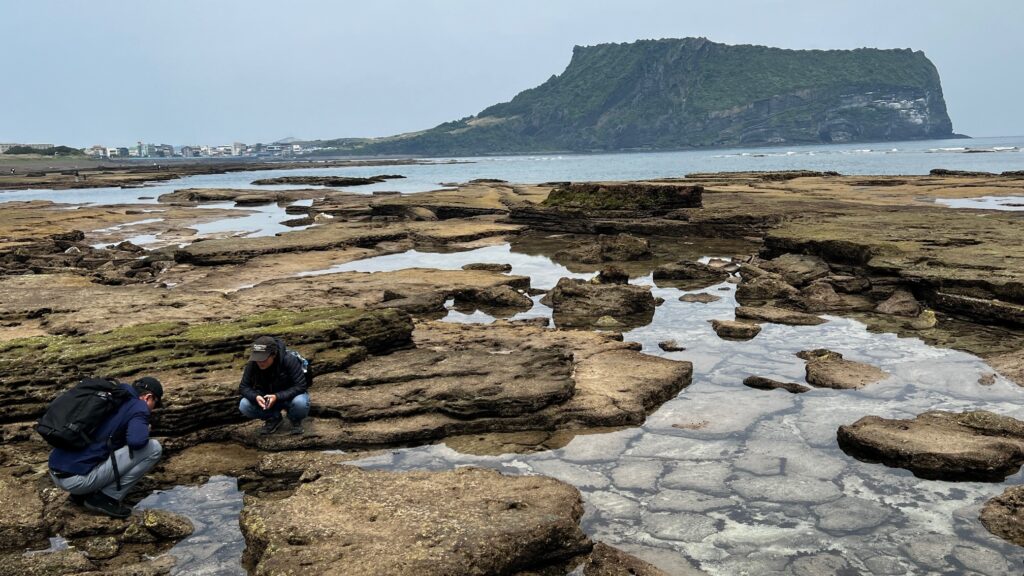
If you have the time, walk around the base area to Gwangchigi Beach—it’s a 30 min walk, or drive if you have a rental car, or take bus 201. It’ll give you a different perspective on the crater. At low tide, you can see the rocky seafloor formations and tide pools. Photographers love this spot.
Combining with Other Sites
Seongsan is on the east coast, so you might want to combine it with one of the following:
- Seopjikoji Crater (15 mins by bus, then another 45 minutes to get to the far side of the crater) another great spot for views, hikes, and a beach
- Jeju Haenyeo Museum (30 minutes by bus 201) and the nearby Sehwa Beach for white sand and windmills
- Manjanggul Lava Tube (30 minutes by bus)
Plan a full east coast day: Seongsan morning, lunch at local restaurant, Haenyeo Museum, beach time, back to Jeju City evening.
Where to Eat Nearby
There are several restaurants lining the streets a few blocks from the park, if you like Korean food. They are good, and the prices are reasonable given Seongsan Ilchubong is Jeju’s #1 attraction.
The Haenyeos who do the show also run a restaurant right next to where they do the shows. If you like raw seafood like sea squirt and conch, or have been curious about the abalone congee, give the menu here a try.
Bong Cafe: Café that opens late. I don’t know if the coffee is any good, because I come only here for the bingsu – a yummy shaved ice dessert. Open from noon to 10 pm.
There are loads of convenience stores (CU, GS25, 7-Eleven) in the town and lot if you just want a quick and low-cost meal.
Miss Western Cuisine?
I love Korean food, but if you have a hankering for western fare, I get it! Here are two good options.
Willala: Tempura style fish and chips. Tiny place run by a bloke who studied in Australia. Not set up for large groups. I’d be surprised if more than 8 people can fit in this joint. But the fish is legit. Amazing stuff. Only open from 10am to 4 pm (or until he sells out).
Vibe 230: Pasta and cocktail place run by a couple who opted out of Corporate Korea and retreated to this quiet corner of Jeju. The Shrimp Aglio Olio is legit. Open from noon to midnight.
PART 3: Korean You’ll Actually Use
Essential Phrases for Seongsan Ilchubong
One adult (ticket): “어른 한 명이요” Romanization: Eo-reun han myeong-i-yo When to use: At the ticket counter
If you’re buying for two people: “어른 두 명이요” (Eo-reun du myeong-i-yo) = Two adults
Where is Seongsan Ilchulbong?: “성산일출봉이 어디예요?” Romanization: Seongsan Ilchulbong-i eo-di-ye-yo? When to use: If you get turned around or need to find the entrance
Simpler version: “일출봉?” (Il-chul-bong?) + point = Works every time. But seriously it’s hard to miss. It’s the largest thing in the town.
This one, please: “이거 주세요” Romanization: I-geo ju-se-yo When to use: Point at a menu item or dish you want
Even simpler: Just point and say “주세요” (ju-se-yo) = Please give me
It’s delicious!: “맛있어요!” Romanization: Ma-shi-sseo-yo! When to use: To the restaurant owner/staff after eating
Does this (bus) go to Seongsan Ilchulbong?: “성산일출봉 가요?” Romanization: Seongsan Ilchulbong ga-yo? When to use: Confirming with the bus driver before boarding
Most drivers will just nod yes or say “네” (ne) = yes
Quick Pronunciation Tips
- ㅓ (eo): Like the “u” in “butter”
- ㅗ (o): Like the “o” in “go”
- ㅜ (u): Like the “oo” in “food”
- 주세요 (ju-se-yo): JOO-seh-yo (this phrase will be your best friend in Korea)
Practice before you go:
- Eo-reun han myeong-i-yo (One adult ticket)
- I-geo ju-se-yo (This one please)
- Ma-shi-sseo-yo (Delicious!)
Why Start with Seongsan?
Because it perfectly captures what makes Jeju special—and it’s accessible. It’s touristy without being a tourist trap.
Seongsan gives you dramatic volcanic landscape (this is Jeju’s origin story, just like Hallasan), UNESCO World Heritage geology, Haenyeo culture (nowhere else on earth has this), easy access for DIY travelers (clear bus routes, straightforward signage, 20-30 minute climb), and visually stunning views.
Hallasan is Jeju’s soul—the ultimate volcanic experience. But Seongsan is how most people should start their Jeju journey. It’s achievable, it’s beautiful, and it sets up everything else you’ll see on the island.
And because after you climb to the top and look out at the ocean and the crater and the coast stretching in both directions, you’ll understand why people fall in love with this volcanic island.
BTW: We’ll cover Hallasan in a future email. But take it from a Jeju fanboy—Seongsan first, Hallasan later (if you’re up for it). That’s the right order.
What’s Next?
In two days, I’ll send you Email 2 about an experience you won’t find in guidebooks: eating at a butcher shop BBQ. It’s how many locals actually eat Korean barbecue, it’s a better deal than tourist-trap restaurants, and it’s absolutely delicious.
But for now, start planning your Seongsan visit. Check bus schedules on Kakao Map. Screenshot this email. Practice saying “주세요” out loud.
You’re going to love it.
— Ed
