
Play Episode
Episode Summary
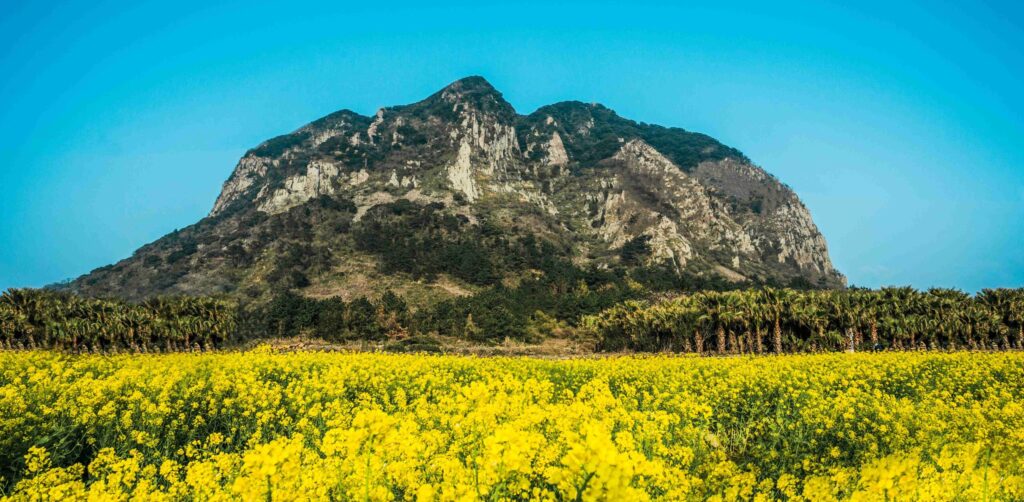
Sora and Ed wrap up the “Jeju Essentials” series with an exploration of Jeju’s 368 oreums — small volcanic cones scattered across the island. Unlike Hallasan or Seongsan Ilchulbong, most oreums are easy to climb (some just 10 minutes to the top), uncrowded, and offer spectacular views.
Sora shares her favorites near Jeju City — Sarabong, Byeoldobong, and Dodubong — where you’ll find kindergartners on picnics, elderly locals exercising, wild rabbits, and cherry blossoms in spring.
Ed recounts his accidental discovery of Gunsan Oreum while hiking the Olle Trail, where a challenging forest climb suddenly opened up to a breathtaking southern Jeju panorama.
For travelers who find Hallasan too challenging or Seongsan too crowded, oreums offer an authentic, peaceful alternative — and you might be the only tourist there.
Key Takeaways
- Oreums are small volcanic cones — 368 across Jeju; as of 2024, no longer called “parasitic cones” since some are older than Hallasan itself
- Why climb oreums: Easy (10-15 minutes), quiet (walking meditation vibes), beautiful views without crowds
- Oreums near Jeju City:
- Sarabong: 10 min climb, views of old Jeju City/airport/ocean, cherry blossoms in spring, very local (kindergartners, exercising elders, wild rabbits)
- Byeoldobong: Connected to Sarabong, harbor views, lighthouse with cafe
- Dodubong: Near airport, K-drama filming location (“Welcome to Samdali”), great for plane-watching
- Yongnuni Oreum (Sora’s favorite): Sunrise views of Seongsan and Udo, horses roaming, trail through horse paddocks
- Gunsan Oreum (Ed’s favorite): Southern Jeju — discovered accidentally on Olle Trail; can drive up and walk 5 minutes, or hike through forest like Ed did (“like an idiot”)
- Government closes some oreums periodically for nature recovery — check before you go
Even non-hikers should try one oreum — easier than Hallasan, more peaceful than Seongsan, authentic local experience
Handy Korean with Sora Ssaem (쌤)
천천히 (cheoncheonhi) = Slowly / Take your time
The opposite of Korea’s famous 빨리빨리 (pali pali / hurry hurry).
천천히 하세요 (cheoncheonhi haseyo) – Please do it slowly/ Take your time
천천히 해 주세요 (cheoncheonhi hae juseyo) – Please do this slowly
천천히 가세요 (cheoncheonhi gaseyo) Go slowly
천천히 오세요 (cheoncheonhi oseyo) Come slowly/Take your time comingTip: Korean allows omitting words — just saying 천천히 works and people will understand from context.
Key verbs: 하세요 (do), 가세요 (go), 오세요 (come)
Next Steps
- Sign up for the 14-part email series at vamosajeju.com/start
- Follow Vamos a Jeju on Instagram, TikTok, or YouTube.
- Share the episode with friends to help the podcast grow
- Visit vamosajeju.com for articles, videos, and resources
- Related Reading: The Oreums of Jeju: 368 Volcanic Cones, Almost No Crowds
Episode Transcript
What is an Oreum?
Soraya (00:19) Hello everyone! So in the previous episode we were talking about the essential of Jeju travel like the Seongsan sunrise peak, woman diver Haenyeo and Tangerine and also the fabulous Jeju coast and to finish the essential Jeju series today, here with me, I have my buddy Ed. How are you?
Ed (00:44) Hello, Chingu. Chingu means friend in Korean. The first time I went to Jeju and I saw the word Oreum I’m like, what the heck’s an Oreum? Is it an animal, vegetable, or mineral? And then when I look at Kakao maps it will say things like parasitic volcano. I was like, man, that sounds terrible. What is an oreum? I know it is but what exactly is it?
Soraya (01:07) So actually, going to Oreum is one of my favorite thing to do in Jeju. It is small volcanic cone. Because until like 2024, like lots of people and researchers say that it was parasitic cone of Hallasan mountain. But from 2024, we have like different theory. So we call this like small volcanic cone, not the parasitic. Anyway. So this is like different from mountain. Yeah.
Ed (01:35) Right. I think you were saying that some of these Oreums are actually even older than Hallasan. So therefore it is not accurate to call them, right, a parasitic or any shape or form. So you mentioned like what that’s one of your favorite things to do, like to climb Oreums. What is it about climbing Oreums that you like so much?
Soraya (01:42) Mm-hmm. Mm-hmm. Can’t be. First of all, it’s easy. It’s so much easier than going up to the mountain, right? It’s, right, comparing to any mountain. Because, you know, to go to Oreum, like for example, one next to my apartment, it’s just like, just 10 minutes, we can go up to the top and then enjoy the beautiful view. And it’s easy and…
Ed (02:01) Okay. You’re talking about Hallasan right? Comparing to climbing Hallasan. Okay, gotcha.
Soraya (02:24) Pretty, beautiful. That’s the first reason. I really like it.
Ed (02:28) Okay. What’s the second reason?
Soraya (02:31) Second reason I think because Oreum are usually very quiet also like compared to other mountain like there is like less people so it’s very quiet so it’s kind of like you can do like walking meditation in Oreum.
Ed (02:47) So you’ve got all the beauty and majesty of looking at the view from an elevated position without any of the crowds and noise that are often associated with like maybe Seongsan Ilchulbong. I remember you telling everybody that there’s 368 Oreums. If I was new to Jeju, which would be some of the easiest Oreums to climb? Where you can actually have a great view, watch a great sunset or sunrise?
Oreums Near Jeju City — Sarabong & Byeoldobong
Soraya (03:11) Mm-hmm. So first of all, my apartment is right next to Sarabong Oreum and it is located like near the Jeju port, also like Jeju airport. So it’s in the city, but when you go up like 10 minutes, then you will see like whole majestic view of like old Jeju city and airport and the ocean as well.
Ed (03:42) I’ve been up there a few times. The first time was because it was along the Jeju Olleh Trail. I’ve been up there a couple more times with my cousin and then with you and Jayden to watch the sunrise, sorry, sunset. Yeah, the sunset.
Soraya (03:51) Sunset.
Ed (03:53) But my favorite part about Sarabong is not actually the view, is that two times I climbed up there, there was kindergartners, little kids, like Yu Ji Won, the teacher had brought them up to have like a picnic.
Soraya (04:06) Mm-hmm. Mm-hmm, right, right.
Ed (04:07) They are so cute! These little kids were so cute! Yeah, it was enjoyable and was very peaceful when the ferries going to the mainland. It’s a great view. That’s Sarabong.
Soraya (04:18) I want to say it’s very peaceful because in Sarabong, you will see like those small children, small kids, and you will see like two rabbits. Did you see that?
Ed (04:28) No, I saw a cat.
Soraya (04:30) There’s a wild rabbit living in that Oreum.
Ed (04:35) I’m shocked the cat hasn’t gotten the rabbit yet. Also you’ll see Halmangs and Halabangs working out. Like exercising at the top. It really feels like you’re plugged into the local community with like the little kids and the older people working out and a great view. When I was there, I think I might have been the only visitor on that hill. I’m sorry, the Oreum, not hill, sorry. So, it feels like a hill though. It feels like a hill. Okay.
Soraya (04:59) Mm-hmm. Not hill, no, it’s different because hill is not from volcanic activity, isn’t it? Hill is like small mountain, no?
Ed (05:10) Okay, alright. Okay, whatever. Okay.
Soraya (05:16) Sarabong is like it’s a local place for cherry blossom. Because lots of visitors they go some places like Cherry Blossom Street but here it’s like locals know to go when the cherry blossom starts.
Ed (05:33) Gotcha. Cool. So cherry blossoms in the spring, great views, great sunset. But I guess if it’s windy or rainy, then it’s not so fun.
Soraya (05:44) Not recommend.
Ed (05:47) So if you keep going you’ll hit another Oreum called Byeoldobong. That one also has very good views of the North Coast and you see more of the harbor. Do you often walk along there or do you just mostly go to Sarabong and then turn around?
Soraya (05:53) Mm-hmm. Because we can go up from my apartment and then go down to the other side. So we usually make like one big circle.
Ed (06:11) I see. So you don’t actually go into the other Oreum.
Soraya (06:17) No, not really.
Ed (06:19) Okay. Because the endpoint of the other Oreum is too far away from your home. Is that it? Okay. Gotcha. Okay.
Soraya (06:24) Yeah, it’s too far, right? To come back home, it’s very far. And also there’s like small lighthouse which is also like kind of famous place to visit, like take photos and enjoy. There’s a coffee shop in front of the lighthouse, so people like to go there as well.
Ed (06:43) So I didn’t realize you could access it as a visitor, there’s a cafe in there. Okay. But not inside the lighthouse, right? I thought you said inside. Okay, okay. Alrighty.
Dodubong — Near the Airport
Ed (06:43) So that is like one of the easiest, but isn’t there another Oreum that is closer to the airport?
Soraya (06:46) Yeah, you could, you could. There’s a cafe right in front of it. Near the rainbow coastal road there’s Dodubong, another small Oreum. It also takes like 10-15 minutes to go up and actually lots of K-dramas were filmed in that Oreum as well.
Ed (07:12) Mm-hmm. Yeah, anytime they want to film a view of like Jeju City and the airport, they will go up there and do the shooting. Yeah, so to that point, like you have a pretty good view of the airport too. So if you are a geek like me, and you just like to sit there and watch planes land and take off, that’s not a bad place to be.
Soraya (07:35) Mm-hmm. Mm-hmm. If you have watched Welcome to Samdali, when they were high school kids, they were dating in that place, like watching the flights coming and going.
Ed (07:54) Mm-hmm. Yeah, and… Yes. Okay, at some point we probably have to cover all these K-dramas that we keep talking about on the show. It’s like, When Life Gives You Tangerines, Welcome to Samdali, Our Blues. Like, what are they talking about? So we just talked about the three Oreums that are closest to Jeju City.
Soraya (08:08) Yes, yes, yes, that’s right.
Ed (08:21) So easy to climb and also quite close to the city. So they’re quite accessible.
Darangshi Oreum — The Queen of Oreums
Ed (08:21) Let’s flip completely to the opposite. What is one of the hardest to climb?
Soraya (08:30) I think from my experience, the hardest one was Darangshi Oreum. It’s in the east of Jeju. But Darangshi feels like a mountain.
Ed (08:41) Okay.
Soraya (08:42) Yeah, takes 30 minutes to go up, 30 minutes down, like one hour in total.
Ed (08:47) How would you compare Darangshi to Seongsan Ilchulbong?
Soraya (08:50) Darangshi has more different trail. Also, there’s lots of stairs like Seongsan Ilchulbong, Seongsan Sunrise Peak. But there’s also some place not paved yet. So it feels really authentic. But sometimes it can be challenging for someone who doesn’t hike often.
Ed (09:12) Okay, so is it steeper than Seongsan Ilchulbong or not?
Soraya (09:19) I think Darangshi is a little more longer than Seongsan Sunrise Peak.
Ed (09:24) I see. Okay. But on the flip side, there isn’t the tourist crowds or the high school field trips on top of that. So what’s the payoff? Like when you finally climb up to Darangshi, like what is the payoff up there?
Soraya (09:33) Yeah. Yeah. So I think like for up to the top, the path is really beautiful. So one of my favorite thing was that there is a beautiful tree in winter, when I walk into that forest without any leaf, I felt like I’m back in Patagonia so it felt like dreamy. I don’t know how to explain. Yeah.
Ed (10:06) Okay. So let me try and capture what you’re seeing. So like in the winter, these trees have shed the leaves and so the bark of the tree turns… So I’ve never been to Patagonia and I’ve not been to Darangshi but I’ll take your word for it. The climb up is worth the climb itself. But then once you get to the top, there’s an extra bonus because I imagine there’s a crater and a great view.
Soraya (10:34) Right, the view is amazing. You can see like Udo, Seongsan Sunrise Peak, like many different small volcanoes and beautiful ocean. We call Darangshi as queen of Oreum because it’s so beautiful.
Ed (10:44) Mm-hmm.
Favorite Oreums — Yongnuni & Gunsan
Ed (10:44) So we talked about the easiest Oreums to get to and the hardest to get to. Let’s flip the script a little bit and talk about which Oreum is your favorite because you must have climbed dozens of these.
Soraya (11:04) One of my favorite is Yongnuni Oreum. Because we liked that Oreum for a long time before we moved to Jeju. And finally when we moved to Jeju, we tried to go that Oreum in the morning to see the sunrise. So on that day, we went there before sunrise and then we felt the sunrise and like horses just walking around, no people. So I felt like one with the nature in that morning. I think that’s why I like that so much.
Ed (11:42) Yeah, I think I remember climbing up that one with Jayden and at the top of that you see Seongsan Ilchulbong, Udo as well and I remember the horses, the Ganse. Was it the horses? And so the trail up there takes you through the horse paddocks.
Soraya (11:53) Mm-hmm, mm-hmm, mm-hmm.
Ed (11:58) And so like there are several turns that are designed to keep the horses in, but you can actually walk through that. So yeah, was a very pleasant walk. But when I was there with Jayden, it was actually very crowded. It was in the afternoon. A lot of people were there. But yeah, I guess I can totally see how in the early morning it would have been a very fabulous view.
Soraya (12:10) Mm-hmm. So one thing we have in Jeju is that the government, they close the Oreum for a few years for the recovery of the nature. So we went there right after the recovery period. And now that Oreum become so famous among social media. So now it become a little bit more popular.
So, Ed, how many Oreums have you been to? I think you have been a few, more than a few among your Olleh Trail, isn’t it?
Ed (12:44) Okay, Neh Neh. Yeah, so that’s the thing. Unlike you and Jayden, I do not intentionally, purposefully find an Oreum and then go climb it. The Olleh Trail takes me through a few Oreums and not every one of them is spectacular but the one I really remember, because I was going in a direction of the Jeju Olle Trail through a forest, which is quite steep and I was just going and going, it was getting more and more difficult. And then when I reached the top, it was like, oh wow, this is beautiful. You are climbing in a forest, all you’re trying to do is keep going because it’s difficult, but you don’t see far and then suddenly the forest falls away and then now you’re at the top and it’s a fantastic view of the southern part of Jeju Island. And yeah, I think it was memorable for me because it was serendipity. Like I didn’t plan it. It just happened. It just happened to be very, very beautiful. So yeah, for that reason, Gunsan Oreum is my favorite.
Soraya (13:47) Mm-hmm. We went to Gunsan Oreum for sunset and it was really, really beautiful. I really love that place. And for someone who can’t walk very well, I recommend Gunsan Oreum because you can drive up and then you just walk like five minutes, not like Ed.
Ed (13:53) Okay. Mmm. It wasn’t so difficult, but it wasn’t… I feel like I’ve accomplished a good climb. And then a couple walked by. I was like, these two are really fit. Wow. And then some other people come and I say, where are these people coming from? And then I saw on my way down, there’s a parking lot. Oh my God. I must have been the only one who walked all the way up like an idiot.
Soraya (14:26) Parking lot.
Why You Should Climb at Least One Oreum
Ed (14:34) So that’s on the Oreums of Jeju. Oreums are really such an iconic part of Jeju Island and they take their place alongside Seongsan Ilchulbong which is also an Oreum and then with the haenyeos, the tangerines and the coastline, the beaches.
Soraya (14:49) Coast, beautiful coast.
Ed (14:52) That covers the entire spectrum as a destination and I would really like to encourage our listeners to at least climb one Oreum even if you are not an outdoor person or even if you don’t really like climbing. Because okay, Hallasan is difficult to climb so if you’re not an outdoor person maybe don’t do Hallasan. Seongsan Ilchulbong is beautiful, iconic, but if that too is too difficult, maybe don’t give it a go. But if you want to still be able to get a great view, then definitely check out one of the Oreums, the easier ones that Sora talks about, maybe Sarabong, which is right in the east side of Jeju City. Give it a go because it is a very local, very authentic experience. And if you are the kind of person who likes to be in a place where you’re the only visitor from outside Jeju, then definitely Sarabong is a great place to go.
Soraya (15:39) Thank you.
Ed (15:51) If you are having a hard time climbing we’re going to cover some useful phrases in our next section, which is Handy Korean with Sora Ssaem.
Soraya (16:12) Waaaa Waaaa
Handy Korean with Sora Ssaem (쌤)
Ed (16:16) The self-cheers are getting a bit more tired. Okay, Sora, tell us what are we going to help our listeners learn today?
Soraya (16:24) So today we’re gonna talk about please take your time or please make it slow. So when you travel, you know, like Koreans always, we’re always busy. And what we say a lot is make it quick. I think you may know this. So we always say, 빨리빨리 (pali pali).
Ed (16:48) Yes.
Soraya (16:52) On the other hand, you want to make it slow. You want to make them like speak slow, something do slow. So you can say 천천히 (cheoncheonhi). 천천히 literally means slowly. So you can say like 천천히 하세요 (cheoncheonhi haseyo). Please take your time. Please do it slow. Or you can also say 천천히 해 주세요 (cheoncheonhi hae juseyo), please do this slowly for me. But I think you can just say 천천히 then people will understand. Just make it slow.
Ed (17:30) So in the context of the Oreum, if we were climbing the Oreum and we were a bit tired, I guess you can tell someone to go like, 천천히 가세요 (cheoncheonhi gaseyo). Go up slowly.
Soraya (17:40) Right right right. Aha go slowly right.
Ed (17:43) Or if you are up there already and you’re waiting for me to catch up with you, you can shout, 천천히 오세요 (cheoncheonhi oseyo). Right? Right, and so we’ve covered a few important verbs there. We’ve covered like 하세요, which is like to do or to speak. And then 가세요 is to go and 오세요 is to come. So if you combine, if you add 천천히 in front of it, it literally means, hey, you know, take your time or do it slowly, speak slowly or go slowly or come slowly. How else can people use 천천히?
Soraya (18:17) Okay. I think 천천히 itself you can just use it. You know, Korean language, we can omit many things. So even though you omit everything and just say 천천히, people will understand the context. But to use 천천히, I would say… if you know some Korean, maybe you can ask like, please speak slowly.
Ed (18:48) Mm. Mm-hmm. Okay, and that’s asking a lot of Koreans, like asking them to speak slowly. That’s like a huge favor. And if you’d like to see the phrases that we just covered today, check out our show notes. To recap, it is 천천히 하세요, 천천히 해 주세요, 천천히 가세요, and 천천히 오세요. And that’s the one where super fit Sora is yelling to me when she’s at the top of the Oreum.
Soraya (19:21) I always say this when I wait for you in the cafe. Like, you’re coming now and I’m in the cafe. I’ll say, 천천히 오세요.
Ed (19:31) You make it sound like I’m always late. So if today’s show has got you thinking, wow I really need to climb one of those Oreums, one of those 368 Oreums, we’ve got something for you. Sora and I have taken everything we know about visiting Jeju as a DIY traveler, and we’ve put it into a 14-part email series.
Soraya (19:51) So to get that email sent straight to your inbox, sign up at vamosajeju.com/start. Also for the latest update, follow us on vamosajeju on Instagram, TikTok, also Facebook group. And finally, the best way for a new podcast like us to grow is organically. So if you found this episode helpful, please share us with your friends, family. And who knows, maybe we will Vamos a Jeju together.
Ed (20:22) And with that, all that’s left for us to say is… Annyeong!
Soraya (20:27) Bye!
