
Play Episode
Episode Summary
Ed and Sora tackle public transportation for DIY travelers. Sora admits she doesn’t take buses because she’s “very Korean” and impatient — buses to small villages come only once per hour.
Ed shares a story about Chinese tourists stranded in Seongsan after 10pm when buses stopped running. They cover bus colors (red = express, blue = regular, green = village), the T-Money card system, transfer rules, and the new option for tourists to use contactless payments on Jeju buses.
For taxis, Uber now works in Korea but summons real taxis due to the strong taxi union.
Key Takeaways
- Buses stop early (9-9:30pm) in tourist areas; check Jeju bus website for schedules, not just map apps
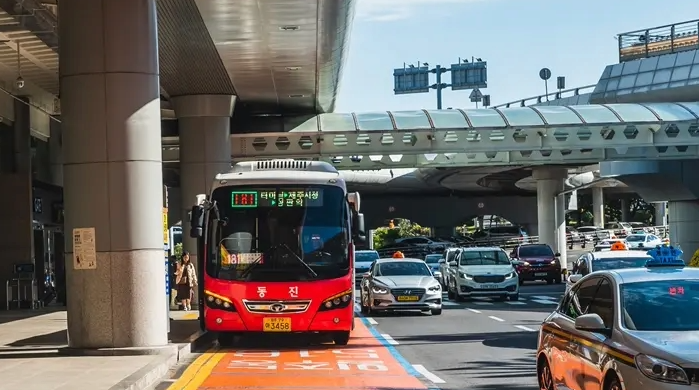
- Bus colors: Red = express (~$3), Blue = regular (~$1), Green = village (infrequent)
- T-Money card works everywhere; tap out for free transfers (40 min window, up to 2 more buses)
- Buy T-Money at convenience stores (3,000-4,000 won); most buses don’t accept cash
- Tourists can now use contactless Visa/MasterCard and Apple Pay on Jeju buses (not mainland Korea)
- Large luggage: use airport limousine bus or taxi; some blue buses have luggage bays
- Uber calls real taxis in Korea (same app, same payment method from home)
- Red taxi light = empty, green = occupied (counterintuitive!)
- Have your destination address in Korean on your phone for taxi drivers
- Kakao Map recommended over Naver Map for restaurant reviews (fewer fakes)
Handy Korean with Sora Ssaem (쌤)
가요 (gayo) = Go / Going — raise intonation to make it a question
- 공항 가요? (gonghang gayo?) — Does this go to the airport?
- 성산일출봉 가요? (Seongsan Ilchulbong gayo?) — Does this go to Seongsan?
- 안 가요 (an gayo) — No, it doesn’t go
돼요 (dwaeyo) = Is it possible?
- 카드 돼요? (kadeu dwaeyo?) — Can I pay by card?
Next Steps
- Sign up for the 14-part email series at vamosajeju.com/start
- Plan your Jeju trip at vamosajeju.com/trip
- Follow Vamos a Jeju on Instagram, TikTok, or YouTube.
- Share the episode with friends to help the podcast grow
- Visit vamosajeju.com for articles, videos, and resources
- Related Reading: Jeju Bus Guide 2026: Routes, Fares & T-Money Card (Bus 201, 600, and More)
Episode Transcript
Why Jeju's Bus Network Rocks!
Ed (00:18) Hey everybody, I’d like to welcome all of you to today’s episode of the Vamos a Jeju podcast. And as always, I have the fabulous Sora with me. Say hi, Sora!
Ed (00:31) episode, we’re going to continue with our series on DIY Jeju. And that is basically our series for helping the DIY traveler explore Jeju on their own terms. And so far we’ve covered is the best season to go. And we’ve also talked about how to budget for your Jeju trip. And of course in episode, We talked about where to stay in Jeju, basically touching on accommodations. Today we are going to be continuing this series and that is getting around with public transportation. so we recorded, Sora and I had a conversation and I was like, Hey Sora, so what are we going to do about talking about buses? And she was like, I don’t take buses. So why do you not take buses, Sora?
Soraya (01:22) Why do I not take buses? Because I have a car and the bus actually in the city we have quite like bus come and go quite often but to go to a small village the bus comes like every hour so I don’t want to wait I’m Korean you know I’m very impatience but I’m very impatient I can’t wait for that so I just get my car and then go
Ed (01:52) When you mentioned that buses sometimes take a long time to come. Another thing about buses in Jeju is that they operate within certain hours. So if you are in, let’s say a smaller town like Songsan where Songsan Ilchubong is, then the buses stop coming around nine o’clock, nine thirty. I think it depends.
Ed (02:17) Yeah, and I know that one time when my wife Michelle and I were living, were staying in Songsan. I was walking from our pension and if you listen to our previous episode, you know exactly what a pension is. I was walking from our pension to a Mart Hanaro Mart in Songshan. And I noticed like three tourists and from listening to them speak, it was Chinese and I could tell they were from China. And they were like trying to figure out how to get a bus back to Jeju city.
Ed (02:52) And I was like, it’s pretty late. I, I went over and I spoke to them in Chinese. It’s pretty late and you might not have a bus anymore. but they’re like, it’s like, no, it’s no big deal. No big deal. No big deal. It’s okay. It’s okay. So was like, okay, fine. Whatever. So I went in and bought my stuff and I came back out again. They were still there.
Ed (03:18) You guys better get a taxi because by now it’s was late, like Hanaroma was closing, so maybe 10 o’clock. 10 right? Yeah, it was closing and it was almost 10 o’clock. and finally they’re going to order a taxi. And so I say this to let the listener know that Jeju city has a great bus transportation system. But when you get out to the outskirts, not only are the buses less frequent, but even in a tourist attraction where there are usually a lot of buses, once you get outside the tourist times, then the buses like stop.
Just make sure that you know when the buses are going to be coming and going and the best way to do that is using the, in my opinion, the Kakao app. Some people like the NaverMap app. I’ve only used the Kakao app. So I cannot compare, which is better. But my personal bias is… Kakao Map app also because Sora you told me that the reviews on restaurants are more reliable on Kakao Map.
Soraya (04:21) say that, So we have two main map applications in Korea. One is Naver map and the other one is Kakao map. But nowadays Naver itself, a lot of people from advertising and they try to make like fake reviews on Naver. Actually, the Naver map, because the Naver map has the database for all the different restaurants, cafes and the places. So the people will ask others to make fake review on Naver. But on the other hand, the Kakao map is still very clean. So yeah, so if you want to check restaurant, cafe or places, just check Kakao map. It’s better, a lot
One more thing I want to say is it’s better to check the Jeju bus website for timetable than check the map application because sometimes map application has not accurate real time stuff. So I would recommend check the timetable on Jeju bus website and then you can use those Naver map, Kakao map for backup source for the information.
Ed (05:33) Yeah, I’m really glad you said that, Sora, because once you get out into the outskirts of Jeju, even the Kakao app will say, please check bus schedule. there’s a good reason for that, because if you don’t check the schedule, There may be no bus coming.
Understanding Bus Colors & Schedules
Ed (05:33) While many buses in Jeju, in South Korea, actually are connected over cellular signal, and give the app real-time updates of where the bus is, not all the smaller buses, the green buses that go to the smaller towns have that. So very often, some of these buses, their frequency can be like maybe once every one hour. But then when it’s like, and that’s usually in the mornings and in the late afternoons, but in the middle of the day, sometimes there’s no bus coming for like two hours.
Sora do you know? What the different colors are in in the buses in Korea?
Soraya (06:28) Of course I know. It’s actually all the same color all around Korea. So we have green bus and blue bus and red bus. So it depends on how far it goes. The red bus will go far away like one or two hour and then blue bus it’s… How do I say? Like within one hour and then green bus will be for the like small village, village bus. Yeah, is that right?
Ed (06:49) Kind of, yeah. I want to push back a little bit on that because, the, Jeju anyway, like the red and blue buses, they go to the same places sometimes. So sometimes like the red buses will go from Jeju City to Seongsan, Ilchubong, or to Seogwipo City. The difference is that the red bus is the express bus and it makes less stops.
Ed (07:22) So it’s not about like one hour or two hours per se. Like they can go to the same place, just that the red one will get you there with usually is a more direct route. So, and it stops less time whereas the blue bus will go to the same place, but they have more stops and they will often turn into some of the smaller places So it will actually make all these detours. And so it’s a less direct route.
Soraya (07:46) So it’s more slower, a little more slower.
Ed (07:50) Yeah, yeah, yeah. But not by much. 15, 20 minutes. But it’s cheaper it’s like usually about 1,250 won if you use a… Yeah, yeah. Whereas the red ones are gonna be like $3.
How to Pay — T-Money, Transfers & Contactless
Ed (08:09) I want to touch on two more things about buses and one is how to pay for the buses and the other is what to do with your luggage. Let’s start with how to pay for it. So I guess the most simple way to pay for buses on Jeju is basically using the T-Money card, It’s the same T-Money card that’s used across all of South Korea, including on one small island that’s away from Jeju Island. It’s called Chujato and there’s only one bus that runs that. Even that one bus that runs once an hour uses the T-Money card. So the T-Money card is great to use and it’s very handy.
And a couple of things I’ve learned about the T-Money card. For instance, If let’s say there’s three of you in your group and you have one T-Money card, you can still use that one T-Money card. You just go on the bus and you ask the driver to say like three people, please send me on to say, oh, and then they will and then they will like press a couple of buttons so that and then when you tap it, You’ll be charged for three people automatically.
Ed (09:16) thing to note about Korean bus systems and this is the same in on the mainland Korea is that you need to tap in and tap out no brainer there but if you want to do a transfer After you tap out, you have 40 minutes to take up to another two buses. like total of three buses to count as a one trip. The catch is if you had used one card for three people, only only one person gets the transfer. Not all three. Yeah.
Ed (09:45) If you were going to transfer buses but you forgot to tap out, then it’s considered a new bus ride. So you’re going to be charged twice if you didn’t tap out. So it is very important to tap out so that you can get your transfer if you need to take another up to two more buses in the next 40 minutes.
Soraya (10:21) And one more thing I want to add is after using the bus, you can also transfer to a taxi as well. So in 40 minutes, if you take a taxi and pay by a T-money card, you can also have some discount as well.
Ed (10:37) So that was very interesting about the taxi. I didn’t know that. so people actually pay the taxis with, the T money card, huh?
Soraya (10:45) Yeah, you can also I sometimes use my T-Money card to pay for the taxi and of course we have T-Money card on my phone so I can just use it everywhere so…
Ed (11:42) And I also read that it’s now possible for tourists, not just people like Sora, are Koreans, to use your Apple Pay or Samsung Pay to tap on and tap off as well. That is something that is not yet doable in mainland Korea, definitely not in Seoul.
Soraya (11:47) one more thing nowadays, I think most of the bus, they don’t accept cash. So you better prepare a T-money card than cash because there’s no Change nothing.
Ed (12:14) Yeah. I mean, the also important to note is that, where to buy the team money card. so I guess if you are first time visitor to Korea, arrive at Incheon airport, whether terminal one or terminal two, you could get it from a few places. Anytime you see a convenience store is called Pyeoni-jom in Korea. And so the brands are GS25, CU, 7-Eleven. You can go there and ask them for a card. which is quite cheap. 3000, 4000 won depending on, depending on the design. you can use a credit card to buy the T-Money card, but you to use cash to add value to the card.
At the airport in Incheon, you can also go to the train station. So it will be the the A-Rex. They call it the all-stop train. right in front of the All-Stop that’s where you can buy your So depending on which you see first, if you see the convenience store, you buy the card there, you can top up your card there at the convenience store or you can buy your card at the A-Rex train station and you can top it up there as well.
Luggage on Buses
Ed (13:59) That’s kind of the nuance of paying for buses in Jeju. And then we talk about the schedule, we talk about how to pay for it. And now I want to talk about luggage. So officially, Sora, you told me once that officially you’re not supposed to be carrying luggage onto the buses.
Soraya (13:59) I mean there’s a different size right so the luggage for carry-on you can take a normal bus I mean up to carry-on size but if it’s check-in bag only airport bus you need to take a taxi
Ed (14:09) So actually that is not completely true Sora because some of the blue buses that go like a like let’s say from Jeju City to Sokryo-po they actually bays from the outside
Ed (14:39) So they are not the red express buses. Yeah, they are the regular blue buses. And so you can tell because the blue buses, are usually two kinds. One has a has two sets of doors, one doors to go up and one doors to come out. Those are the normal buses. Those do not have any checking back storage. But if it’s the bus, it’s just like only one door in front. There’s no other doors. So you go in and out from that front door. Those are actually designed to be like tour coach buses. And so they actually have storage base that you can access from the street level. So when a bus stops, you will then open it by yourself. The driver is not going to come and help you with that. you put a bags in there, close it, and then you get on the bus.
Soraya (15:38) okay. I saw some like posting from a bus driver in Jeju. He said it is not allowed by a law. It’s a rule. But people just, you know, people just take their like big luggage and take the bus. It happens. It happens. Yeah. recommendation is just use airport limousine bus if it’s possible or take a taxi it would be better.
The Korean "Wet Bathroom" — A Survival Guide
Ed (16:36) And that’s a great transition to taxis because if like you have a lot of luggage and there’s two or three of you, it’s actually smarter to take a taxi. So let’s let’s transition to taking a taxi. because I was so heavily invested in the bus system I have to say that I only took a taxi one time.
Ed (16:36) And that one time was our very first time when we arrived in Jeju on the day of your wedding, which we didn’t go for. but it was raining very heavily. And I was with my queen, my wife, with a lot of luggage. So I got out there, I was like, if I am going to make this woman take a bus in the rain, she might divorce me. So I took a taxi. And that was the only time I took a taxi on Jeju. First trip, heavy rain with wife and luggage. After that, every time I’ve gone back by myself, I’ve been taking a bus. So I know very little about taxi situation in Jeju. So I think this is where you take over the conversation with our audience.
Soraya (17:10) Okay, so for taxis, I sometimes use Kakao taxi here in Jeju because we have, you know, like lots of drivers registered in Kakao taxi. So the easiest way to grab a taxi is Kakao taxi. I think now the foreigners also can install Kakao taxi application, right?
Ed (17:37) Yes, but it is not as straightforward to use Isn’t there an easier way for first time visitors to Jeju to get a taxi?
Soraya (17:46) We have, we actually have Uber as well, because you know, I think like last year we start having Uber in Korea, but actually Uber is not the Uber with a car like in the States. Uber is actually taxi because here in Korea, the taxi union is so strong. They don’t allow to Uber comes into Korea. So the Uber contract with the taxi union here. So when you call a car from Uber, the regular taxi will come. So it’s going to be a lot easier for you to use.
Ed (18:15) Right. And just to clarify, this is the same Uber app that if you’ve ever used Uber in your home country, it’s exactly the same app. whatever credit card that you’ve, stored on that on your Uber app, that’s what It’s going to pay off. It’s going to be in the language of your choosing. So if you come from an English speaking country, it’s in English.
Soraya (18:51) when you just arrive at the airport in Jeju, you just follow the sign for taxi, then you will see people lining up. So just line up at the queue, and then you will see like hundreds of taxis are waiting for you. So just take that well when you arrive at the airport, but later maybe you can call Uber or a Kakao taxi or you can just ask at the reception of your hotel. and you can also just get a taxi on the street, just wave your hands. Just remember that when you have the, when you see the red sign in the taxi, that means it’s empty, If it has green sign, it means it’s already booked or have passenger. So you need to wave to the one with the red sign.
Ed (19:44) So that’s so counterintuitive, normally red means no and green means go, so now it’s like green means like no and red means yes.
Ed (19:56) I Heard someone tell me one time that in Korea It is so hard to find an empty taxis like it is is so hard to to like a Hey a flag a taxi down these days like almost everybody uses an app to get a taxi. Isn’t that right? Is that true?
Soraya (20:11) I think it is true in Seoul, especially on a Friday night, Saturday night, it’s impossible to take a taxi. Also, with the app, it’s very difficult because the drivers, don’t want to go short distance. But in Jeju, I think it’s a little different. We don’t really have lots of… like the company gathering… drinking, yeah, drinking this stuff. So we don’t really have these kind of problems. We just wave your hands and then just take a taxi.
Ed (20:43) I wonder if it’s intimidating for a first time visitor arriving in Jeju at the airport go to the taxi line and then from what I remember there was nobody helping us talk to the driver. I could speak some Korean and so we were able to figure it out but if you speak no Korean how do they take the taxi?
Soraya (21:05) Just show them that you’re phone in Korean or…
Ed (21:11) and the address. Yeah, it’s okay for a hotel, but if you’re going to some like Airbnb, it might be difficult. Yeah. And then they’ll put it into the GPS.
Soraya (21:19) You need to have the address in Korean.
Handy Korean with Sora Ssaem (쌤)
Ed (21:26) So that is our episode on using the buses and getting taxis. if you are a DIY traveler to Jeju. So now here’s the part of the episode where we teach you some handy dandy Korean phrases And we call it Handy Korean with Sora Sam! What are we going to teach our friends today Sora?
Soraya (21:49) So today we’re gonna learn verb to go so the verb to go in Korean is 가요 and in Korean we actually don’t have like different grammar for like making question we can just make the same sentence and then the intonation goes up So if I say 가요 means to go but if I say 가요, is it going? Do you go? So for example, to take a bus, if you’re going to the airport, airport is 공항, 공항. So you can just ask the driver 공항 가요. But you really have to put the intonation goes up. Because if you say gonghang gayo means I go to the airport. So what? you need to make gonghang gayo.
And then the driver will say, maybe he will just nod. 네, 가요. Or 안 가요. Meaning not going. 안 means not going.
Can you ask the driver, is it going to Seongsan?
Ed (23:11) So to answer your question Sora-San, the way I would say that is, Song-San-Yu-Ju-Bong, Gayo!
Soraya (24:46) for the taxi, you might want to ask If it’s possible to pay with card or cash or apple pay so you can just put 돼요 at the end. 돼요 can have like many different meaning like is it possible? So you can just put like apple pay 돼요 or 카드 돼요.
Ed (24:46) Okay and so if you’d to check all the phrases that Sora covered today, just make sure you check out our show notes. And if today’s show has gotten you thinking, wow, you you really want to get yourself to Jeju, we’ve got something for you. We’ve taken everything that’s so and I know about visiting Jeju for DIY travelers and put it into a 14 part email series.
Soraya (25:10) So to get that email series sent straight to your inbox, sign up at valmassageju.com forward slash start. Also for the latest update, you can follow us on valmassageju on Instagram, TikTok, and Facebook group. And finally, the best way for a new podcast like us to grow is organically. So if you found this episode helpful, please share with your friends and family. And who knows, maybe we will vamos a digit together.
Ed (25:41) And with that, all that’s left for us to say is… Annyeong!
Soraya (25:46) Bye!
