Play Episode
Episode Summary
Ed has been confused about the word “anju” for three years.
In this episode, Sora finally explains: anju (안주) literally means “hold down the alcohol,” but in practice it refers to the food Koreans pair with specific drinks.
More than just food, anju is a cultural practice tied to Korea’s drinking rounds (il-cha, i-cha, sam-cha), third-place culture, nunchi, and even dating (hunting pocha).
The episode covers classic pairings from dried squid with beer to jeon with makgeolli, and reveals that yes, pizza with beer counts as anju too.
Key Takeaways
- Anju (안주) literally means “hold down the alcohol”; refers to food paired with drinks, but also the cultural practice of eating while drinking
- Dry anju (dried squid, fish jerky, nuts, chips) is common for beer, especially at convenience stores or during sam-cha (third round)
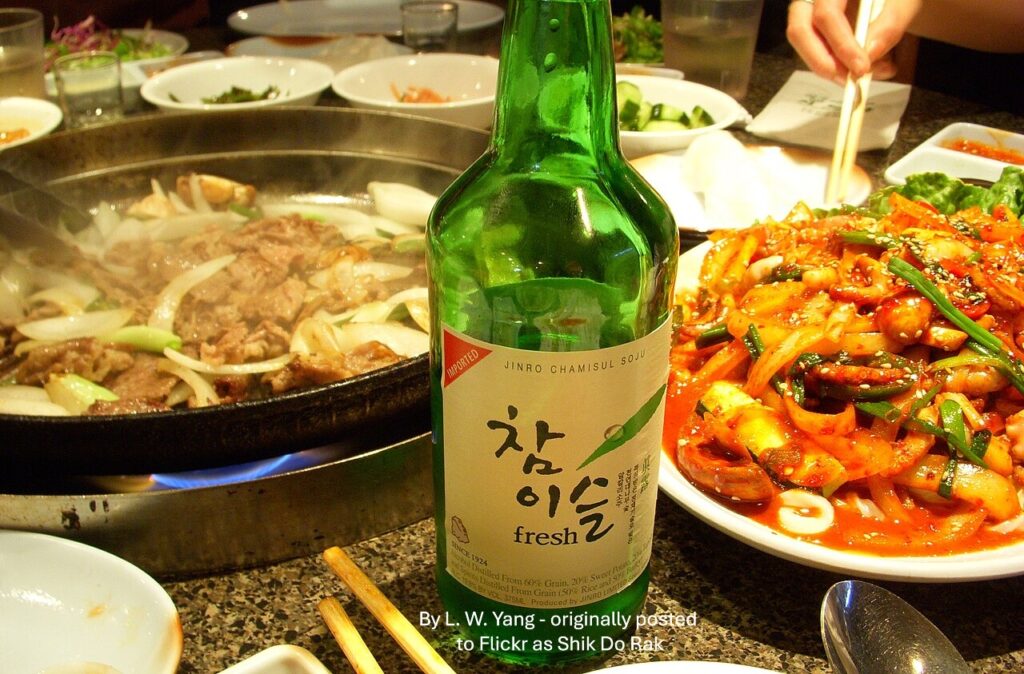
- Soju pairs with spicy and salty foods: samgyeopsal, dakbal (spicy chicken feet), jokbal (pig feet), bossam; the spice is “washed off” with soju
- Makgeolli pairs with jeon (Korean pancakes) and kimchi-tofu
- Beer pairs with chicken (chi-maek) or pizza (pi-maek)
- Anju can be anything: pizza, cheese platter with wine, stew with soju; if you drink alcohol with food, that food is anju
- Korean drinking culture involves rounds: il-cha (first round, real meal like samgyeopsal), i-cha (second round, maybe chicken and beer), sam-cha (third round, dried anju to extend hangout time)
- Nunchi drives the round system: you don’t monopolize one table for hours; you move to give the restaurant space
- Third-place culture: small apartments mean Koreans socialize outside the home
- Hoesik (company dinners) often feature “safe” anju like samgyeopsal that everyone likes
- Jeju anju leans toward fresh seafood with soju; beachside pocha (pop-up bars) serve raw seafood at night
- Hunting pocha: bars in Seoul (Hongdae, Itaewon) where groups of young people meet other groups; age-restricted (under 30)
- Banju: eating a regular meal with alcohol simultaneously (common among Jeju farmers and fishermen)
- Sora’s favorites: fish cake soup with soju, kimchi-jeon with makgeolli, dried squid with beer
Next Steps
- Plan your Jeju trip http://vamosajeju.com/comfortat vamosajeju.com/trip
- Sign up for the 14-part email series at vamosajeju.com/start
- Follow Vamos a Jeju on Instagram, TikTok, or YouTube.
- Share the episode with friends to help the podcast grow
- Visit vamosajeju.com for articles, videos, and resources
- Leave a one-sentence review to help others discover the show
- Related Reading: vamosajeju.com/comfort
Episode Transcript
What Is Anju?
Ed (00:18) So I’d like to welcome everyone to today’s episode of the Vamos a Jeju podcast. And I thought I would like to use today’s episode to my advantage because as a person who speaks some Korean and who reads Korean, I’ve always been confused when I go into a restaurant with this category of food on the menu called Anju.
Soraya (00:21) Okay.
Ed (00:44) And it’s confused me for three years now and today, today I’m finally gonna figure out what the heck it is with the help of my friend, the fabulous, absolutely awesome, Sora! Say hello, Sora!
Soraya (00:59) I’m the expert of Anju.
Ed (01:00) So today, she’s the expert of all things alcohol. So I know Anju has something to do with alcohol, but as a person who doesn’t drink, I am absolutely clueless what Anju is. So Sora, can you tell us what the heck is Anju?
Soraya (01:43) I looked it up in the dictionary and actually I was very surprised by its meaning. 안 means hold down, and 주 means alcohol. So it’s like hold down the alcohol. So I think it means like to hold down the alcohol to drink more or like drink safely. But I think these days anju is more like food or snack you pair with certain alcohol. Like soju with certain food, maekju with certain food, like this kind of stuff.
Ed (02:26) And then in some of these places, there will be little shops where they will take those dried squid, roll them so that they get flattened, grill them, and then you eat them. And I’ve seen people eat them with beer. Is that Anju?
Soraya (02:42) Yes, it is. We call it actually 마른안주 (mareun-anju).
Ed (02:46) Okay, so Anju is not a thing that you do only in restaurants?
Soraya (02:51) No, everywhere you can do. Actually, we do a lot in convenience store. When you buy like convenience store…
Ed (02:56) What, pyeonuijeom?
Soraya (03:02) So from convenience store we usually buy beer with dry Anju. For example like you said the dried squid or like fish jerky or like nuts or can be just potato chips.
Ed (03:18) So I guess Anju is less about a specific food or a specific type of alcohol. Anju is almost a cultural thing that Koreans do.
Soraya (03:26) Yes, exactly.
Ed (03:27) Mind blown.
Soraya (03:28) Actually, we do dry Anju for like samcha.
Ed (03:34) Samcha will be the third round.
Soraya (03:35) Usually, 1st round, we do like real food like samgyeopsal with soju. And round 2, we go like maybe chicken and beer. And then round 3, we’re so full we can’t eat more but we want to stay more. Then we order like dried squid. So meaning that we are going to stay there at least one or two hours more with just dried Anju.
Drinking Rounds and Third-Place Culture
Ed (03:57) Okay, so just from that last few sentences that you said, you’ve actually hinted at several things I know about Korea. And the first is that you said the third round, so it’s like a round one, round two, round three. So it’s like, you might think that Koreans just eat food, but no, no! They eat, drink and then they eat and drink again at a different place and then they eat and drink again at a third place. There’s usually two or three rounds. So that is something to think of.
And then another thing that it alludes to is that a lot of people in Korea or rather in big cities like Seoul, they don’t live in big places. So oftentimes the place where they live is very, very small and is often not equipped to get together. So the concept of a third place in Seoul is very common. A lot of people meet their friends in third places. And so if you want to hang out for a long time you got to just keep going to another place.
Like therefore explains the whole il-i-sam-cha culture. Another dimension to that is that of nunchi. Like you cannot just go to the first place, buy your food and stay there for like four hours or three hours. Like the restaurant owner will be so upset with you. And so you have some nunchi to keep moving on. And so you’re kind of like moving on among your friends to different places
so that you’re not just monopolizing one table in one place for four hours. That would drive the restaurant boss crazy.
Soraya (05:21) But I mean it’s okay if you order more food. The owner will be okay. But I think Korean people we like to change the place. We don’t want to stay in that place for a long time. I don’t know why but it’s just we just do it always.
Ed (05:34) I see. So Anju is not just food. It’s a whole way of looking at how you can spend as much time as possible with your friends, I guess?
Soraya (05:51) Right. I think also we choose different Anju for different events or different relationship. So if it’s 회식 (hoesik) then maybe we go somewhere like very safe like everyone likes samgyeopsal or chicken. Like safe choice. So usually we go this kind of Anju for 회식 like company gathering. Or if it’s like friends then maybe you choose something your friends like. Or if it’s a new… with wine, fancy Anju. Cheese!
Ed (06:32) So it’s not just Korean alcohol, it can be like Western alcohol too. Okay. So wine and cheese is also Anju. What? Wine and cheese? Like a cheese platter with wine is Anju? What?
Soraya (06:36) Cheese is anju. Cheese platter is anju, of course.
Classic Pairings — Soju, Makgeolli, Beer
Ed (06:47) So wait, so pizza and beer is also anju?
Soraya (06:50) Yes.
Ed (06:50) Oh my god, okay, and the anju refers to the food part, right? Not the alcohol part, right? Okay, so the pizza is anju, if you drink it with beer, and the cheese platter is the anju, if you have it with wine.
Soraya (06:51) Mm-hmm. Mm-hmm.
Ed (07:04) Whaaaat? I’m so confused but I’m getting less confused. I’m getting less confused. You’re teaching me about Anju. Wow, this is fascinating. Like, for the audience, normally I do a lot of research coming to this but we just decided to do this Anju episode like maybe 15 minutes before we recorded it so I have zero preparation.
Soraya (07:06) Are you okay? What? Fascinating.
Ed (07:30) But… Wow, this is amazing. Okay, cool.
Soraya (07:31) Hmm. So other thing like other pairing we do is like usually dry Anju we talked about now, it’s for you know, beer.
Ed (07:43) Okay.
Soraya (07:44) But for Soju, we usually have spicy and salty food. Like samgyeopsal or dakbal, like spicy chicken feet. Or like jokbal, bossam.
Ed (07:48) Mmm, yes. Yeah, so jogbal is like pig feet. And dagbal is chicken feet. So if we’ve not lost half of our audience already, it’s a thing that is eaten in, I was going to say Korea, but they eat that in China as well.
Soraya (08:11) Make it very very very spicy.
Ed (08:14) Yes, spicy and salty. And so that goes with Soju? Okay.
Soraya (08:17) Soju, right? Because if it’s spicy, we say the food is too spicy, you can wash off with Soju. That’s what we really, really say.
Ed (08:27) Okay, wait, so if I was to go order like a jjigae and I have alcohol with it, does that automatically make the stew an anju?
Soraya (08:39) Can be, yes. Yes, can be.
Ed (08:41) Can be, good. Then I got one more question. If Anju is like a cultural practice in Korea, can you do Anju by yourself? Or must it be with friends?
Soraya (08:50) Yeah, of course. No, by yourself, it’s okay. Yeah.
Ed (08:55) Okay, it feels very sad to be drinking by yourself, but… Okay.
Soraya (08:59) And other pairing we have is that, you know, the traditional Korean liquor Makgeolli.
Ed (09:05) Yes, love it.
Soraya (09:06) So Makgeolli always needs to come with jeon, the Korean pancake.
Ed (09:11) Right, right, right.
Soraya (09:14) Or like kimchi, tofu, tofu kimchi.
Ed (09:18) So how about Chi-Maek? That is… that is Anju. Chi-Maek, confabulation of two words. It’s chicken, which is exactly what you think it is. It’s just fried chicken. And then Maekju which is beer.
Soraya (09:23) Bye, bye, Chi-Maek. Mm-hmm. Also, we have Pi-Maek. Pi-Maek.
Ed (09:34) Pi-Pi-Pi-Maek?
Soraya (09:35) Pizza and beer.
Ed (09:40) Okay. Wow. So since this show is Vamos a Jeju, is there any difference between how Anju is done on the island versus on the mainland?
Anju in Jeju — Seafood, Pocha, and Banju
Soraya (09:51) I think in Jeju we have more seafood for Anju. Like fresh seafood. And those fresh raw seafood always comes with Soju of course.
Ed (09:56) That makes sense.
Soraya (10:02) So I think most of the Anju culture is similar to mainland Korea. But in Jeju, we have more pop-up restaurant or bar. Like we call it pocha in Korea. So like, in the daytime, there’s no bar. But at night, they will put like many tables and chairs, like plastic chairs. And then the bars pop up there.
Ed (10:18) Yeah.
Soraya (10:26) But I mean, sometimes we have it like right in front of the ocean or beach. And so it’s really… romantic having Soju and raw seafood together with your lover.
Ed (10:37) So I have so many questions like eating raw seafood with alcohol and your lover. What?
Soraya (10:46) I mean your fiancé.
Ed (10:47) Okay.
Soraya (10:48) Yeah, yeah, what do you mean?
Ed (10:51) I mean…
Soraya (10:52) What do you mean? Because I mean… Because I mean, I actually… I mean, you know that in Korea we have like hunting pocha. You know that. Like in Hongdae, Itaewon, there’s many hunting pocha. And you know the meaning of…
Ed (10:52) I think it’s… Mm-hmm.
I think I know the meaning but I don’t think everyone who’s listening to us knows what hunting pocha is. Maybe you should tell us what it is.
Soraya (11:12) Mm-hmm. So hunting is like hunt. So you hunt a girl or a boy that you like. So you go and approach and ask them like, do you want to drink with us? Like that.
Ed (11:22) Okay. Okay. A pickup, right? And you said us, plural, which means oftentimes it’s like two groups of people.
Soraya (11:42) Yes, oftentimes it’s like three boys will try to find like three girls or like if it’s four boys they will try to find four girls group so they can match all together.
Ed (11:55) I see. Okay, so it is not like three guys and one girl which will be not safe for the girl. Yeah, because hunting sounds very aggressive.
Soraya (12:01) No, it’s weird. Usually those places only for under 30 years old. So I can’t get in as well.
Ed (12:13) Wait, wait, wait, wait. So the hunting pocha. They check IDs? They check your ID?
Soraya (12:15) Age limit. Yeah, they check ID. Right, yes. And if you’re too old, you can’t get in.
Ed (12:22) So it’s like a… So it’s like a club then.
Soraya (12:27) Yeah. Yes. Pop-up. Usually it’s not pop-up in Hongdae. It’s just a bar or restaurant.
Ed (12:30) But it is a pop-up. It’s like a regular bar. Okay, so they call it a pocha but it is not actually pocha in any way. It is… Okay, I see, I see.
Soraya (12:43) No, it’s actually not pocha, right? They just do like pocha style bar. So these pocha style bars we are talking about is in Hongdae in Seoul. It’s not in Jeju.
Ed (12:56) So that’s the mainland and we’ve come a long way from Anju and eating raw seafood by the water with your loved one.
Soraya (13:03) Mm-hmm.
Ed (13:07) How else is it different with Anju culture in Jeju and the mainland? Is it mostly the same?
Soraya (13:14) I think it’s mostly the same but in Jeju we have more like farmer and fishermen. So we have more people doing banju as we talked. Like regular meal with alcohol. Anju, you do drinking after finishing a regular meal. But banju is like just eating and drinking at the same time.
Sora's Favorite Anju Pairings
Ed (13:37) Mm-hmm. Like I said earlier, this is such a foreign concept to me because I don’t drink very much. I drink very, very occasionally. So I really have to ask you, Sora. What are your three most favorite kinds of Anju situations?
Soraya (14:00) So I would say there’s no top three. There is like favorite for each liquor, each alcohol. Soju, my favorite is soup because Soju is too bitter for me.
Ed (14:15) What kinds of soup?
Soraya (14:17) My favorite is fish cake soup. Fish cake soup. Right. For Soju, fish cake soup. And for Makgeolli, I would say like kimchi jeon. Or for beer, squid.
Ed (14:34) Well actually I have had Chi-Maek so I guess if you force me to choose my favorite Anju, which I don’t have a lot of, it will have to be Chi-Maek. Fried chicken with Maekju. Pi-Maek.
Soraya (14:39) Mm-hmm. Mm-hmm. Mm-hmm. You should try the dried squid.
Ed (14:51) Okay, I don’t drink a lot so like, when Michele and I went for Chi-Maek we shared one beer.
Soraya (14:54) Yeah, me neither. I don’t drink a lot. It sounds like I drink a lot. It sounds like… No! One small beer. Whoa.
Ed (15:12) Yeah, so like we had the chicken and then we had a hard time finishing one beer. The restaurant owner was not impressed.
Soraya (15:16) Mmhmm. Not happy. He’s not happy.
Ed (15:22) Yeah, he was like, ugh.
Wrap-Up and Next Steps
Ed (15:25) So I guess today’s episode can be called, Sora Teaches Ed About Anju Culture.
Soraya (15:25) Mm-hmm. Today we talked about like anju for like many different kinds of alcohol. But the main thing, the most important thing is that anju is like… are you going to spend your time? Like, on Anju, we know how long we are going to stay there.
Ed (15:51) So today we’ve learned all about this Korean culture that is quite unique to the peninsula. And that’s Anju. Going into today’s recording, I had thought that Anju was basically a kind of food that you eat with alcohol, but as Sora has shared with all of us, Anju is a lot more than that. It really is a way for people to connect and to form deeper bonds. And also have a good Korean… realities of it being challenging to host activities in the home. And therefore this idea of third places where Koreans hang out with each other outside their home has come to the forefront and nothing else represents this better than the culture of Anju.
Sora (16:42) One more thing. Did you know it’s very easy to share our show with your friends? On Apple Podcast, just tap on the horizontal three dots on the top right corner and tap on the share show icon. And on Spotify, you can find the three horizontal dots near the top right under our show art and you will see the share icon.
Ed (17:04) Yup, and with that, all that’s left for us to do is to say… Annyeong!
Sora (17:08) Bye!
