The Free Show, the Coastal Villages & the Best Times to Go
You came to Jeju for the volcano, the tangerines, and the coastline. But the thing you’ll still be talking about a year from now is the moment you watched a woman in her eighties walk into a cold sea with nothing but a wetsuit, a float, and a lifetime of breath control, and disappear under the surface for a minute at a time.
The haenyeo (해녀, literally “sea women”) are Jeju’s free-diving grandmothers, and seeing them is one of the few irreplaceable things left to do on the island. The catch: there are now fewer than 3,000 of them, most are over 70, and they dive on the tide’s schedule, not a tourist’s. So “where do I see haenyeo on Jeju?” is a fair question, and the honest answer has a few layers. Below is where to look, what’s free, what’s worth booking, and how not to be the person who treats a working grandmother like a photo prop.
New to the haenyeo? Read the backstory first (The Last Chapter of the Jeju Sea Women Story) then come back here for the how-and-where.
The quick answer
| If you want to… | Go to | Costo | When |
|---|---|---|---|
| A scheduled performance | Seongsan Ilchulbong beach | Gratis | Daily ~2:00 pm (weather permitting) |
| Real haenyeo at work | Coast villages | Gratis | Usually early morning, but tide-dependent (물때) |
| The full story | Haenyeo Museum, Hado-ri | ₩1,100 adults | Daily except Mondays |
| A play/art + a meal of their catch | 해녀의 부엌 (Haenyeo’s Kitchen): Jongdal or Bukchon | Paid, book weeks ahead | Show days vary |
| To get in the water yourself | A booked haenyeo experience | Paid | by arrangement |
| Actually meet a haenyeo (not just watch) | A small, private meeting I run on Jeju as a guide | Paid · by arrangement | Available: email me (full program launching soon) |
Now the detail.
1. The free haenyeo show at Seongsan Ilchulbong
This is the answer most people are looking for, and the best part is that it’s free.
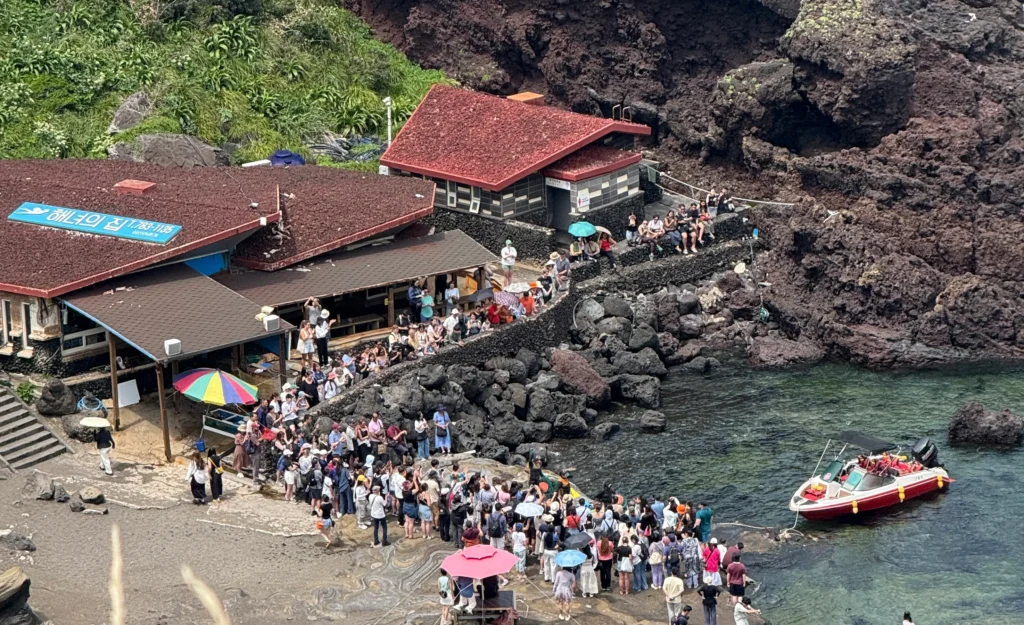
At the foot of Seongsan Ilchulbong, the dramatic tuff cone on the east coast, a small group of veteran haenyeo gives a daily demonstration on the beach below the peak. At the time of writing it runs once a day, around 2:00 pm, weather permitting, and you do not need a ticket to the Ilchulbong peak to watch it. Take the open path to the left of the main entrance and walk down the steps to the little cove.
What you get is about twenty minutes of the real thing: the women sing 이어도 사나 (Ieodo Sana), the rowing-and-working song haenyeo have passed down for generations, then they actually go in and dive, what they call 물질 (muljil), the work of harvesting by breath alone. Listen for the 숨비소리 (sumbisori): the sharp, almost bird-like whistle they make exhaling as they surface, releasing a minute’s worth of held breath in one breath out. The performers are usually in their 70s and 80s, which is the point. This is not a costume show by twenty-five-year-olds.
How not to miss it:
-
- Be at the parking lot by 1:30 pm. The walk down takes a few minutes and the good spots fill up.
-
- It’s outdoors and weather-dependent. High wind or rough seas cancels it, and the divers’ safety always wins. Don’t build your whole day around it: pair it with the Ilchulbong sunrise climb (see our complete Seongsan Ilchulbong guide) so the trip is worth it either way.
-
- Schedules shift with the season and can change without notice. Confirm that morning and ask your guesthouse or the Seongsan ticket booth (T. 064-783-0959).
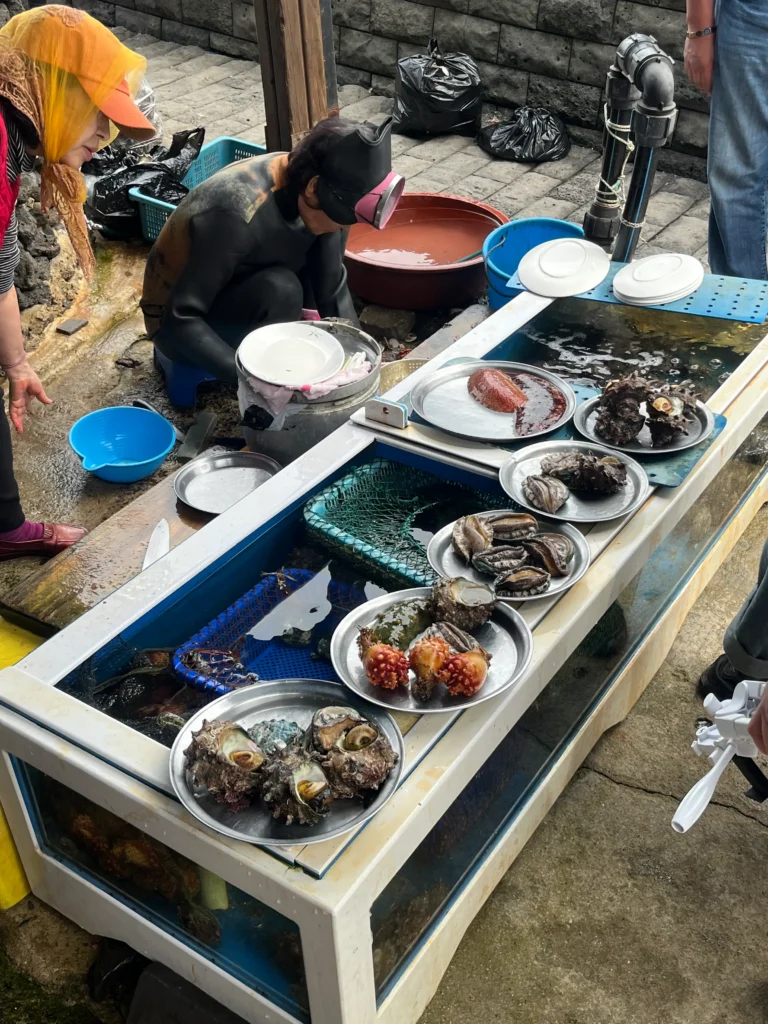
After the dive, the haenyeo usually sell what they just caught, like 성게 (seonggae, sea urchin), 소라 (sora, conch), sometimes 전복 (jeonbok, abalone), straight off the rocks. Buying a plate is the best “tip” you can leave. (More on this in Eat What the Haenyeo Catch.)
2. Catching real haenyeo at work (not a show, just life)
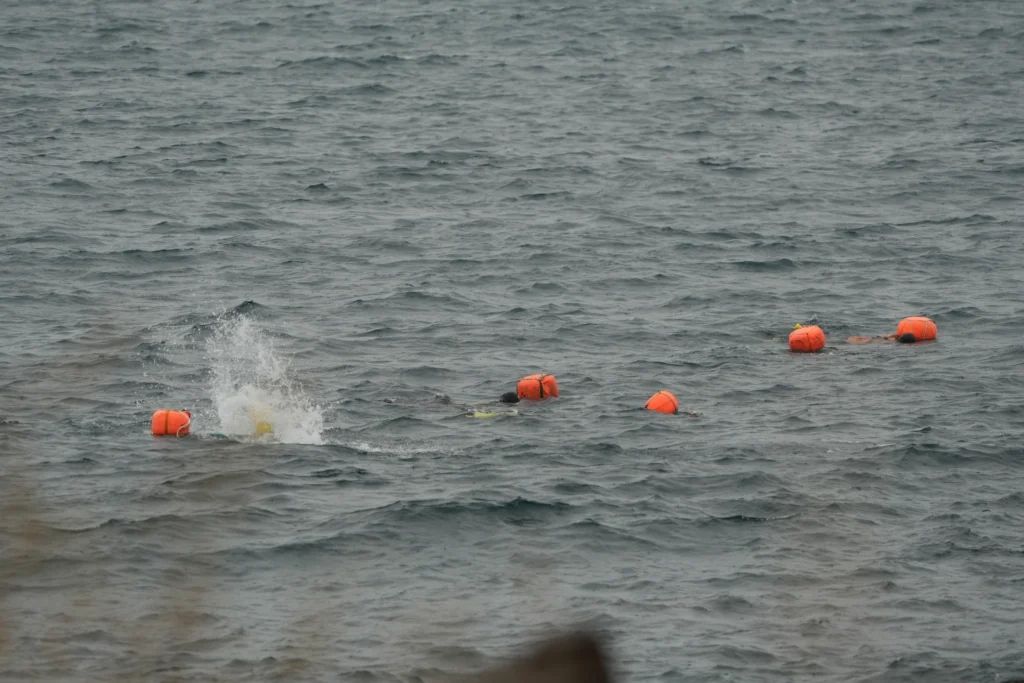
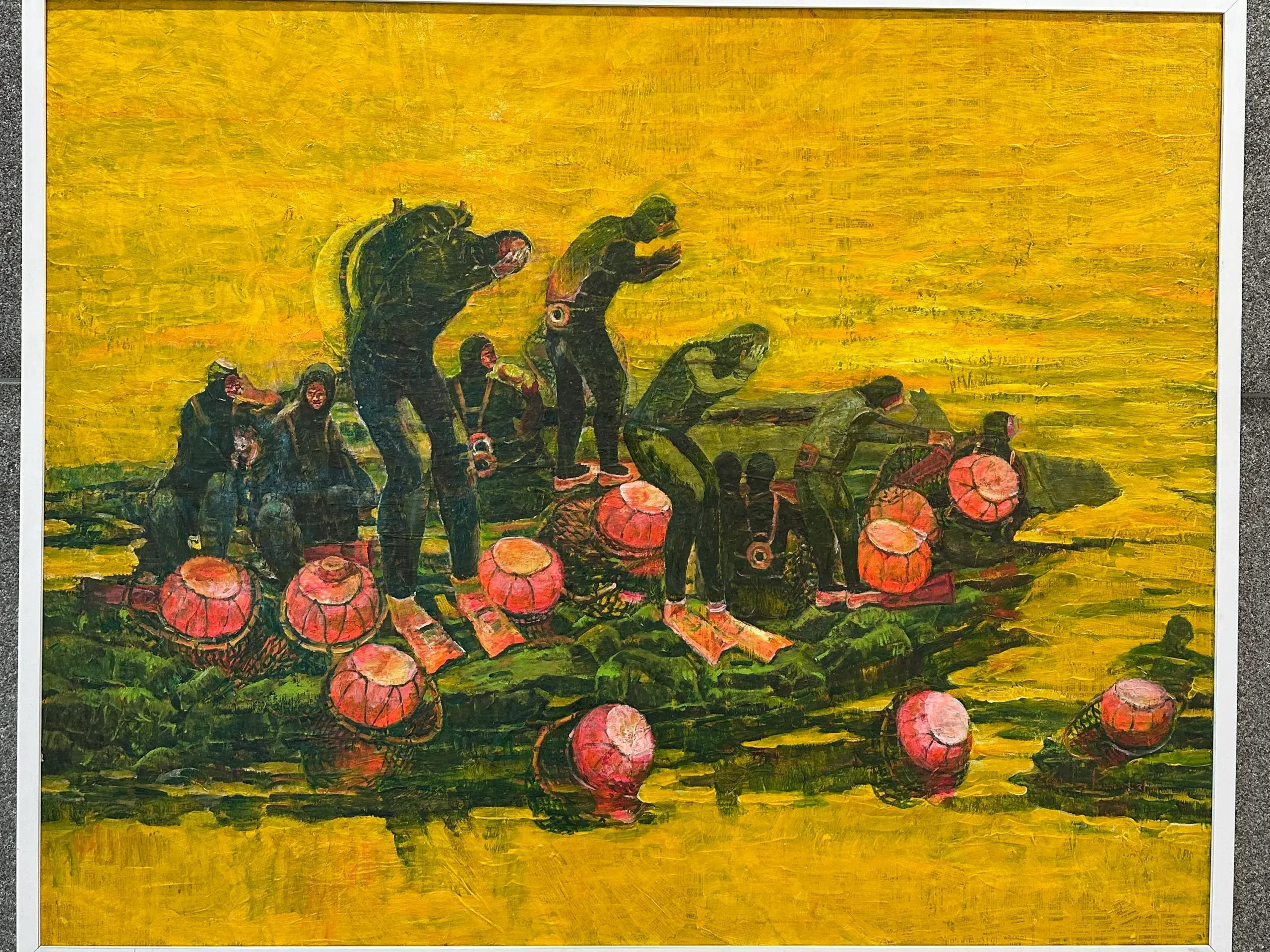
The show is reliable; the real thing is unpredictable but unforgettable. Haenyeo dive from the 불턱 (bulteok), the low stone shelters where they change and warm up by a fire, in fishing villages all around the island. When they’re out, you’ll spot orange floats called 테왁 (tewak) bobbing offshore, each trailing a 망사리 (mangsari) net bag, and women in black wetsuits hauling their catch up the rocks.
The east coast is your best bet. The villages of Hado-ri (하도리), Sehwa (세화), y Jongdal (종달) still have some of Jeju’s most active haenyeo communities. Drive the coastal road early in the morning, look for the bulteok and parked scooters with diving gear drying outside, and you may get lucky. Just know there’s no fixed timetable: their hours follow the 물때 (multtae, the tide) more than the clock, so it varies day to day. Check a Korean tide app (Badatime, or Naver Weather) and ask locally, and treat any sighting as a lucky bonus, not a guarantee.
A few hard rules so you’re a good guest:
-
- Don’t crowd the water’s edge or get between a haenyeo and her exit from the sea. She is working, cold, and carrying a heavy load.
-
- Ask before photographing faces. A wide shot of buoys on the water is fine; zooming into a working woman’s face without permission is not.
-
- Buy something if they’re selling. It’s their income, not your backdrop.
If that makes you wonder why these women still do this and what’s at stake, that’s the whole story. We go deep in Jeju Shamanism: Haenyeo, Persecution & the Future.
3. The Haenyeo Museum (when you want the why)
If the weather kills the beach show, or you just want context before you watch, the Jeju Haenyeo Museum (제주해녀박물관) in Hado-ri is the move. It lays out the whole world of the sea women: the evolution of their gear, the bulteok social system, the diver ranks like the 상군 (sanggun) for the most skilled, down through 중군 and 하군, and the political fire of 1932, when Jeju’s haenyeo led one of the largest women-driven anti-colonial protests in Korean history.
-
- Address: 26 Haenyeobangmulgwan-gil, Gujwa-eup (Hado-ri), Jeju-si
-
- Entrada: ₩1,100 adults / ₩500 youth (free parking)
-
- Closed Mondays and major holidays (Seollal, Chuseok). Last entry ~1 hour before closing.
-
- Allow about an hour, and climb to the rooftop observatory for the Hado-ri coast view. Pair it with the nearby villages so the museum and the real divers reinforce each other.
It’s the difference between watching a haenyeo and understanding one.
4. Dinner with a story: 해녀의 부엌 (Haenyeo’s Kitchen)
For something between a museum and a meal, 해녀의 부엌 (Haenyeo-ui Bueok, “Haenyeo’s Kitchen”) pairs the divers’ catch with live storytelling. There are two locations, and they’re different experiences:
-
- Jongdal (종달점): a renovated old fish market turned into a small theater. You watch a play about haenyeo life, then sit down to a generous buffet of seafood the local divers actually harvested. Intimate (~40 seats), warm, a little tear-jerking.
-
- Bukchon (북촌점): a more polished, media-art room with a fine-dining-style course built around the same haenyeo ingredients. Same heart, dressed up; better if you want a special-occasion dinner.
Both run at high satisfaction and book out often, so reserve weeks in advance through their site. Either is a strong rainy-day or evening plan after the 2pm show.
5. UNESCO, and why “see them while you can” is literally true
The culture of Jeju haenyeo was inscribed on UNESCO’s Intangible Cultural Heritage list in 2016, precisely because it’s fading: the divers are aging, the sea is warming, the catch is shrinking, and few young women take it up. The 2024 Apple TV+ documentary The Last of the Sea Women put all of this in front of the world. If that film is what brought you here, read our viewer’s guide for where to find the real thing after the credits.
In 20 years, the 2pm beach show may not exist. Seeing a haenyeo in 2026 is a privilege with an expiry date.
A personal note
Why this matters so much to me is that I’m in the water with these women right now, training at a haenyeo school here on Jeju, spending a season learning to equalize, to read the swell, and to dive beside grandmothers who’ve done it for fifty years. Some mornings I surface gasping after forty seconds while a woman two times my age slips back down for her thirtieth dive of the day. It is the most humbling thing I’ve done.
I also guide here in English, and I kept hearing the same quiet wish from travelers: “I don’t want to just watch a haenyeo from the rocks, I want to actually meet one.” So now I make that happen. A few people at a time, never a tour bus: we sit with a haenyeo, she tells her story in her own words, and we share what she pulled from the sea that morning.
I’m shaping these meetings into a proper program that’ll go live here on the site soon. If you’d like to join one while you’re on Jeju, or simply hear when it opens, write to me at soraya@vamosajeju.com. Come meet them while they’re still here. You won’t forget it, and neither will I.
