Reproducir episodio
Resumen del episodio
Ed has been waiting 22 episodes to talk about his favorite mountain in the world: Hallasan, South Korea’s tallest peak at 1,947 meters.
This episode breaks down everything visitors need to know about climbing Hallasan, from the two summit trails (Gwaneumsa and Seongpanak) to the two partial trails (Eorimok and Yeongsil) for those who want the experience without the full commitment.
Ed shares his hard-won lessons about wet rocks, knee braces, and the humiliation of being passed by children and seniors on the descent, while Sora reveals she climbed to the summit solo on a snowy November day and made friends along the way.
Puntos clave
- Hallasan is the tallest mountain in South Korea (1,947m) and a bucket-list climb for Koreans; about 900,000 people climb annually
- Two summit trails (reservation required): Gwaneumsa (north, shorter but steeper, many rock stairs) and Seongpanak (east, longer but gentler, more forest); 1,500 spots per day total (1,000 Seongpanak, 500 Gwaneumsa)
- Book on the 1st of the month for the following month; weekdays are easier for visitors since Koreans tend to book weekends
- Recommended strategy: climb up Gwaneumsa (steep but faster), descend via Seongpanak (longer but easier on knees); you must start from your registered trailhead but can descend either way
- Time cutoffs: must pass checkpoints by certain times (varies by season, roughly 11:30am-12:30pm for checkpoints, 1-2pm to leave summit); start by 7am at the latest, 5am is better
- Two partial trails (no reservation): Eorimok (longer, wooden decks, famous for autumn foliage at Eorimok Gyegok) and Yeongsil (shorter, steeper, famous for 500 rock formations called the “500 sons of the goddess”); both meet at Witsaeoreum
- No convenience stores in the park; bring all food and water; bathroom water is not confirmed potable
- Koreans bring thermos flasks to make ramyeon at rest stops; at altitude, water boils at a lower temperature so noodles don’t fully cook (this is apparently the point)
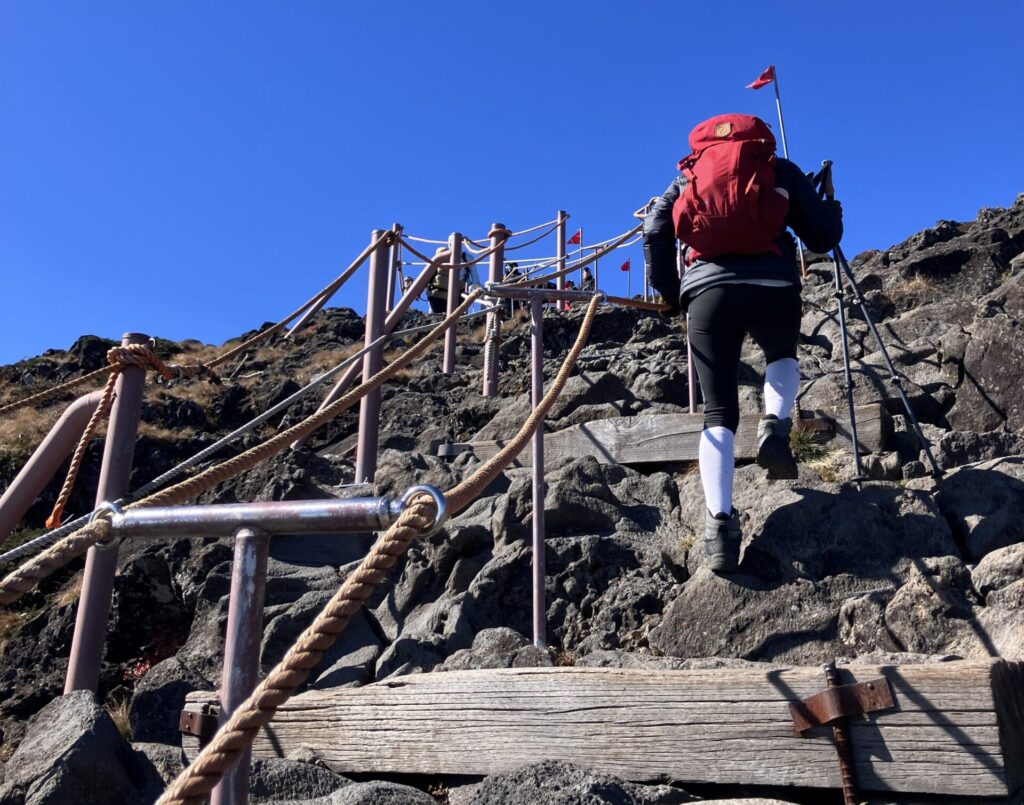
- Gear: hiking poles, knee braces (especially for descent), crampons in winter; wet volcanic rock stairs on Gwaneumsa are treacherous
- Bus 240 connects Jeju City to Eorimok, Yeongsil, and Jungmun (once per hour), but plan a 30 minute hike from the bus stop to the trailheads
- Koreans are friendlier on hiking trails; strangers share snacks and encouragement (파이팅!)
Próximos pasos
- Plan your Jeju trip http://vamosajeju.com/comfortat vamosajeju.com/trip
- Suscríbase a la serie de 14 correos electrónicos en Vamos a Jeju.com/comenzar
- Sigue a Vamos a Jeju en Instagram, TikTok, or YouTube.
- Comparte el episodio con tus amigos para ayudar a que el podcast crezca.
- Visita vamosajeju.com para artículos, videos y recursos
- Leave a one-sentence review to help others discover the show
- Related Reading: Hallasan: lo que todo visitante de Jeju debe saber
Transcripción del episodio
Why Hallasan Matters to Koreans
Sora (00:00) Hello everyone! Welcome to Vamos a Jeju Podcast. So today we’re gonna talk about the mountain, the majestic volcanic mountain in Jeju Island, which is whose favorite mountain in the world. I will… say hello to everyone Ed, please.
Ed (00:21) Ed, please. Yeah, so yeah, mean, just as I’ve been waiting many episodes to talk about the Jeju Olleh Trail, I have been waiting even more episodes to talk about Hallasan.
Sora (00:23) Please, say bye.
Ed (00:36) It took us 20 episodes to get to talking about Hallasan because even though Hallasan is beautiful to look at and it’s so majestic and it’s so important for Jeju’s geography and culture and all that. The truth is not many people would want to come to Jeju to climb Hallasan. It is a very major commitment. It is very tiring, it is a very major commitment and it is quite a lot of effort. And honestly, when I was climbing Hallasan, most of the people that I saw climbing were other Koreans. There were obviously tourists as well, but most of them were Koreans. Has that been your experience as well, Sora?
Sora (01:16) I mean, it takes like one full day. So, of course, it’s hard to like put one full day for tourists because usually they come here for like just three or four days and then one day only for hiking. I think if you’re not a hiker, maybe people would not do that. But for Korean, mainland Korean, they come to Jeju to hike. And of course there’s a lot. I just look it up and then it says like annually 900,000 people climb to Hallasan mountain. So every day is like around like 2,000, 3,000 people is going there. And then for visitors, like for foreigners, it’s hard but I’ve seen some foreigners during my hiking on Hallasan and then also like as a tour guide there are some demands as a mountain trekking guide as well.
Ed (02:17) Right. So I guess for today’s episode, we are going to help our audience get a sense of how it might be like to climb Hallasan. We realized that today’s episode may not be for everybody, especially the full actual summit. And so the good news is there’s actually two options. One option. There are actually two options and both options have two trails each. The main option that most people talk about when they say we’re going to climb Hallasan is the summit trails. And there are two trails that lead to the summit, but you don’t have to go all the way to the top. There’s another set of trails. There’s another two trails that go only part way up to the mountain and so that one is going to take a little bit less time and it’s going to be less difficult. So if you are thinking of at least climbing some part of Hallasan, this option may be great for you. But if you do want to climb up all the way to the summit, highly recommended. And so today we’re going to break it down how to do either the full summit or the part summit.
So before we get into the nitty gritty of climbing Hallasan and covering all the logistical details and all that, I guess let’s take a couple of steps back and help us understand why so many Koreans climb Hallasan? You mentioned earlier, there’s over 900,000 a year and most of them are from Korea. I guess, yeah, walk us through what, why Hallasan is such an in demand mountain to climb for Koreans.
Sora (03:53) First of all, Hallasan Mountain is the tallest mountain in South Korea, 1,947 meters above the sea. And it’s because it’s the tallest mountain in Korea. So of course it’s meaningful for Korean people and also has like spiritual significance. And especially for hikers, usually they have their own bucket list to go to like all of these mountains inside South Korea and also outside South Korea and of course the number one bucket list inside South Korea is Hallasan mountain. So yeah I think that’s why people always want like say I want to go to Hallasan one day, I want to go to the summit to see Baengnokdam, the pond up there.
Ed (04:42) I believe you’re talking about the little pond that’s at the top of the crater, but it’s not always there.
Sora (04:49) No, no, only in summer, only in summer. When it rains hard, then we have the pond, but usually no.
Ed (04:56) Okay, so it’s only there in the summer, you said?
Sora (04:58) Not only but like after the rain.
Ed (05:00) I see, I see. But it is not just looking into the crater, right? It’s also like the views from… I just remember the views being so spectacular because like, depending on where you’re standing, you see sometimes like all the way to the south coast, can see Seogwipo City. You can see all the way east to… I believe I could even see Seongsan Ilchulbong. If you’re going up to the north side, you can see Jeju City. So it’s really spectacular. It’s not just looking into the crater, but it’s looking out from the mountain. And then also the approach to the summit is also breathtaking.
Ed (05:36) Yeah, I think even though I’m not Korean, Hallasan has become like my favorite mountain that I’ve ever climbed. Every time I’m on Jeju, one of the first things I do every day is to look out the windows and look for Hallasan. And if it’s rainy or it’s cloudy and I can’t see the mountain, I get a bit grumpy. I cannot explain it. This is totally irrational. I have no explanation for why I feel that way.
Ed (06:00) That I’m not joking. Hallasan is my favorite mountain in the world.
Weather, Wind, and the Views from the Top
Sora (06:07) You told me like you’ve seen like all the spectacular view from the summit but when I got there, it was cloudy, cloudy, cloudy. I couldn’t see anything so it was very difficult to see the crater as well. But the thing is the weather changes very fast so what I want to say is go up early and so that you can wait and then you can spend some time on the summit. So if it’s cloudy, you can wait for a while to change.
Ed (06:39) Right. And we can talk about the details later. But I do remember when I went up there, I think part of the reason why it was not cloudy was that the wind was really strong. I’m sorry, the wind was very strong. It was, I don’t know, was it strong for you when you were there or?
Sora (06:51) It was strong. I think it’s always strong near the top part.
Ed (07:00) Okay. Okay. Yeah, the top was crazy strong. It was… I remember calling Michelle and it was hard to talk because the wind was so strong. And you know, it’s not the same when you’re watching your husband trying to show you the majesty of Hallasan through a phone. It’s like, what is this? This doesn’t look so impressive. It’s very different.
Sora (07:22) This is windy.
Ed (07:24) Yeah, yeah. So one thing I noticed is that some Koreans bring their children, you know, like 8 years old, 10 years old. They’re not… I was quite surprised to see there wasn’t a lot of children, but there was enough children for me to go like, kids, even kids climb Hallasan.
Sora (07:43) Because I think the parents are hikers and then they were trained to be a hiker at that age. So yeah, it’s not easy for the kids but what they can do.
Ed (07:56) So earlier you said that there was about like 900,000 a year and that breaks down to about two to 3,000 a day. Not all of that is to the summit, right?
Sora (08:07) Mm-hmm. To go to the summit, actually you need to register yourself on the website of Hallasan. And to go to the summit, there’s two different trails. One is Seongpanak and the other one is Gwaneumsa. And for the Seongpanak, like every day, only 1,000 people can register and go inside. And then Gwaneumsa, the other one is 500 people maximum every day. And actually you can start, you can start making reservation from the first day of the month for the next month. So if you want to go in February you need to book it on January 1st because I mean we have like enough space but during like winter or like summer, fall, now every season, it’s very popular. So people wait to make a reservation like a concert ticket. So sometimes even if you want to go to Hallasan you can’t get in because it’s hard to book a registration.
Ed (09:12) Right, but that is… When you say people, that’s not… It’s Koreans. Koreans will wait on the first day of the… the earliest possible day and then to reserve. But for the rest of us people, like, rest of us visitors, we don’t… I guess our advantage, Sora, is that we can look for the off-peak times.
Sora (09:36) Mm-hmm, mm-hmm, right.
Ed (09:36) Because most Koreans will try to go on a weekend like they fly out from Seoul or Busan and then they do the climb and go back home again. So our advantage is to try and find a weekday and yeah I think that might work. Right.
The Two Summit Trails — Gwaneumsa vs. Seongpanak
Ed (09:53) And so you mentioned earlier Gwaneumsa which is kind of on the northern edge of the Hallasan National Park and then also mentioned Seongpanak which is on the eastern edge of the National Park. Could you talk us through what are the differences between these two trails that go to the summit?
Sora (10:12) So, Gwaneumsa and Seongpanak both are going to the summit. The main difference is that Seongpanak is a little more long, less steep. But Gwaneumsa is shorter, a little more steep, and a lot more stairways. So it’s up to you. So for my recommendation, what I do is I go up from Gwaneumsa, more steep one. And then when I came down, I come down with Seongpanak because I don’t want to go down with too many stairways.
Ed (10:47) Yeah, actually I made a huge mistake. I did the opposite. I went up Seongpanak and then I came down Gwaneumsa and it was a mistake because… Well, I think I didn’t have a choice because I think Gwaneumsa was fully booked. And so it was only available for… Yeah, okay. So it was unfortunate but it was a mistake but I had no choice because there was no other availability on Gwaneumsa. So I went up Seongpanak which is actually you go through a lot of forest in the beginning and it can get a little bit boring. But then when you get to like the last 20% of the climb, it becomes all the forest falls away and now you’re climbing in just, you know, the edge of the volcano. And that’s where if the weather is clear, you can see like all around the island, which is great.
The problem is coming down Gwaneumsa, the shorter and more steep trail, it was challenging because a lot of it, there’s one stretch that’s over a kilometer long. It is just like rocks. It’s like steps that have been carved into the rock, right? And so it’s basically volcanic rock and it is jagged. It is uneven. And unfortunately for me, the previous day had been raining. So the rocks, which is covered by a lot of like trees and shelter, they were wet. It was very time consuming coming down, even with hiking poles because the rocks were slippery and the steps are quite far apart. So they’re not actually regular stairs where, you know, every step is not too bad. This is like some of the difference is quite maybe like what is this, about 30 centimeters? And every step is variable and yeah, so even with all the usual tactics of like, you know, going sideways or coming down in a zigzag manner and using poles, after a while, your knees will start to feel it. And so I noticed a lot of the Koreans actually have knee braces and stuff like that. I was like, man, next time I do Hallasan I’m going to have to make sure I have that because I definitely felt it coming down.
Sora (12:27) It’s very high. Yeah, yeah. Not easy.
Ed (12:50) So yeah, don’t get me wrong, I’m really glad I did it but I would have preferred to go up Gwaneumsa on the north side. And then get to the top and then at the top is where it meets with the Seongpanak trail. And then come down like you did on the Seongpanak trail, which is an important thing to say. Like, if you get your registration from Gwaneumsa, you have to climb, you have to start from Gwaneumsa. And if you’ve got your QR code for the registration from Seongpanak, you cannot go to Gwaneumsa and start there. You have to start from Seongpanak.
One thing I wanted you to talk about Sora is like you have to make good time and you need to get to the checkpoints by a certain time. Can you talk a bit more about that?
Sora (13:36) You have to start from the one you have booked, but going down is your choice. You can come down like any trail you want. You can use the same trail to come down or a different one. Because some people like to bring their car to the parking lot. So if you have a car in the parking lot, you can just come down the same way.
And also for the time planning, actually there’s a certain point that you have to pass before a certain time because there’s no campsite in the mountain so you have to finish the trail on the same day. You can’t sleep there. So from the top, usually the time can be changed but usually like in summer it’s like around 2pm and in winter it’s around 1pm. That’s the maximum. So from the summit, the crater, you have to leave the crater before 1pm during the wintertime.
And then also before the summit, there is one checkpoint which is called Samgakbong. There’s like a beautiful mountain, looks like a triangle. And from that place, usually in the summertime you have to pass that checkpoint before 12 and then wintertime, 11:30. So you have to pass that check. Yes, right. And then there is another checkpoint in Seongpanak, it’s also same, 12:30, 11:30, similar.
Ed (14:59) But that’s for the Gwaneumsa trail, right? Okay. Okay.
Sora (15:11) So it means you have to start at least before 7am.
Ed (15:16) Right, but you can start as early as 5am I think. Yes. Yeah, so it is quite amazing sometimes like, it was quite amazing when I started climbing around 7:30am which is a bit late I think.
Sora (15:19) It’s really late.
Ed (15:35) Yeah, but I made really good time. I was up before 11am. I was fast. But coming down I was very slow. I took more time to come down. This is the first, like of all the mountains I’ve climbed, this is the first time that I took more time to come down than to go up. It was crazy. Like Seongpanak is actually very easy, well, is it very easy to climb? It’s the forest parts are actually very easy.
Sora (15:35) Yeah, you’re running. You’re running? It’s easier. It’s easier than the Gwaneumsa.
Ed (15:57) And because going up, even though the ground is wet, it’s not so dangerous, right? Whereas coming down, I have to slow down because of the wet rocks. And Seongpanak didn’t have as many rocks, you know, it’s like stairs and it’s like a forest walk. Gwaneumsa was like rocky and wet. So I had to take a long time to come down.
Ramyeon at the Summit and Trail Logistics
Ed (16:15) So I want to talk about something that is very, as a foreigner, I found very interesting, very interesting because like people, Koreans like do this whole big thing about making ramyeon at the checkpoints. The place where they check your QR code, there’s like a rest area, that’s like toilet facilities and you can rest there a little bit. But a lot of people will bring up hot water in a flask, a thermos flask, and they’ll make ramyeon there. What is this fascination with making ramyeon? It’s like a bucket list of a bucket list, right? Like you have to do this when you go to Hallasan.
Sora (16:48) Of course, that’s… No, it’s just… it’s just like a typical meal for hiking. I don’t know why but we like to do that. So like when we go to hiking, we always prepare some cup noodle and hot water in thermos and kimbap.
Ed (17:12) Okay, I understand the kimbap. I did that too. The ramyeon though, when you’re at a higher temperature, boiling point is different. So like when you try to make the noodles, it’s different. It doesn’t taste as good.
Sora (17:31) That’s the point. That’s the point. You just experience… I don’t know. Not cooked, not fully cooked ramyeon is the… I don’t know, is the beauty of the meal there.
Ed (17:31) What’s the point? I’m sorry, I’m missing, what’s the point again?
Sora (17:45) I don’t know. Yeah, but it’s like typical typical stuff and but in winter like if it’s cold it’s really really good to have like hot soup. Like we like to have hot soup. So like for Korean meal, we always need one soup with a dish, with the rice. So we always need the soup. I think that’s why people bring hot water and then make soup by themselves like for ramyeon.
Ed (18:11) But then I saw these signs that say like only put half the amount of water and half the amount of the seasoning. I think there was a major issue of like people trying to dispose of their leftover soups, the broth, and it became an environmental issue on the mountain itself.
Sora (18:26) I think so, yeah. I think so. Right, right.
Ed (18:33) It was all in Korean. The signs were all in Korean. So I was trying to like read it slowly. But I think I understood to be like use half the seasoning and half the water and don’t waste. Yeah. Something like that. Yeah.
Sora (18:42) Mm-hmm. Mm-hmm. Right, right. Do not dispose any…
Ed (18:47) So yeah, I understand having noodles on like Jeju Olleh or something because it’s on sea level usually but up in the mountain, up on Korea, South Korea’s tallest mountain is like eee! The noodles will never be cooked near enough to be yummy. It’s just a bit weird. No? Have you done that too? Okay. Okay.
Sora (19:04) Yeah, of course I always do that. We always do that. I am Korean. Yeah, and one more thing, like for those two trails, there’s no… There’s no stores. There’s no small shops, no convenience stores. You need to bring everything you need before you start the hike.
Ed (19:14) Alright. So is the water from the faucets in the bathrooms in the rest areas, is the water potable? Is it safe to drink?
Sora (19:33) I don’t think so. I don’t think so. It’s better not to drink from the bathroom. Of course not. Just bring enough water. Yeah, I think that’s better. I mean if it says like drinkable, but I don’t think there is one faucet with drinkable water.
Ed (19:55) Okay, but water is very heavy.
Sora (19:57) Yeah, that’s true.
Ed (19:59) Okay, so I guess that’s the logistics of climbing up the two trails that go to the top, to the summit. To recap, it is Gwaneumsa on the northern edge of the Hallasan National Park and Seongpanak on the eastern edge of the National Park. And you mentioned earlier, Sora, that while you have to start climbing from the trailhead that you registered from, you are free to come down from either trail once you’re at the summit. And so you said that some people will come back to the same parking lot because that’s where the car is. But you can also just take a taxi or bus back to your car if you choose to come down the other route. Right?
Sora (20:39) Of course, yeah, of course, of course. And for the bus, I think you know better than me.
Ed (20:45) Yeah, yeah, from the Gwaneumsa side, there’s not many buses. It’s like one every hour. So if you’re coming down like me and you’re slower than you expected. And then I was like, oh my bus is at 4:15pm and at 4:10pm I’m still half an hour away. I’m like, Andwae, no! So I had to wait for the next bus an hour and 10 minutes later. It was okay, it’s not a big deal. I just had to go slow after a while. My knees were really hurting. And it was a little bit… I’m not sure if I should say this because I like to maintain a tough guy image but fine, I’ll say it.
So coming down, my right knee was in so much pain that like people were passing me, like even old people were passing me and I will be like pretending to check my phone for the map or pretend to take a photo because it’s so embarrassing. Like everyone, little kids are passing me, old people are passing me, everyone is passing me. It’s like I felt so humiliated. It’s like my gosh, I got my ass kicked by Hallasan coming down this thing.
Sora (21:36) ⁓ no.
Ed (21:50) I was like, they all have like knee braces. Man. I really needed knee braces on that trip. But yeah, it was… Yeah, good thing there was no one I knew who saw me. It would have been very embarrassing. And now my secret’s out. Now my secret’s out. Everyone knows now.
Sora (22:04) What are you doing here? Okay, next time just don’t forget bring your knee braces.
Ed (22:12) Knee brace. Yeah, I actually when I got back to my hotel near Dongmun Market, I went to a yakguk, pharmacy. I went to yakguk and I bought my knee brace and I wore it for the next two days. So it was terrible. It is unusual for me, like normally it’s going up is longer than coming down and usually coming down is like, okay, no problem. I don’t know. I underestimated Gwaneumsa coming down. I should have gone up, but I couldn’t have. Okay. No choice.
The Partial Trails — Eorimok and Yeongsil
Ed (22:46) But speaking of no choice, like if I hadn’t been able to have gotten like any registration QR code from either Gwaneumsa or Seongpanak, then what do I do?
Sora (22:57) There is another trail and actually you don’t need reservation for those two trail which is called Eorimok and Yeongsil. And I went up these two trails with my mom. So because it’s shorter and you can still see like beautiful views around it. Because these two trails is not gonna go to the summit, but it’s gonna go to like Witsaeoreum, another small mountain. And also you can see the wall of crater, Baengnokdam as well. And it is also beautiful. So if you have like less time, those two trails you can do in like four or five hours. So like half day.
Ed (23:39) And it’s the same situation as the summit trails. Like one is longer but less steep, another one is shorter but more steep and then they both meet at the Witsaeoreum. And so you can choose to go up one or come down the other one. Same dynamic, you can pick and choose. Correct?
Sora (23:55) Right, right. So Eorimok is a little longer but has like many many wooden decks so it’s easy to walk. The other one, Yeongsil is shorter but steeper and more stairways like Gwaneumsa. Like very high stair steps. Yeah. And it’s uneven so you don’t want to take too much risk, Eorimok is better. Because when I went there with my mom, we took Eorimok to go up and then to go down as well. And it was beautiful.
And one more thing, for Yeongsil, it’s beautiful. You can see like 500 rocks there. But in the parking lot, there’s not many parking spaces right in front of the trail. If there’s no parking, you have to walk like 30 minutes more.
Ed (24:53) Because I’ve not done this before I have to ask you, is there a bus that connects both trailheads?
Sora (25:01) There is actually a bus. It’s not a shuttle between those Eorimok and Yeongsil different trails, but there is a normal bus. It starts from the bus terminal from the Jeju city and it’s going to go to Eorimok, the first trail and then it will go to the next trail, Yeongsil as well. But there is a bus, only one bus per hour, once an hour. So you need to check the timetable before you planning.
Ed (25:25) Right. So the bus goes from Jeju city to Eorimok to Yeongsil and then to Jungmun which is near Seogwipo city. And then it turns around again and hits back up. And so you have buses going both ways. Okay, great. And that’s bus number 240. That would be a blue bus then.
Sora (25:44) Yes, 240, yes. Mm-hmm, mm-hmm. Wow.
Ed (25:53) I’ve never been to Eorimok and Yeongsil. Maybe that’s where I’ll go with my family when I go there in December. But tell me more about what are some of the highlights of both Eorimok and Yeongsil trails.
Sora (26:05) So actually what people say is Yeongsil is the most beautiful trail of Hallasan Mountain because in Yeongsil there’s like 500 rocks, which is the 500 sons of the goddess of this island, Seolmundae Halmang. This is a legend. Anyway, you will see like many, many beautiful rocks with the mountain. And also for Eorimok, it’s beautiful in autumn because we have like Eorimok Gyegok. There’s like small river. I mean actually it’s not the river like dry river but in the dry river we have many many maple trees and it turns like beautiful red and yellow color during the autumn. So that’s why those two trails are really famous like popular in Korea as well.
Ed (26:53) Right, so Yeongsil is well known for its 500 sons of the goddess, which is rocks. And Eorimok is well known for its autumn foliage.
Sora (27:04) But the scenery with all of these rocks are beautiful.
Ed (27:17) In a previous episode, we talked about how in the winter, if you want to climb Hallasan, you need to have like crampons and hiking poles. And we talk about how in the summer to bring more water and maybe some electrolytes because number one, the water is not maybe… We don’t know if it’s potable or not, but let’s be safe and not drink it. And plus there’s no convenience store anywhere in the national park. So you should bring everything. But beyond that, like what else should people plan on bringing?
Sora (27:47) For more information, if you’re curious about Hallasan, you can check on our website, vamosajeju.com/climb, C-L-I-M-B.
Training Tips and Sora's Solo Summit
Ed (27:58) Yeah, on that article, you’ll also see some tips on how to train if you’re not used to climbing mountains. Hallasan, how do I say this? Like Hallasan is challenging, but not too difficult. And even though I had a hard time coming down, that’s because of the wet rocks and I didn’t have a knee brace to support that. Plus I’m more than 50 years old, so I’m getting up there. But if you’re younger than me and you’re not used to climbing, there’s some exercises that you can do to get your cardio up and also get your knees ready for that kind of exercise. And so we list some things that you can consider doing before climbing Hallasan.
So Sora, as we are about to wrap up on this episode about climbing Hallasan, what would you say to a person who wants to climb Hallasan but is a bit afraid to do so?
Sora (28:51) Hmm. Don’t be afraid. You can do it. Just go, don’t be afraid, you can do it. Because I don’t go hiking often. I think I go hiking like once, twice a year like serious hiking but I did it and it was not too difficult. Of course after the hiking I had muscle aches but it was all right. So and it’s more, I mean the muscle pain was nothing to compare to the rewarding when I finished the trail. So just try, just go, don’t be afraid.
Ed (29:12) Mm. So the payoff was worth the pain. And you went with some friends, right?
Sora (29:30) No, I went up to the summit by myself, alone.
Ed (29:36) Wow, why did you go on your own? Like did nobody want to go with you?
Sora (29:41) Actually, yes, nobody wanted to go and my husband was working. And that time I had some time and it was November and the day before it was snowing. And I really wanted to see like snowy mountain, snowy Hallasan mountain. So I just booked it and then just went there and then it was beautiful, beautiful. And like being alone in the hiking trail, like I could talk to like many different people because usually Koreans, we don’t really talk to strangers. But since I was alone I could talk to like many different people, being friends. And it was really really nice experience.
Ed (30:22) Right. So did you mean that when, if so if you had been with a friend, you would probably be talking only with a friend. But I have noticed that Koreans are more open to talking when we are all doing something difficult together.
Sora (30:29) Yes, right.
Ed (30:38) So it could be Hallasan or it could be one of the Olleh trails. You know what I’m saying? Like because we’re doing something difficult together, there’s some thing that we share. And so in those situations, Koreans are actually okay to having a conversation.
Sora (30:38) Mm-hmm. Mm-hmm. Right, because usually the Koreans we don’t do like small talk, we don’t talk in the bus stop, we don’t talk in the subway station. But like especially for hiking we talk each other a lot like how far is it or how long should we go more and then like 파이팅, 파이팅, like this kind of stuff.
Ed (31:10) Yeah, exactly. Like I’ve offered like, you know, a little snacks and stuff to other people and then they offered me something else. It’s quite unusual. But yeah, but when you’re on the Jeju Olleh trail or Hallasan, yeah, it’s like you, it’s almost like we leave the city behind and we also leave some of the rules of how Koreans behave behind too. And they become more friendly. Is that right? More friendly? Yeah. Yeah.
Sora (31:36) Right, people are more… Yeah, I think, yeah, people are more…
Ed (31:40) So, wow, I did not know that you climbed the Hallasan on your own. So that’s pretty gutsy. But I guess it also helps that Korea is so safe.
Sora (31:48) Right, right. Like being a girl alone can go to the mountain summit like full day alone, no problem at all.
Resources and Next Steps
Ed (31:57) If you would like to find out more about Hallasan, we’ve got an article prepared. You can get that at vamosajeju.com/climb. That’s V-A-M-O-S-A-J-E-J-U.com/climb.
And speaking of Hallasan, you can actually find all the details of climbing Hallasan as well with our Trip Planner app. The Trip Planner app will help you figure out where the starting point is for all the trailheads. So that’s the Summit Trails, Gwaneumsa and Seongpanak. And then it will also help you find the starting points for the Yeongsil and the Eorimok trailheads. To access the Trip Planner, just go to vamosajeju.com. That’s V-A-M-O-S-A-J-E-J-U.com.
Sora (32:58) One more thing, did you know it’s very easy to share our show with your friends? On Apple Podcast, just tap on the horizontal three dots on the top right corner and tap on share show icon. And on Spotify, you can also find those three horizontal dots near the top right under our show art and you’ll see the share icon.
And if you’re listening on YouTube, you can also share this episode to your friends. You know, you press the share button and then copy the link and then send it to your friends.
Ed (33:30) And even though Hallasan sounds very intimidating, we really hope you give it a try. And with that, all that’s left for us to say is, Annyeong!
Sora (33:41) ¡Adiós!
