Lo que encontrarás en este artículo
Jeju has 368 volcanic cones, 258 kilometers of coastline, and more Instagram-worthy cafés than you can visit in a week. What it doesn’t have — or at least, what most visitors never find — is silence. Real silence. The kind that only comes when you’ve put on grey temple clothes, and woken up at 4 AM to the sound of a wooden mallet striking a hollow log.
That’s temple stay, at its essence.
What Is a Temple Stay, Exactly?
Temple stay (템플스테이, templestay) is a cultural program that lets you live inside a working Buddhist monastery for one or more nights — eating what the monks eat, waking when they wake, sitting where they sit. It began in 2002, when the Jogye Order of Korean Buddhism opened temple gates during the FIFA World Cup to give visiting foreigners a window into Korean Buddhist culture. The OECD later named it one of the five most successful combinations of culture and tourism in the world.
You don’t need to be Buddhist. You don’t need to meditate regularly, or at all. What you do need is a willingness to unplug, follow a rhythm that is not your own, and stay awake for a pre-dawn ceremony that will probably be one of the stranger, more beautiful things you’ve done in Korea.
The experience generally unfolds like this:
Arrival and orientation
You check in, receive your temple clothes (a loose grey or brown set), and get a tour of the grounds and a crash course in temple etiquette: how to bow, how to greet monks, how to move quietly through shared spaces.
Evening ceremony (Yebul)
Three times a day, the temple holds a ceremonial chanting service. The evening one is usually your first. The monks chant in a rhythm that takes a few minutes to stop feeling strange and then, for reasons you won’t fully understand, starts feeling calming.
Activities
Depending on the temple and program, you might make a joomok (108 prayer bead bracelet), press lotus flower lanterns from paper, practice seated Seon (Zen) meditation, do 108 prostrations — a physical ritual involving 108 full bows that doubles as a surprisingly hard workout — or sit with a monk over tea and ask him anything.
Pre-dawn wake-up
Somewhere between 3:30 and 4:30 AM, a wooden instrument called a moktak signals that it’s time to get up. You wash your face and walk to the main hall for the dawn ceremony. Whatever you expected from a holiday, this wasn’t it. It’s the part most people are nervous about and the part most people remember.
Temple food (공양, gongyang)
All meals are vegetarian: no meat, no fish, no garlic, no onion. Temple food is simple and often surprisingly good. Eating in silence, with intentionality, tends to change how food tastes.
Programs come in two main types: experience-oriented (structured schedule, activities, ceremonies) and rest-oriented (arrive, sleep, eat, wander the grounds at your own pace). Prices range from around 50,000 to 120,000 won for one night, depending on the temple and program. Most run year-round.
Reservations can be made through templestay.com — the official booking platform with an English interface. For some temples, you’ll also need to confirm by phone after booking online.
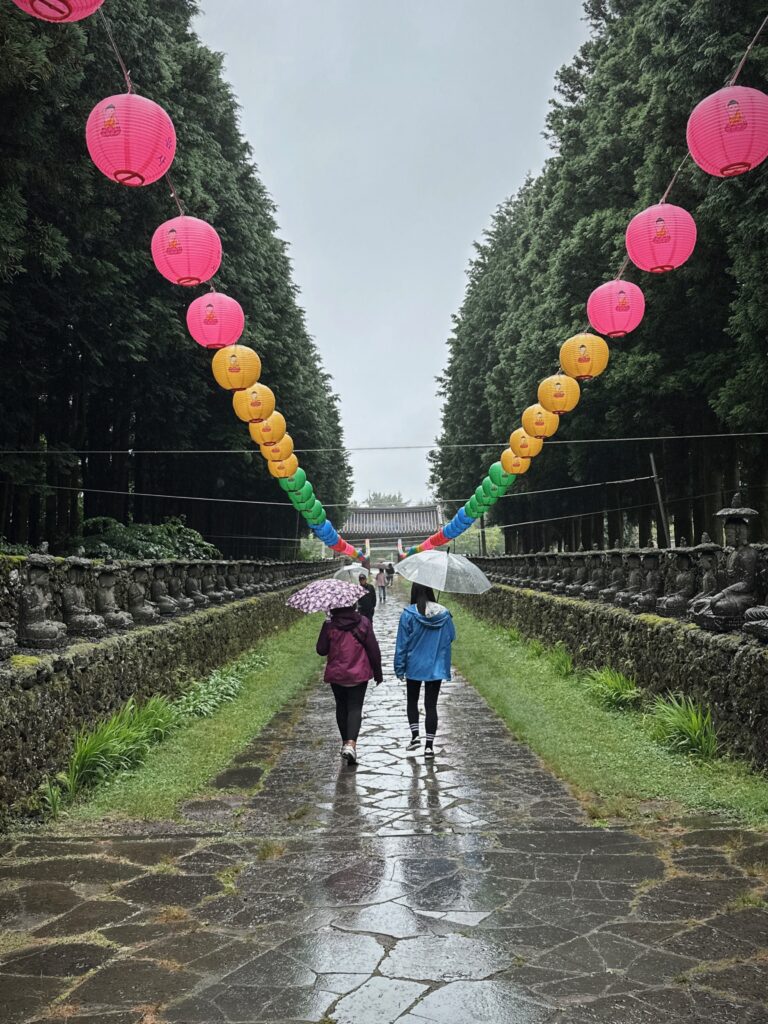
Gwaneumsa (관음사)
Where: Hallasan, 650m elevation. Jeju-si Aradong, Sangnokbuk-ro 660.
Gwaneumsa is not the most dramatic temple on Jeju. What it is, is the most historically layered — and once you know the story, the grounds feel completely different.
Buddhism was effectively banned on Jeju for about two hundred years. In 1702, the Joseon-era governor Lee Hyeongsang — a strict Confucianist who considered the island’s shamanic shrines a threat to moral order — ordered every Buddhist temple on the island destroyed. Hundreds of shrines and temple buildings were razed. It took two centuries for Buddhism to come back.
The comeback has a name: nun Anbongyeogwan (안봉려관 스님). In 1908, she returned to Jeju determined to rebuild. The local community pushed back hard. She was effectively driven out of the village and ended up sheltering in a cave called Haewol Cave (해월굴, Haewol Gul) on the slopes of Hallasan, where she prayed for three years and eventually completed a small prayer hall and living quarters. From that cave, the modern Gwaneumsa was born.
The temple burned down in 1939. Then, in the late 1940s, Gwaneumsa found itself at the center of one of the darkest chapters in Korean history. During the April 3rd Incident (4·3 sakeon) — a prolonged period of armed conflict and mass civilian killings on Jeju that lasted from 1947 to 1954 — the temple’s high position on Hallasan made it a strategic site. By 1949, clashes between armed groups and military forces had destroyed every building on the grounds. The site was reconstructed beginning in the 1960s.
Haewol Cave is still there, inside the temple grounds. So are the traces of the April 3rd period. Most visitors to Jeju never encounter either.
If you’ve read our piece on Jeju’s dark tourism, you already know that this island carries its grief in specific places. Gwaneumsa is one of them.
Temple Stay Programs
1 night, 2 days — Experience type (70,000–120,000 won): 108 prayer bead making, lotus lantern making, walking meditation, loving-kindness meditation, breathing meditation, dawn ceremony, tea talk with a monk.
Day program (approx. 3 hours, 11 AM–2:30 PM): Temple tour, prayer bead making, tea ceremony. Minimum 2 people.
What it feels like
The forest at 650 meters is genuinely quiet in a way the coast never is. Waking before dawn and walking to the main hall through Hallasan’s dark cedar trees — knowing what happened on these grounds — gives the experience a weight that’s hard to find elsewhere.
Getting there
Bus 365 from Jeju Airport to Jeju National University, then transfer to bus 475 (runs approximately every hour) to Gwaneumsa entrance. Taxi from the airport costs approximately 15,000 won.
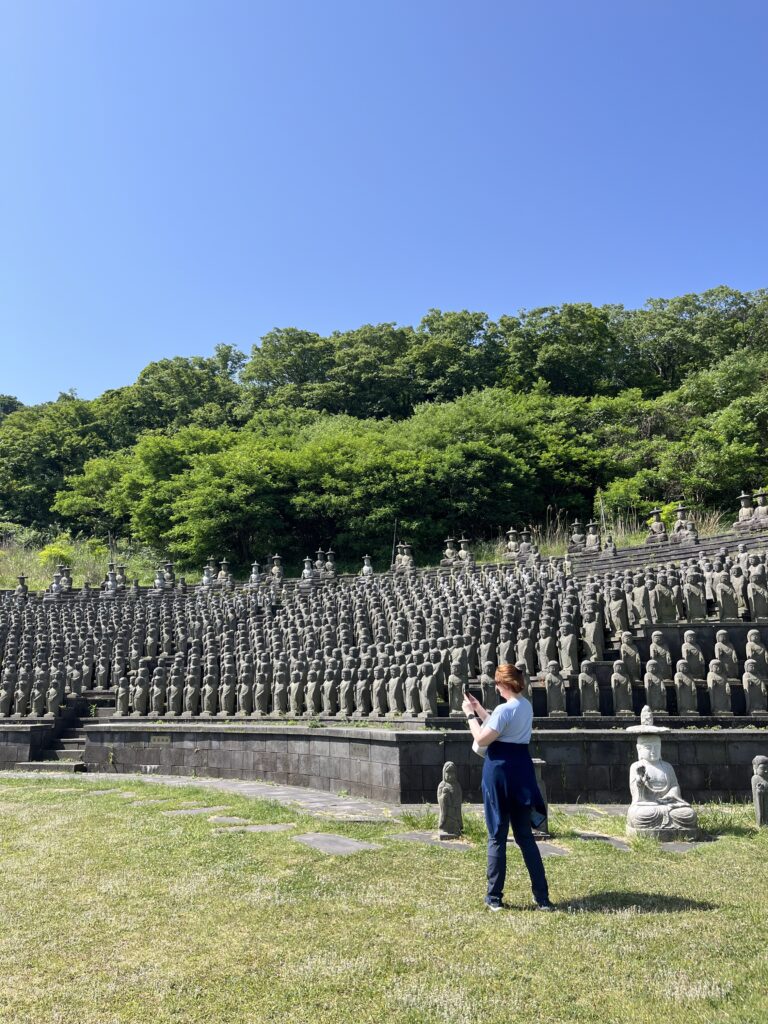
Geumryongsa (금룡사)
Where: Gimnyeong-ri, Gujwa-eup, Jeju-si. Five minutes from Gimnyeong Beach.
Geumryongsa sits in the island’s northeast, in Gimnyeong village, surrounded by the flat stone-walled fields (밭담, batdam) of Gujwa-eup and just a short walk from a beach facing the open ocean. Directly underneath the temple grounds, a lava tube runs through the rock — part of the same volcanic system that produced Manjanggul Cave (a UNESCO World Heritage Site) a few kilometers away. The spring water that surfaces near the temple flows from Hallasan’s mountain veins, through the village well, all the way to Seongsegi Beach.
The temple was founded in 1930, when a layperson named Kim Yeonhwa established a small prayer hall on the site. It’s a modest place — flat rocks, pine trees, no grand gates or dramatic mountain backdrop — but its location is extraordinary.
Temple Stay Program — 1 night, 2 days (70,000–80,000 won)
Day 1: Check-in and room assignment → 3:30 PM Temple tour and etiquette → 4:00 PM Gimnyeong village walk → 5:20 PM Dinner → 6:00 PM Bell-striking experience and evening ceremony → 7:00 PM 108 prayer bead making or salt mandala → 8:30 PM Loving-kindness meditation → 9:00 PM Lights out
Day 2: 4:00 AM Wake-up → 4:30 AM Dawn ceremony → 5:00 AM 108 prostrations and breathing meditation → 6:00 AM Seongsegi Beach ocean meditation → 7:00 AM Breakfast → 8:00 AM Temple maintenance (unyeok) and free time → 8:30 AM Tea talk with the monk → 9:30 AM Sharing reflections → 10:00 AM Closing ceremony
What it feels like
The beach meditation at dawn is the moment that defines this temple stay. You’ve been awake since 4 AM. You’ve chanted in a dim hall and bowed 108 times until your legs are tired. Then, as the sky starts to lighten, you walk down to the ocean and sit on volcanic rock while the waves come in. The sound is real, the cold is real, the dark turning blue is real.
The salt mandala activity the night before is also worth noting. You create an intricate pattern from fine salt on a flat surface and then, at the end, scatter it. It’s a meditation on impermanence that doesn’t need explaining.
The Gimnyeong village walk on the first afternoon gives you an unusually grounded entry into the experience — not rushing straight into ceremony, but moving slowly through the flat stone-walled fields that local farmers still tend.
Getting there
Rental car recommended. Approximately 40 minutes from Jeju City. Pairs well with Manjanggul Cave and Woljeong-ri Beach.
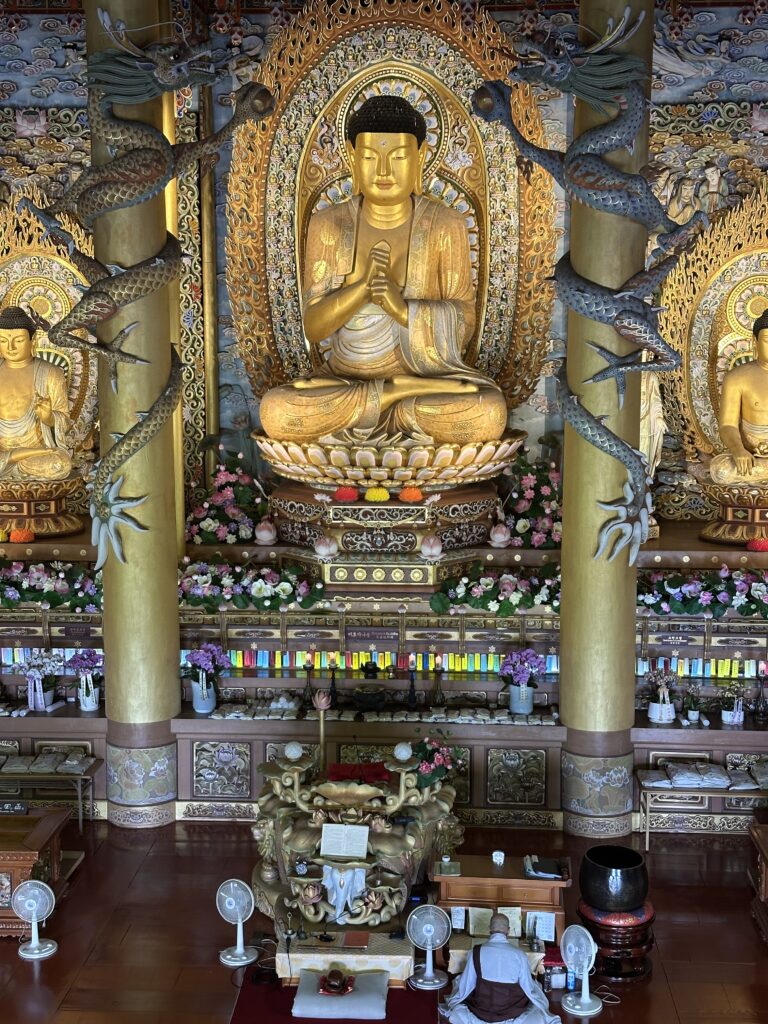
Baekjesa (백제사)
Where: 54 Gwangnyeongnam 6-gil, Gwangnyeong-eup, Jeju-si. In the Aewol area, between the coast and Hallasan’s mid-slopes.
Baekjesa belongs to the Taego Order of Korean Buddhism — a different lineage from the Jogye Order that runs most major Korean temples. The atmosphere here is the most deliberately open of the four temples on this list.
The temple’s stated philosophy is that it welcomes everyone regardless of religious background, and unlike at some other sites, Baekjesa appears to mean it structurally. Since 2012, it has run an alternative classroom program for teenagers, commissioned by the Jeju Provincial Office of Education. More than 200 young people have come through for mentoring, meditation, counseling, and career coaching. The facilities have been fully modernized. The rest-oriented program runs 365 days a year with no minimum stay commitment.
Temple Stay Programs
Rest-oriented, 1 night (60,000 won): Arrive, eat communal meals, sleep, walk the grounds. No fixed schedule outside of meal times. Long-stay options (a week or more) available on request.
Experience-oriented, 1 night: Temple etiquette, meditation, individual counseling session included.
Youth and family programs: Available on inquiry.
What it feels like
Baekjesa is the right choice if what you’re after is subtraction rather than addition. The programs at Gwaneumsa and Geumryongsa are structured and full. Baekjesa’s rest format is almost the opposite: you stop doing. The fully renovated facilities mean fewer of the small discomforts that can distract first-time visitors at older temples. The setting in Gwangnyeong-eup’s mid-mountain area is quiet without being remote.
Getting there
Rental car recommended. Approximately 20–25 minutes from Jeju Airport. Combine with a drive along the Aewol coastal road.
Yakchunsa (약천사)
Where: Jungmun area, Seogwipo-si. The terrace overlooks Jeju’s southern coast.
Before anything else: Yakchunsa’s main prayer hall, the Daejeokgwangjeon, is the largest single Buddhist prayer hall in East Asia. It rises thirty meters above ground, is three stories tall inside with an open interior reaching twenty-five meters, and houses the largest Vairocana Buddha statue in Korea. The first time you walk through the doors and look up, you will feel small in a way that is not unpleasant.
The temple traces its origins to a small hermitage called Yaksuam, which sat on a site where a natural spring had flowed for centuries — the name yakcheon (약천) means ‘medicinal spring.’ In the 1960s, a Confucian scholar named Kim Hyeongon spent 100 days in meditation in a small cave on the site, believing the spring water had cured his illness, and rebuilt the hermitage as an act of gratitude. In 1982, the monk Hyein arrived and began the larger construction project that culminated in the Daejeokgwangjeon’s completion in 1996.
Temple Stay Programs
Day experience (50,000–60,000 won, 2–3 hours): Temple tour, etiquette introduction, 108 prayer bead making or lotus lantern making, percussion instrument experience (bubgo, beomjong, unpan, mongeo).
1 night, 2 days — Experience type (50,000–60,000 won): Bium (emptying) meditation, percussion experience, 108 prostrations, tea talk with monk.
1 night, 2 days — Rest type: Dawn ceremony, seated meditation, tea ceremony, free time in the grounds.
What it feels like
The 108 prostrations here are described as harder than anticipated — physically demanding, but followed by a lightness most people don’t expect. Some stay after the scheduled program ends to do more. The outdoor walking meditation on the wide temple terrace, with the southern coast visible below, is a setting that’s difficult to replicate.
Yakchunsa is also the most visitor-friendly of the four in terms of drop-in access. The grounds are open to the public during the day, and the day program fits inside a Seogwipo afternoon without restructuring your trip. You can further finetune your own itinerary using the Jeju Trip Planner.
Getting there
Rental car recommended. Near the Jungmun resort area. Easy to combine with Cheonjiyeon Waterfall, Jeju Olle Trail Route 8, or the south coast drive.
The Practical Part
Booking: templestay.com for all four temples.
Price summary (1 night, 2 days):
| Temple | Price | Day program |
|---|---|---|
| Gwaneumsa | 70,000–120,000 won | Yes (~3 hrs) |
| Geumryongsa | 70,000–80,000 won | Inquire |
| Baekjesa | 60,000 won | Yes |
| Yakchunsa | 50,000–60,000 won | Yes (2–3 hrs) |
Prices include accommodation, all meals, and program activities. Multi-night and specialized programs are priced separately.
Qué llevar: Personal toiletries, a towel, comfortable socks (required inside prayer halls), and one extra layer — mountain temples get cold at night, including in summer. Temple clothes are provided.
Rules that apply everywhere: No alcohol, no smoking, no meat brought in, no loud conversations. When passing a monk, bring your palms together (합장, hapjang). When entering a prayer hall, remove your shoes.
Non-Buddhists: All four temples explicitly welcome visitors of any or no religion. The ceremonies are in Korean, but you don’t need to understand the words to follow the rhythm.
Which One Is Right for You?
- Go to Gwaneumsa if you want to be somewhere that carries the weight of Jeju’s history — and if waking up inside a Hallasan forest sounds like your idea of an extraordinary morning.
- Go to Geumryongsa if the idea of meditating on a volcanic beach at dawn, in the silence between the waves, sounds like something you’d actually remember for years.
- Go to Baekjesa if this is your first temple stay, or if what you need is genuinely unstructured rest — no agenda, no performance, just stillness and meals.
- Go to Yakchunsa if you’re based in Seogwipo, if scale and architecture move you, or if you want a full experience that fits inside a single afternoon.
All four are within an island you can drive end to end in two hours. There’s no reason you can’t visit one and walk the grounds of another on the same trip.
Conclusión
Jeju is easy to do fast. Two nights, a rental car, the famous sites, back to the airport. There’s nothing wrong with that trip. But there is another version of this island — quieter, older, less photographed — and temple stay is probably the most direct route into it.
What most people report afterward isn’t a revelation. It’s smaller than that: a few hours of genuine quiet, a meal eaten without looking at a screen, a morning that started before the rest of the world did. That’s worth one night.
Temple stay programs and prices are subject to change. Always confirm directly with the temple or via templestay.com before booking.
