What You'll Find in This Article
When I guide Korean tourists to places like Mexico or Guatemala, they sometimes ask if I know about shamanism. They assume that because I’m from Jeju, I must be familiar with it. And I am. But what they don’t realize is that Jeju shamanism is very different from what they might have seen in Seoul or other parts of Korea.
The differences are so significant that some scholars debate whether they should even be classified as the same tradition. If you’ve ever seen a dramatic mudang performance on the mainland – a shaman shaking, speaking in tongues, seemingly possessed by spirits – you might be surprised to find that Jeju shamans don’t do that at all.
This article explains how and why the two traditions diverged.
How Jeju Shamanism Differs from the Mainland
While Korean shamanism shares common foundations across the peninsula, Jeju’s version diverged so significantly that it’s almost a separate tradition. Understanding these differences reveals how geography, economy, and social structure shape spiritual practice.
Spirit Possession vs. Sacred Implements
Mainland (Kangsin-mu tradition): The dominant form of mainland shamanism involves direct spirit possession. During Gut rituals, the mudang enters trance states where gods or ancestral spirits temporarily inhabit their body. The shaman becomes the deity, speaking in the god’s voice, dancing as the god dances, conveying messages directly from the divine. This possession is dramatic, often violent. The mudang may shake, scream, speak in tongues, perform feats of strength or endurance that seem superhuman.
The mudang’s identity temporarily dissolves; the god takes over completely. Worshippers speak directly to the deity through the possessed shaman’s mouth. This creates intense, emotionally charged rituals where the boundary between human and divine collapses.
Jeju (Simbang tradition): Jeju shamans do NOT become possessed. They remain themselves throughout rituals. Instead, they use mengdu. The sacred brass knives, bells, and divination implements which are believed to incarnate spirits of gods and previous shamans. The simbang communes with deities through these objects, interpreting signs, conveying messages, but never losing their own consciousness or identity.
This creates a more mediated, controlled ritual atmosphere. The simbang is intermediary, not vessel. They maintain professional distance, using their mengdu to divine the gods’ will and communicate requests, but the gods remain external – present in the implements, honored through offerings and recitations, but not inhabiting human bodies.
This fundamental difference affects everything: ritual intensity, the shaman’s role, worshippers’ experience, even how shamanic authority is established. Mainland shamans prove their authenticity through dramatic possession; Jeju shamans prove theirs through mengdu ownership and mastery of mythology.
Calling vs. Inheritance
Mainland: Most mainland mudang become shamans through sinbyeong (신병, ‘spirit sickness’), which is a spiritual crisis involving severe illness, mental distress, misfortune, or visions that can only be cured by accepting the shamanic calling. The gods choose you, often against your will. You resist, you suffer, eventually you surrender and undergo initiation. This ‘called’ or ‘destined’ path (kangsin-mu) dominates mainland practice.
The initiation ritual (naerim-gut) is dramatic. The gods descend into the new shaman for the first time, confirming their election. Family background doesn’t matter; anyone can be called. This creates relatively egalitarian access to shamanic authority. After all, the gods don’t care about your social status.
Jeju: Jeju shamanism is primarily hereditary (seseummu tradition). Shamanic knowledge, mengdu, and authority pass through family lines. Parent to child, teacher to apprentice within kinship networks. You’re born into shamanic families, trained from youth, inherit your mengdu from previous generations.
This doesn’t mean ALL Jeju shamans inherit the role. Some do experience sinbyeong and are called. But the hereditary path is much more common and prestigious on Jeju than mainland. Mengdu ownership matters enormously. You can’t practice independently without them, and they’re typically passed down within families.
This creates different social dynamics. Mainland shamanism is more fluid. Anyone can be called, status is earned through demonstrated power. Jeju shamanism is more institutional. Lineages matter, family reputation matters, inherited mengdu carry accumulated spiritual authority.
Village Integration vs. Urban Marginalization
Mainland: Over the past century, mainland shamanism has been increasingly marginalized and urbanized. As Neo-Confucian values, Japanese colonialism, Christian missionaries, and modernization campaigns attacked traditional village structures, shamanism retreated to cities where it operates more individualistically.
Modern mainland mudang often work independently, renting ritual spaces (guttang), serving individual clients who come seeking personal help, such as healing illness, resolving family problems, sending off deceased spirits. The communal village-wide rituals that once anchored shamanism have largely disappeared, replaced by private household ceremonies.
Shamans face social stigma. Many keep their profession secret from neighbors. They’re stereotyped as con artists, superstition-peddlers, or mentally ill. The ‘ten thousand spirits’ (mansin) term emerged partly to counter these negative associations.
Jeju: Shamanism remains integrated into village life. Almost every larger village has a simbang, a dang shrine, regular communal rituals. Village danggut are still major community events involving extensive participation, food preparation by many households, resolution of conflicts beforehand, and collective celebration afterward.
Simbang aren’t hidden or stigmatized. They’re known community members with recognized roles. Even people who don’t strongly believe personally still participate in village rituals because that’s what maintaining community means. Shamanism functions as social glue, not just individual spiritual service.
This difference reflects Jeju’s slower urbanization and stronger maintenance of traditional village structures. While the mainland rapidly industrialized and depopulated rural areas, Jeju retained more traditional settlement patterns longer, allowing shamanism to stay embedded in community life.
Differences In Mythology and Narrative Traditions
Mainland: Mainland shamanic narratives vary by region but share common pan-Korean myths. The most important is the Princess Bari narrative: a princess abandoned by her parents who journeys to the underworld to obtain medicine, becomes the first shaman, and guides souls to the afterlife.
Other major mainland narratives include the Chilseong (Seven Stars) myth about fertility gods, tales of generals who became guardian deities, and the Dangun founding myth connecting shamanism to Korea’s legendary first king.
Jeju: Jeju has an entirely distinct mythological corpus. Princess Bari is unknown on Jeju. She simply doesn’t appear in the tradition. Instead, Jeju mythology centers on:
The Samseong myth: Three divine men (Go, Yang, and Bu) emerged from three holes in the ground (Samseonghyeol), married three princesses who arrived by boat carrying seeds and livestock, and founded Jeju civilization.
The Chogong bon-puri: The origin myth of Jeju shamanism itself, telling how the Mengdu triplets became the first shamans and how ritual implements were passed down.
Seolmundae Halmang: The giant creator goddess who built Jeju Island, unique to the island’s mythology.
Yeongdeung Halmang: The wind goddess who visits annually, central to Jeju but peripheral or absent in mainland traditions.
Jeju possesses the richest corpus of shamanic narratives in Korea, hundreds of bon-puri myths, each associated with specific rituals. The largest Gut ceremonies traditionally included recitation of the entire mythological cycle over fourteen days. This encyclopedic oral tradition far exceeds what exists on the mainland.
The divergence is so complete that scholars debate whether Jeju shamanism and mainland shamanism should even be classified as variants of the same tradition or as separate traditions with common prehistoric roots that evolved independently.
Ritual Structure and Performance Style
Mainland: Gut rituals are divided into segments called geori, each honoring different deities or serving different purposes. The mudang’s dramatic possession is central: they wear elaborate costumes representing different gods, change clothing multiple times during ceremonies, perform acrobatic dances, sometimes walk on knife blades to demonstrate divine power.
Colorful paintings of gods (mudang’s paintings) are displayed during rituals. The performance is spectacular, emotionally intense, designed to generate spiritual ecstasy in both shaman and worshippers. Music is crucial: drums, gongs, cymbals creating driving rhythms that induce trance states.
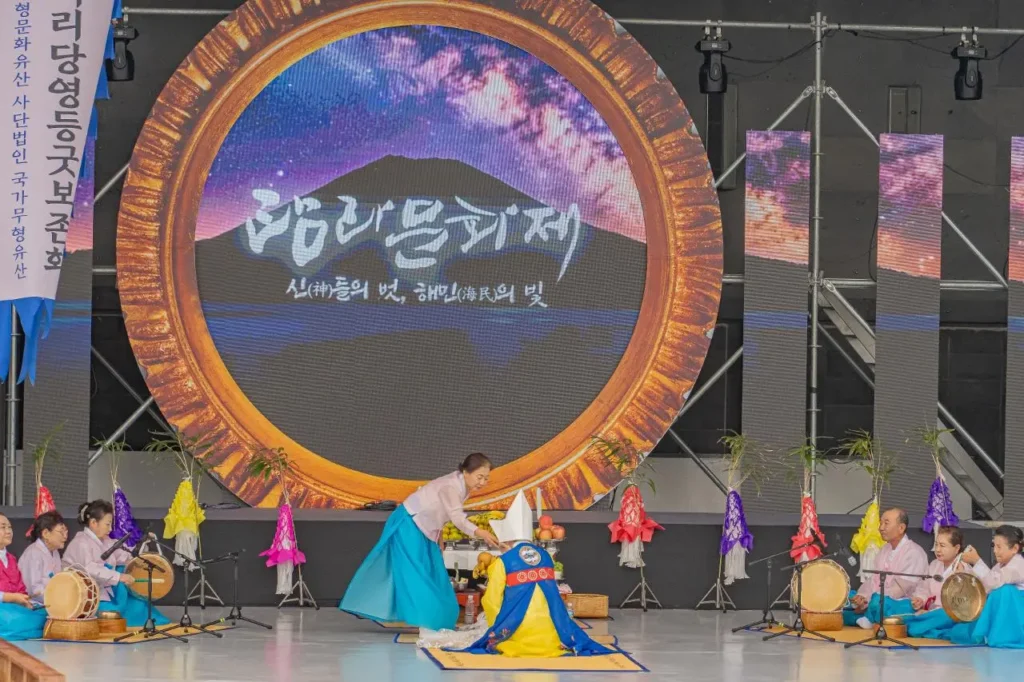
Jeju: Rituals are also divided into segments, but the structure emphasizes recitation of bon-puri myths more than dramatic performance. The simbang sings and chants lengthy narratives: origin stories of gods, founding myths of villages, tales explaining why certain rituals are performed certain ways.
While there’s music and dance, the focus is more on storytelling and the proper execution of ritual sequences. Simbang use their mengdu for divination: shaking implements in sieves, interpreting how they fall, reading signs. The aesthetic is less spectacular than mainland Gut but more narratively dense, more focused on preserving and transmitting oral tradition.
Jeju shamans don’t typically use the colorful god paintings that mainland mudang display. The mengdu themselves serve as embodiment of divine presence: no additional visual representations needed.
The two styles reflect different priorities: mainland shamanism prioritizes ecstatic divine encounter and emotional catharsis; Jeju shamanism prioritizes proper ritual procedure and mythological preservation.
Same but Different
The divergence between Jeju and mainland shamanism demonstrates how religious traditions adapt to local conditions. Geographic isolation, economic structures, social organizations, and environmental pressures shape spiritual practice in profound ways.
Jeju shamanism survived better than mainland traditions not because Jeju people were more devout or superstitious, but because the island’s unique circumstances – dangerous maritime economy, haenyeo dominance, village cohesion, limited Confucian penetration – created persistent demand for shamanic services and maintained social structures that supported practitioners.
When scholars describe Korean shamanism, they usually mean mainland practices: dramatic possession, female-dominated, urban-based personal services. But Jeju offers an alternative model: hereditary, implement-based, village-integrated, myth-centered, with gender parity.
Both are authentically Korean shamanism. Both descend from prehistoric roots. But they represent different evolutionary paths shaped by centuries of distinct social and environmental conditions.
For visitors, this means that experiencing shamanism on Jeju gives access to something genuinely different from what exists elsewhere in Korea. Not just regionally variant but structurally distinct, a window into how Korean spirituality might have developed without Confucian suppression and rapid modernization.
So now you understand what makes Jeju shamanism distinct: no possession, hereditary practice, village integration, and a unique mythology. But knowing how it’s different doesn’t explain how it survived when the mainland’s tradition was pushed to the margins.
In the final article, we’ll look at the haenyeo. The women divers whose dangerous work created the demand for spiritual protection and the waves of persecution that should have killed this tradition but didn’t. We’ll also talk about what’s happening now, and whether Jeju shamanism has a future.
