Play Episode
Episode Summary
Sora is finally back home in Jeju after heavy snow delayed flights and stranded travelers — including some who were caught having affairs when they couldn’t return on time (K-drama in real life!).
This episode breaks down what to expect in each season:
- winter offers fewer crowds, cheaper prices, tangerine picking, and snowy Hallasan;
- spring brings cherry blossoms, canola flowers, and better air quality than Seoul’s yellow dust;
- summer means beach time, typhoon season, and crowds from mainland Korea;
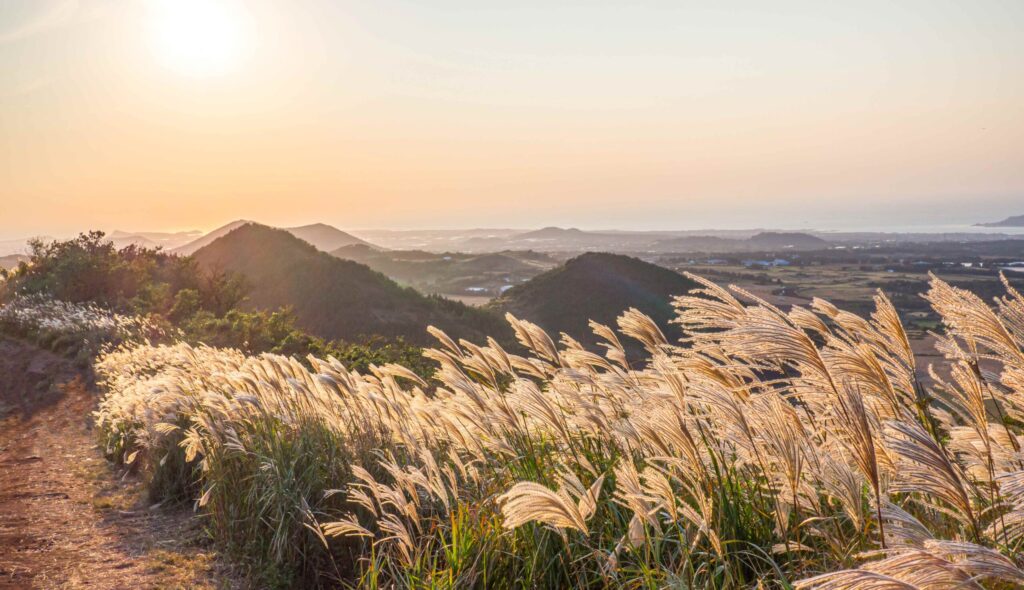
- fall delivers the best weather, stunning autumn foliage on Hallasan, and tangerine season starting up.
Ed and Sora also warn about Korea’s “golden weeks” — Seollal (Lunar New Year), the August vacation shutdown, and Chuseok (Korean Thanksgiving) — when half of Korea is on the move and competing for tickets is impossible.
Key Takeaways
Winter (December – early March)
- Fewer crowds, cheaper flights and accommodations — great for budget travelers
- Snowy Hallasan is beautiful but requires crampons and hiking poles
- Tangerine picking season (see Episode 5)
- Outdoor jjimjilbang (sauna) experience available
- Avoid: Seollal (Lunar New Year) — impossible to get tickets
Spring (late March – May)
- Cherry blossoms (late March – mid April) and canola flowers (Feb/March – May)
- Much better air quality than Seoul (less yellow dust/황사 and fine dust)
- Good hiking weather
Summer (June – August)
- Beach season — can start swimming from late May
- Very hot and humid
- Beach parasol/chair rentals: ~30,000 won ($20) for the day
- Best time: June or July before the August rush when half of Korea heads to beaches
Fall (late September – November)
- Stunning autumn foliage on Hallasan
- Tangerine season begins end-November
Handy Korean with Sora Ssaem (쌤)
있어요 / 없어요 (isseoyo / eopseoyo) = There is / There isn’t (or: Do you have? / We don’t have any)
Useful for asking if stores have seasonal items:
Spring
- 마스크 있어요? (maseukeu isseoyo?) — Do you have masks? (for yellow dust)
Summer
- 선크림 있어요? (seонkeulim isseoyo?) — Do you have sunscreen?
- 우산 있어요? (usan isseoyo?) — Do you have umbrellas?
- 비옷 있어요? (bi-ot isseoyo?) — Do you have rain jackets?
Fall
- 셀카봉 있어요? (selkabong isseoyo?) — Do you have selfie sticks?
Winter
- 핫팩 있어요? (hatpaek isseoyo?) — Do you have hot packs?
- 패딩 있어요? (paeding isseoyo?) — Do you have puffer jackets?
If they don’t have it: 없어요 (eopseoyo) = “We don’t have any”
Combine with 주세요 (juseyo): 핫팩 주세요 (hatpaek juseyo) = “Please give me a hot pack”
Next Steps
- Plan your Jeju trip at vamosajeju.com/trip
- Sign up for the 14-part email series at vamosajeju.com/start
- Follow Vamos a Jeju on Instagram, TikTok, or YouTube.
- Share the episode with friends to help the podcast grow
- Visit vamosajeju.com for articles, videos, and resources
- Leave a one-sentence review to help others discover the show
- Related Reading: Hallasan: What Every Visitor to Jeju Must Know
Episode Transcript
Winter in Jeju
Soraya (00:18) Start. Yeah. Hello everyone. Welcome to our Vamos a Jeju podcast. finally I am back home. I’m so happy. And today, of course, as always, we have my buddy Ed is here. Hi Ed.
Ed (00:34) Hey Sora, so yeah I think the person that’s most happy to have you home is Jaden. Before recording I saw him walk past definitely was happy to have his wife back and I totally get that. was heavy snow in Jeju and the Jeju airport, there were multiple flights were delayed. you affected by the delays at all?
Soraya (00:55) I was okay but a lot of flights were like delayed, suspended, cancelled and some people could not make it back home and had some problems
Ed (01:09) I’m very excited because Sora told me that some of these people who didn’t make it back on time were actually caught for having an affair. Tell us more about this Sora!
Soraya (01:21) some people they were cheating on their partner and then having a happy trip to Jeju with their girlfriend, boyfriend and of course didn’t tell their actual family. For example, he’s supposed to go back but he could not make it and there’s no excuse because he told his wife that he’s having a business trip for a day and then couldn’t go back because he was in Jeju with someone else
Ed (01:46) Mm-hmm. this is such salacious, scandalous stuff it’s like a K-drama, um, but in real
Soraya (01:54) Mm-hmm.
Ed (01:55) weather definitely affects the entire tone of your visit to Jeju as well. that’s exactly what we’re going to focus on in today’s episode. what each season is like and why every season is a good time to visit Jeju depending on what you’re looking for. Sora, what can you tell our listeners about a trip to Jeju in the winter? What to look out for and what to prepare for.
Soraya (02:23) So in Korea, like in Jeju, winter is usually from December, January and February. And sometimes it snow a lot, especially like near the mountain. So sometimes we can’t get into the park, but like near the It’s okay, even though we have heavy snow it’s gonna melt down very soon so it’s easy to travel. reason I like winter in Jeju is because there’s less crowd and it’s cheaper. So budget traveler, winter could be a good choice because it’s cheaper but still it’s beautiful with the in December, it can be still warm. like in Jeju city and Seogwipo city can be still warm. yesterday, I went out with my friends and I didn’t wear my jacket. I just wear my hoodie. And also in March, I think March is still a bit of winter. Spring actually started from at the end of March. like early March can be also very cold and windy.
Ed (03:21) I see. Okay. So as we are recording I guess with winter, the days are also shorter, right?
Soraya (03:34) is around 5.30 to 6. and then you can a nice dinner.
Ed (03:39) So it’s not so far north that the sun goes down too early. in the winter in the Scandinavian countries, the sun comes out at like nine o’clock in the morning and goes down at three o’clock. And then you’re like, the day’s over. so it’s still a fairly decently long day.
Soraya (03:52) no.
Ed (03:57) and sometimes the weather can be great and you’re getting Jeju at a bargain the crowds and get really great views the mountain. if you do climb Hallasan in the winter the amount of preparation that you need and amount of equipment and gear that is required is drastically different than if you climb in any of the other seasons where sure it’s windy it’s cold but it is not going to be as dangerous or treacherous without special equipment. Have you climbed in the winter at all?
Soraya (04:27) Yeah, I did. I think like two years ago I went there like right after the snowy day. So it was beautiful, beautiful. And of course, that you need the hiking pole and crampons of course. Crampons, hiking poles, I think that’s the essentials. And of course you have to layer, lots of layers.
Ed (04:35) Mm-hmm. Crampons? yes. Yeah. Yeah,
And so we’ve got articles about climbing Hallasan on vamosajeju.com / climb. But yes, if you do plan to climb Hallasan in the winter, aside from all the other… things that you need to do like register with the website and all that you really need winter hiking equipment including crampons and your hiking stick
Soraya (05:11) The other highlights of winter in Jeju, of course we got like snowy Hallasan, but we also have the tangerine farms, right? Because only in winter we can do like tangerine picking and like eating tangerine until you get sick of it. So that’s why, that’s other reason that I love winter in Jeju.
Ed (05:31) That’s right. totally forgot about tangerines So if you’re you can go back to episode five of this show where we talk specifically about tangerine picking. Did I tell you, Sora, that I’m going back with my family in the winter this year?
Soraya (05:46) Yeah, yeah, for Christmas.
Ed (05:47) with my whole family, yeah, yeah, for Christmas. I was at first very resistant to the idea of going to Jeju in the winter Which is like, hell no, I’m not gonna go to Jeju in the winter, that’s dumb! But now that I’ve committed to it for Christmas…
Soraya (05:56) Yeah.
Ed (06:03) I’m actually very psyched. Yeah, of course, like maybe we’ll climb Hallasan and we’ll do tangerines and it’s going to be great. So we’ll have to figure it out.
Soraya (06:08) Cool. Yeah. the weather is gonna be great, like snowy and clear.
Ed (06:16) Is there anything else about winter that we should discuss that I have not mentioned?
Soraya (06:21) It’s not Jeju special, but we can also do a sauna especially in the winter in Jeju we have one outdoor jjimjilbang they’re make a fire to make the room hotter it’s very very authentic So when you are here, I will take your family to those places so you can experience a new jjimjilbang here.
Ed (06:45) wait, is this the one that we have to be naked in front of everybody? Because I don’t think I can do that in front of my kids.
Soraya (06:48) Noooo
Spring in Jeju
Ed (13:37) let’s move on to the fourth and final season that we’re going to talk about today and that is fall or autumn
Soraya (13:43) Mm-hmm.
Ed (13:45) and it’s called Ka-eul in Korean. So talk to us about fall.
Soraya (13:48) Mm-hmm. we Koreans say is that the best season in Korea is spring and fall because of the nice weather, it’s easy to walk around. So fall in Jeju, I would say it starts from the end of September until November. Because early September can be very hot, still very hot. like summer.
So my favorite part of the fall in Jeju is the autumn foliage. Because as you know, we have the tallest mountain in Korea, Hallasan. The autumn leaves there are beautiful. So I like to bring my family or friends to the mountain, especially in the fall.
I just go to like 30 minutes, go in, there’s a beautiful bridge, and then we just take photo, enjoy the view, and then come back to the parking lot.
in the spring and fall we have some like school field trip season. So there will be lots of school buses coming from the mainland Korea. Usually like middle schoolers or high schoolers.
Ed (14:51) Right. And, and people have to watch out for the Chuseok golden week period. Avoid. travel destinations in Korea during the Chuseok, that’s Korean Thanksgiving period
Soraya (15:03) and Seollal.
Summer in Jeju
Ed (09:04) And I am, is So then the next season is going to be summer, Yeoreum
Soraya (09:08) Yeah.
Ed (09:15) I often see that in Seoul, if you’re ever going to see underground parking lots get flooded, that will be in summer with the huge torrential rains that hit the mainland, especially Seoul. So what is it like on Jeju in the
Soraya (09:23) Mm-hmm. I think in Jeju we don’t really have flood because as you know the volcanic rock cannot hold the water so it goes through it so no flood but we have typhoon. So during the typhoon season, of course, you can’t go to swim. You can’t take the boat. it’s better to stay inside if there is a typhoon. But if there’s no typhoon, it’s always sunny, very humid, hot. It’s perfect weather for swimming in the beach.
Ed (09:56) Okay. just East of Jeju city, there’s a beach called Samyang beach, right?
Soraya (10:08) Mm-hmm.
Ed (10:09) Yeah, in episode six, we talk to Jeju’s fabulous coast and Samyang Beach is one of those. And I was writing an article to support that. And the article is at vamosajeju.com / coast. I learned when I was researching the article that some Koreans actually bury themselves in the sand.
Soraya (10:22) I’m one of people who responsible. It’s not only in Samyang, everywhere you can do that. So if you go to the beach, if it’s a popular beach, they will have their own parasol, the big umbrella, then the chairs, tables. And one set is usually like 30,000 won, which is like $20. So you can rent those parasol, you can rent parasol table and chairs for whole day.
Ed (10:50) all day.
Soraya (10:56) us, our own parasol or our tent so we can just set up in the beach and then chill. what we do usually in the summer, like we go to the beach early morning, as early as possible and then enjoy the beach until the sun gets too hot like 1 PM, 2 PM, we just finish and then come back.
Ed (11:21) So summer then we’re looking at rain and then we’re looking at a huge surge in tourists from the mainland because it’s the school holidays.
Soraya (11:21) Hmm. usually other country you have only like 15 days, 20 days for a year, right? The day off. But here in Korea we have that and plus we also have like three or four days for summer vacation.
Ed (11:38) mm-hmm right
Soraya (11:45) So people usually take their summer vacation on July, August and come to Jeju.
Ed (11:45) Wow.
Soraya (11:51) and some company they do like summer vacation shutdown for everyone at the end of August.
Ed (11:58) so I’ve seen photos of like the Busan beach, Haeundae beach It looks terrifying. It’s like every square an umbrella or parasol It looks like a nightmare and then everyone’s in the It just looks terrible is that what happens to all of Jeju beaches as well
Soraya (12:19) Busan is easier for people to go because you can drive or you can take a KTX but here you need to prepare, you need to get the flight so I think it’s less than Busan usually from May you can start swimming. So June would be a perfect time to enjoy with less crowd.
Ed (12:35) Okay. Okay, so then that means all the water sports are going to be available. I guess surf, windsurfing, kite surfing and all that.
Soraya (12:47) like sarfine. kite surfing.
Ed (12:53) earlier, we talked about how if you’re going to climb Hallasan in the winter, you need to make sure that you have special equipment, like hiking poles and crampons. So while you don’t have to worry about special equipment, hiking Hallasan in the summer, you do need to bring a lot of extra water because it gets really hot and with the higher than normal humidity, it’s going to be harder for your body to cool off.
So that is summer. And if you want to hit up Jeju in the summer, and you want to avoid the peak crowds from the mainland, then you’re going to want to go in July and even June, because you’re going to have a great experience on the beaches without too many people.
Soraya (13:32) Mm-hmm.
Fall in Jeju
Soraya (16:09)
Okay, so number seven is Aewol Cafe Street Also Hamdeok (함덕해수욕장) But actually those beaches in Aewol and Hamdeok are really beautiful, but what I mean is the Cafe Street. Because nowadays the Cafe Street becomes so popular. so many like overpriced cafe and lots of tourists just like taking photo in front of the places so
Ed (16:59)
Right. So they typically they buy a drink and then they spend like five minutes taking a photo of the drink in their hand. And then that doesn’t sound terrible, but then you multiply by those people doing it at the same time, all trying to find their own angles. That makes it look like they’re the only ones there, but they’re not. That’s crazy. So when you say overpriced, like how much are we talking about?
Soraya (17:24)
Coffee can be like 10,000 Won
Ed (17:28)
Okay. That is ridiculous. Like if you go for like a regular, like a, like a Mega Coffee or Compose Coffee or Paik Da Bang Coffee is like, I think right now is around 1,700, 1700 Won
Soraya (17:29)
like usually like in an overpriced cafe like Americano is like 7,000, 8,000. Because I don’t know, there’s like in Jeju, there’s like many like fancy, beautiful cafe. If you like to go like cafe hopping, then maybe it’s a good place to go. But if you just want to enjoy the view or relax, then it’s not the place.
Ed (18:21)
Right. Okay. And so is it the same for the other beach on the list? Is it also like a cafe kind of a situation?
Soraya (18:37)
Also, there’s a lot of cafes but Hamdeok nowadays also this beach is really really beautiful the color like it’s emerald Yeah, but the thing is now there are too many people also like tourist group comes to Hamdeok to visit there. So sometimes you see like big like cruise bus is coming to the beach and like 40, 50 people coming at once. Yeah.
Ed (19:10)
Aewol and Hamdeok Those are two of like many, many beaches. And so there are lot of other alternatives to go to where you can, you know, get the beauty of the beaches, but not the crowds. Moving on, we’ve got Seongeup Folk Village (성읍민속마을) So
Soraya (19:24)
Okay, so This one for me, I think it’s 50-50
Ed (19:35)
50 50 means maybe worth going, but maybe not. But they’re all very far away. They’re all very far away. Right. So.
Soraya (19:39)
Yeah right right so if you’re staying in the Seogwipo like south then maybe worth it maybe worth it yeah
Ed (19:53)
Okay. And it’s worth it because especially Seongeup Folk Village is people still live there, right?
Soraya (20:00)
Right, so this is a folk village where still people like living like around 60 people is living there. And this is actually a folk place from like Joseon dynasty and they preserve it, preserve them from the Joseon dynasty and you can actually see like traditional houses and the architecture also like if you enjoyed the K-drama, When Life Gives You Tangerines, you’re gonna see like something similar environment here.
Ed (20:38)
So I guess that’s why you say it’s 50-50. Like it’s a long way to get there. It can be crowded sometimes, but then at the same time, it is also pretty realistic and authentic Next on our list is Jusangjeolli (주상절리) cliff, which… Okay. So when I saw it, like, okay, I’m trying to like be less biased against it. I’ll talk about the good things. The good things is that it’s legitimately very beautiful. The hexagonal shapes of the rocks really reminded me of what I saw in Iceland. And so, and it’s hexagonal columns and it looks really amazing. It boggles your mind how nature can produce shapes like that. That’s the good part.
Ed (21:34)
The bad part there’s a lot more people. And so they’ve got like a narrow little platforms that they build. build a platform overlooking these columns and it’s almost always full of people. Sometimes I wonder if the platforms will actually hold will this collapse and all of us fall to our death? There’s so many people and everyone’s trying to take their own photos They all want to make it look like they’re the only ones there. It’s just, so it’s very stressful. then it’s like, and then they try to pushing and shoving you, especially if the tourists are from a certain country who have no manners. They’re like shoving you aside. It’s, it’s not pleasant. So yeah, it’s, it’s, At the same time, it is still very beautiful. And that’s why it’s not number one on the list of tourist traps. It’s like number nine is like, yeah, maybe it’s worth going to because it’s so beautiful, but maybe you have to pack a lot of patience. You have to pack in your bag patience and understanding and whatever. If you’re already feeling stressed and grumpy before you get there, you get even more stressed and grumpy. But if you pack…
Ed (22:43)
patience and kindness, maybe you can manage it because you’re going to get jostled around a little bit and yeah, but it is beautiful.
Soraya (22:49)
So the number 10 tourist trap is Osulluc Tea Museum (오설록 티 뮤지엄). For me, it’s also 50-50. can be very nice for someone, but it’s also kind of stressful because there are so many people. There’s tourist and also lots of school field trip bus is coming here, like every school bus. So you will hear High schoolers screaming at each other sometimes. But the thing is Osulloc is the biggest green tea farm in Jeju. And you’re gonna see like huge green tea fields and then there’s like Innisfree, the cosmetic shop and then the tea cafe and tea museum.
Ed (23:25)
Yeah! Yeah. Right. Yeah, they do not do justice to the word museum. It’s not a tea museum. like maybe like one or two exhibits and then it’s basically a part of the cafe itself. It’s part of the gift shop. Yeah.
Soraya (23:47)
Right, Yeah, the biggest part is gift shop and then to buy a green tea, maybe you have to line up like 10, 20 minutes to pay.
Soraya (24:15)
when you think of a tea place, should be like tranquil, relaxed, but this place is very tense. Right.
Ed (24:28)
Like sometimes you like, I remember when we went there we couldn’t get a place to sit when we ordered coffee. So we had to wait around for someone to leave. then normally Koreans will clean up after their own table when they leave, but not tourists from some countries. And they’ll leave a mess.
Ed (24:47)
And so the staff will obviously clean up, but then there’s so many tables that the staff don’t always have enough time. And so I, I mean, you know me, I’m perfectly fine cleaning up anyway. So I do it just to be able to sit down, but despite the efficiency of the Korean staff, it’s just not enough to cater to certain tourists who just
Ed (25:10)
Don’t give a shit about other people. They just don’t care Yeah
Soraya (25:13)
Right. It feels like very busy food court.
Ed (25:19)
Yes, that’s exactly the vibe. The vibe. You go there expecting a very tranquil tea house kind of vibe, you know, but then you end up going like, my gosh, I’m in the food court. It’s noisy. It’s like a of like people talking and yelling and it’s just not that fun.
Ed (25:40)
So that’s our list of 10 tourist traps.
Ed (25:47)
Earlier, I mentioned that Sora and I agreed on number one, Mysterious Road. What were the ones that we kind of didn’t agree on? we had to talk about it before we put it on the list. Do you remember?
Soraya (26:00)
I think Osulloc You told me number one was Osulloc and I was like Osulloc is some people yeah because some people like it right
Ed (26:04)
That’s true! You’re right! You’re right! Yeah, okay. Okay, so to be fair, that’s my bias. Instead of Mysterious Road, I was going to put Osulloc Tea Museum there. And then Sora talked me down from the cliff. It’s like, no, actually, you know, it’s quite nice. And the stuff like that. But I still want it on the list. And she’s like, okay, how about we put it on number 10? So that’s right. You’re right. Osulloc Tea Museum was definitely one that we did not agree on.
Soraya (26:19)
based on what other tourists says like sometimes people like Osulloc, Jusangjeolli or Folk Village but Mysterious Road really
Ed (26:42)
Yeah, even the tourists are like, what just happened? Like, what? So yeah, so those are our list of our top 10 tourist traps and I hope you find this useful. especially after we’ve covered in the previous episode the touristy places that were worth going to and so that kind of strikes a nice balance between the places that we feel are really worth going to but then also the darker side so to speak of the places that you should probably avoid
Periods to Avoid — Seollal, August & Chuseok
Ed (15:04) for instance if you are trying to go to Jeju where like almost like half of Korea is gonna be there at the same time everything is gonna be so expensive that’s assuming you can even get accommodations
Soraya (15:14) in full.
Ed (15:17) Number two is, don’t even try and travel the day before Chuseok or the day of Chuseok because whether you’re going to be flying or in a bus or on the train or driving, it is just going to be nightmare because half of Korea is going to be on the move at that point in time.
Soraya (15:35) Moving.
Ed (15:37) been in Korea over Chuseok, we just stayed in hotel. It’s fine. It’s okay. You know, just don’t try to be like flying to Jeju or taking the train to Busan. Like it’s just a nightmare. Yeah. So that’s…
Soraya (15:43) better. It’s actually impossible to get the tickets for the train or flight. There’s no tickets. So before Chuseok or Seollal, the KTX, they start opening the ticketing, I think one month before that. And it’s like a concert ticket.
Ed (16:07) I just wanted to clarify for our listeners who may not understand this about Korea, Koreans are so damn competitive and organized that they are going to be like, if they know the ticket’s going to open up like tomorrow morning at I’m going to give it a time like let’s say 7 a.m. 6 45 a.m. 15 minutes before they are waiting at computer and then just to be clear they are refreshing their screens again and again and again and again it’s like OMG is like like I am too old to be competing with Koreans for concert tickets, flight tickets, train tickets, anything that involves lottery like
Soraya (16:30) you
Ed (16:48) My friend was like, hey, BTS is going to be doing the Arirang comeback tour in March. Let’s try and get tickets. I’m like, hell no. I’ll just watch on Netflix. It’s like, I’m not going to compete with half of Korea and then the rest of the world. It’s just no, no, no. So yes.
Soraya (16:52) Mm-hmm. Mm-hmm. impossible impossible Usually the concert ticket they finish like in one or two minutes.
Ed (17:12) Yeah, like if you’re lucky and if, and then sometimes like y’all I’ve heard from my friends that other friends, not just you, they’re waiting and then the, and then they think they got it and then the page hangs and then they didn’t get it in the end. Yeah, because like everyone is trying to access the website at the same time. So, take it from me. Do not try and compete.
Soraya (17:23) Yeah, so no tickets. Mm-hmm. Mm-hmm.
Ed (17:34) Do not try and out-compete Koreans during like Chuseok and like Sora mentioned, Seollal which is the in the winter. No. On the flip side, in the West, Christmas and New Year is a major holiday. It is not so big in Korea. Is that right?
Soraya (17:41) Impossible. Yeah, Yeah, Christmas is more like for friends or a boyfriend and girlfriend. Couples, right.
Ed (17:57) Couples. to recap, in the winter you want to avoid the Seollal the Lunar New Year period. And then for the summer, you want to avoid the last week of August because half of Korea is going to be on vacation. And finally, in the fall, you want to avoid the Chuseok, the Korean Thanksgiving period, because there’s usually two or three vacations stacked up at the same time too. So these are the three major periods you should…
Soraya (18:16) Mm-hmm.
Ed (18:24) not be trying to out-compete Koreans. If you have the flexibility, definitely try to travel outside of that. And so, today we talk all about like the best time to visit Jeju
Soraya (18:27) Mm-hmm.
Handy Korean with Sora Ssaem (쌤)
Ed (18:37) This is a great time for Sora to help you guys learn some useful things to talk about when you’re here in Jeju. And so for that, we’re going to move on to our next segment, which is Handy Korean with Sora Ssaem
Soraya (18:59) Okay.
Ed (18:59) Yeah, she’s getting more and more depressed, like no more cheering. Like I may have gone too far in making fun of her and now she doesn’t want to do it anymore. My bad So Sora what are we going to help our listeners learn today?
Soraya (19:12) Today let’s try to use 있어요 없어요 which means there is, there are or there isn’t, there aren’t like or can be, do you have or no? prepare some items that you might need for each season. So you can just put the item… down and then 있어요 can be are there or do you have this for example like 마스크 마스크 is mask for you know the dust in spring so you can ask people in the convenience store or pharmacy you go there and then 마스크 있어요 meaning are there any masks here or do you have masks here
summer of course you need that sun cream meaning sunscreen or sun stick so you can ask like sun cream 있어요 so you can go to olive young or convenience store or cosmetic shop and ask sun cream 있어요 or what you also need in summer is 우산 which is umbrella so can you say that Ed do you have umbrella are there umbrella
Ed (20:29) I like that you go on for so long and then suddenly you like try to catch me in something like yes I’m paying attention
Soraya (20:33) Yeah, you’re not paying attention. other thing is 비옷 which literally means rain clothes like rain clothing 비옷 있어요.
so in in autumn fall you may want to take selfies when you are traveling so in Korean selfie is 셀카 So we say 셀카 and then 봉 is stick. So it’s like a selfie stick.
And in winter now the must-have item is hot pack I always buy a hot pack for ARMYs because that lasts like 24 hours. you can also buy this from Daiso, convenience store, everywhere. So you can ask,
Ed (21:17) got
Soraya (21:22) Hot pack 있어요? Meaning do you have hot pack And other thing. you might need in the winter is padding. Padding is like puff jacket jacket for winter.
Ed (21:37) I see. But, but, wouldn’t visitors already travel to Korea with their winter gear?
Soraya (21:44) Maybe if they didn’t expect that much cold.
Ed (21:48) So Sora, what happens if you walk into any of these stores and you ask for something like such and such 있어요 and then they say there isn’t? How would the staff say there isn’t something?
Soraya (22:01) So it’s gonna be It’s kind of similar. So there are, there is. There is 없어요 There is no.
So we have learned 있어요 and 없어요. So now I want to put one more phrase that we have learned before. Do you remember 주세요? Please give me. So you can actually put all of these items and then you just put 주세요. For example, like hot pack 주세요. Like please give me those hot pack. So you can make a sentence like. Do you have this one? And then please give me this one.
Ed (22:28) yes.
Ed (22:43) So those are very helpful phrases that Sora just shared with us. if you would like to use some of those phrases when you go to Jeju, just check out our show notes. You’ll find all the different versions in Hangul and Romanization and all that.
Soraya (22:55) you
Ed (22:59) And if today’s show has gotten you thinking, wow, really like to experience all four seasons in Jeju, We’ve put everything we know about DIY travel into a 14-part email series.
Soraya (23:10) So to get that email straight to your inbox, sign up at vamosajeju.com / start. And for the latest update, follow us on vamosajeju on Instagram, TikTok and Facebook group. And finally, the best way for a new podcast like us to grow is organically. So if you found this episode helpful, please share with your family and friends. who knows will Vamos a Jeju together.
Ed (23:41) And with that, all that’s left for us to say is… Annyeong!
Soraya (23:45) Bye
