
Play Episode
Episode Summary
Continuing Ed’s menu of hike-hater-friendly options for his family trip, this episode covers coastal headlands, windmill walks, historically significant trails, tea plantation strolls, and waterfall visits.
These are all designed with the same principles: not too long, not too steep, interesting throughout, and easy to bail out of when needed.
Key Takeaways
- Coastal headlands: Seopjikoji (east coast, flat, canola flowers March-May, views of Seongsan); Songaksan (southwest, loop trail, K-drama filming location for When Life Gives You Tangerines)
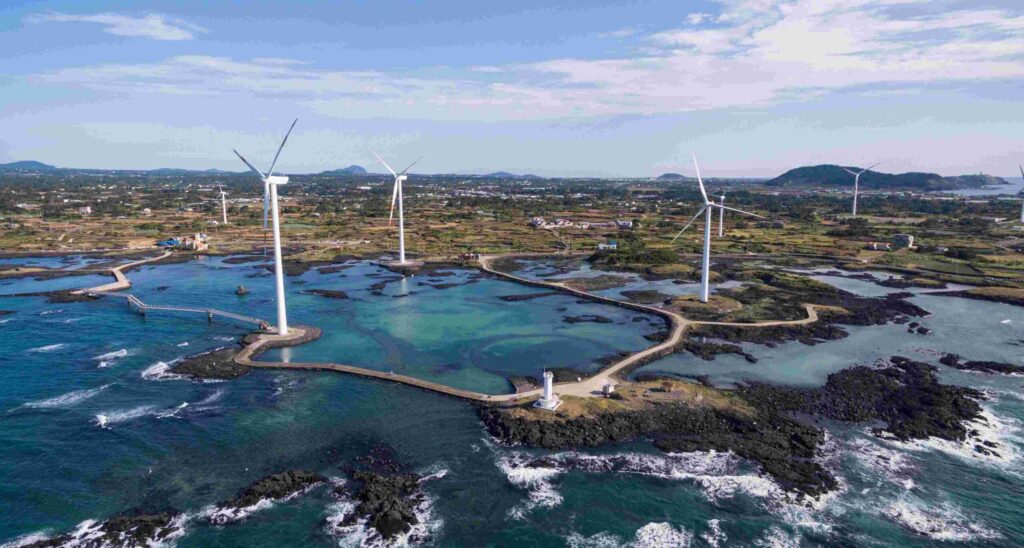
- Windmill walks: Sinchang Windmill Coastal Road (west coast, 30-60 minutes depending on route, raised platform over water); Haengwon to Gimnyeong Beach (east coast, Camel Coffee starting point, Woljeong and Gimnyeong beaches, snorkeling in summer)
- Historical hikes: Sumbisori Gil from Haenyeo Museum through farmlands to Hado and Byeolbangjin fortress (2 hours full loop; take bus one way to halve it); Altereu Airfield (WWII Japanese hangars among garlic and radish fields, connects to Seodal Memorial and April 3rd massacre site; dark tourism, requires car)
- Tea plantation: Osulloc (walk past the crowded cafe into the plantation itself; biggest in Jeju; rows of tea as far as you want to walk)
- Waterfalls: Jeongbang (only waterfall in Korea that flows directly into the sea); Sojeongbang (small Jeongbang; peaceful, fewer crowds); both connect to Lee Jung-Seop Street walk; art gallery and Sora’s House (shell museum) nearby
- Blog post with all hikes: vamosajeju.com/hike
Next Steps
- Plan your Jeju trip at vamosajeju.com/trip
- Sign up for the 14-part email series at vamosajeju.com/start
- Follow Vamos a Jeju on Instagram, TikTok, or YouTube.
- Share the episode with friends to help the podcast grow
- Visit vamosajeju.com for articles, videos, and resources
Episode Transcript
Coastal Headlands — Seopjikoji & Songaksan
Ed (00:18) Welcome to today’s episode of the Vamos a Jeju podcast. Last week, if you recall, we talked about some of the hikes that I planned for my family to do when we were going to be in Jeju at the end of 2026. And those hikes were really designed for people who don’t really like hiking. That’s why it was called hikes for hike haters. And so today we’re gonna pick up where we left off by talking about several hikes that we’re gonna go on but before we do that I have my buddy Sora with me. Say hi Sora.
Sora (00:49) 안녕하세요! Hello everyone! Welcome to our show today again!
Ed (00:53) So Sora I got a question for you. Of all the hikes that we talked about last week, which ones were your favorite?
Sora (01:01) Of course my favorite is Sarabong. The one next to my apartment is easy and beautiful. Yeah, it’s always my favorite.
Ed (01:09) Right. And that’s right in your backyard. So that’s really convenient.
Today we’re going to move on to the next group of hikes that I think hikers like some people in my family will actually enjoy and so we’re going to cover the hikes around the headlands or capes, we’re going to touch on a couple of hikes around windmills, a couple of hikes that are rich in history and one in the tea plantation. So with that let’s get going.
Ed (01:39) So I know that I’ve actually never been to the next one, so I’m really curious to get your thoughts on this. And so this one that I’ve not been to yet is Seopjikoji. And so I’m sure you’ve been there. Can you tell us more about what Seopjikoji is like?
Soraya (01:56) Seopjikoji is like the cape, small cape. So you can walk around these places. It’s actually very near to Seongsan sunrise peak. You can actually see Seongsan from Seopjikoji and it’s full of canola flower from March to May. So you’re gonna see like beautiful flowers and the Seongsan sunrise peak and it’s very, very easy to walk. It’s almost no incline. So I think you can, like, even if you don’t like hiking or you don’t like walking, it’s easy.
And also the view for the ocean, because it has like many formation of lava rocks. We have like several names of those rocks. So you’re gonna see beautiful ocean, lava rock formation, canola flower. It’s like classic, classic Jeju attraction like from, I think from 30 years ago.
Ed (02:53) Seopjikoji is a cape on the eastern side of the island. There’s another one on the southwest and that is called Songaksan. So Sora, I know you bring people to Songaksan, because it’s part of your tour itinerary when you work with the agency. Can you tell us more about that?
Soraya (03:05) So, Songaksan is a small mountain and there’s two different trails. So I think Ed is now talking about the loop at the bottom but there’s another one to go up to the top as well. But for me I recommend the loop area because you can see all this panoramic view of the ocean and lava rocks. That is beautiful if the weather is good.
If you are a K-drama fan, if you have watched When Life Gives You the Tangerine, this was the film location. When Hakshi had a date riding a bicycle, it was Songaksan area. And for these K-drama film locations, we’re going to talk about later in a future episode.
Ed (03:56) Yeah, we’ll probably hit those episodes in maybe in a couple of months because we’ve got so much to get through before we actually focus on K-dramas. And so those are some easy walks. And Songaksan, there is some cafes there but once you’re on the trail there’s nothing really much. And so on the plus side it is not too long a walk. On the negative side it’s like once you start walking the loop you gotta finish it. There’s no taxi or bus to rescue you from the rest of the hike. But again it is not too long and it’s not too difficult.
Windmill Walks — Sinchang & Haengwon
Ed (04:30) Okay then, the next category that I thought of for offering as an option to my family is windmills because like personally I’m fascinated with the windmill generators on Jeju Island. And so I remember Jayden telling me that Jeju has so many wind power generators that sometimes they have to stop them because there aren’t enough batteries to store the power. I was like, wow, that’s fascinating. But it’s also very fascinating to see like when you walk under them, it’s just spinning and it just goes whoop, whoop. It’s… I just geek out about stuff like that. But if you’re not a geek like me, it is still beautiful to look at it.
And so one of the places that I enjoy walking or bringing people to is Sinchang Windmill Coastal Road. There’s a longer trail that brings you on a raised platform out into the water. If it’s, especially when the tide’s in, you’re going to be over the water. If the tide’s out, maybe you’ll see some lava rock, but it is longer. And that route maybe takes you about an hour. If you’re a slow walker, or if you’re trying to take your time and take pictures, maybe an hour and a half.
So that’s the longer walk and that connects the windmills further out. If you want to do the shorter walk, just stay near the shore and that could be like just 30 minutes. So again, I like that there’s different options. So for this one, potentially the people who don’t like hiking can just do the shorter walk, while the ones who like hiking will go for the rim. And so those are some nice options. There’s some places to have like tangerine juice, some maybe ice cream and some snacks in the area but this place is much easier to come to if you have a rental car. If you have a bus that might be more challenging because it involves quite a bit of walking from the nearest bus stop.
Now the whole point of today’s episode is for people who hate hiking so walking 10-15 minutes from the bus stop is a no-no. I would do that but it’s not friendly for hike haters. Like what? I got to walk to go hiking? That’s ridiculous. Yeah, to be able to manage expectations, make sure that even people who don’t like hiking get a good time, it’s better to have a car or a taxi. Is it easy to get a taxi on the way back? Just use Uber app, right?
Soraya (06:38) Yeah, you can just use Uber, but I think Kakao Taxi has more taxis, so it’s more easier and faster.
Ed (07:00) Better?
Soraya (07:01) So to walk with the windmill views, of course, Sinchang is beautiful, but I like the one in the east, which is called Haengwon near the Gimnyeong beach. You can also see here this beautiful colored beach area and the lava rocks and then the windmill together. And of course we have a lot a lot of cafes around here, beautiful cafes. So yeah I think this place like near Gimnyeong, Haengwon is one of my favorite places to chill.
Ed (07:36) It’s got all the options. It’s got the windmills, it’s got the lava rock. It’s got the beaches as well and then cafes.
And so speaking of cafes, I like to start my walk where Camel Coffee is. It is connected to a bakery and they are built on lava rock, but it’s overlooking a small beach, a small white sand beach. Then just looking to the left side you will see some of the windmills. So I like this as a great starting point because you have your coffee and then you start walking. You can choose to walk on the lava rock and that’s part of the Olleh trail that takes you out to one of the windmill generators.
So you’re going to be passing two beaches. One is Woljeong beach and then the other one is Gimnyeong beach. And so both have like cafes and food places. So even though this is a longer walk and there aren’t as many options for buses, you can take your time, take a break, have a coffee, watch the beach goers, maybe walk on the sand if you want to. So there are nice options there. So longer walk, but lots of places for breaks and then there’s like wind mills, great scenery. It’s a fantastic walk. And that’s why it makes it onto my list that I will offer to my family as an option.
Soraya (08:43) And also, and in summer, actually around this area is popular snorkel spot for locals. So if you are a swimmer, maybe you can go there, take a walk and swim a little bit in the sunny summer.
Historical Hikes — Sumbisori Gil & Altereu Airfield
Ed (09:04) So those are the hikes with the windmills. And then another one is because I’m a history geek, I really nerd out on Jeju history and Jeju culture. And so I thought I would offer my family some options of hikes that are historically important. And so one of those hikes is, we mentioned this before in the Haenyeo episode earlier on in our series, which is the Sumbisori Gil. And that is in the area of Sehwa Beach and this trail will start at the Haenyeo Museum which Sora and I love. Have you and Jaden walked on the Sumbisori Gil before?
Soraya (09:42) We did part of them, of course, but we didn’t finish like whole of this at once.
Ed (09:48) Okay, so the Sumbisori Gil basically takes you along from the Haenyeo Museum to the Sehwa Beach where you will see like an old bulteok, an old Haenyeo gathering house and they will hug the coast and then it will also cover part of the farmlands that the Haenyeo used to have to work in. And then you end in Hado which is like the neighboring town where Sora always says has the strongest Haenyeo union. And then there’s also a fortress village called Byeolbangjin. I do not know why I can never remember that name. Byeolbangjin. And so that is actually a very nice walk. It takes about two hours to do the complete loop.
But here’s the thing, there are buses. So this one is another example where you can just drive and park your car at the Haenyeo Museum, check out the Haenyeo Museum, get a drink, get a cafe, lots of restaurants in the area. And then you can choose to look at the schedule, take the bus to Hado, and then you walk back. So therefore, for the people who don’t like walking, you’re only walking half the loop.
And again, lots of interesting things along the way. If you’re taking the coastal route, it’s the beautiful scenery and all that. If you’re walking the farmland route, it’s also interesting to see how Jeju people live. There are actual, like you walk past, depending on the season, you’ll see whatever’s grown. Like you see radishes, mu, or you’ll see cabbages, yangbaechue. And you’ll see carrots, danggun. You’ll see all these different things depending on the season. So I found it very interesting to walk across the farmlands.
Soraya (11:30) So the other place with walking with history, I would suggest Altereu airfield which is located in the southwest of Jeju. And it was actually a runway for Japanese army. So we have… Actually, Altereu means “al” is like under, this bottom. And then “tteure” is field. And it was used for Japanese airfield during World War. If you go there now, there’s a lot of crops growing like garlic or radish. Now people just use it for the crops.
But right next to the crops, you’re going to see like hangars, small hangars for small airplane. And at first, when I saw it, I felt it’s kind of weird. It’s grotesque. What is that? And then it turns out it was the airplane that Japanese used to use for the war. And it’s kind of dark to walk around these places, but it’s important to know the history. So I think if you’re interested in history, even though you don’t like hiking, it’s good to go there to see what the remains are.
Ed (12:47) Right. And just a little bit further away is going to be the Seodal Oreum and at the foot of the Oreum is a memorial commemorating a lot of people who were killed in a tragedy called the Four Three Massacre. I don’t think we’ve covered this before in the series, and I don’t think we’ll cover it right now today either. But this is definitely a trail from the Altereu airfield to the Seodal Memorial and beyond, but there’s like Japanese anti-aircraft positions in the Oreum itself. If you’re interested in history, or if you understand what dark tourism is, like learning about tragedies in the past, this is a very meaningful trail to take.
Having said that, even if you don’t know anything about history or what happened in the decades before, it is still an interesting place to walk around. This one, you need a car to get there. No buses. And if you want to walk in, it’s going to be a long, long walk in. So definitely need a car or a taxi to get you to the Altereu airfield area.
It’s in this list, even though there’s no cafes and no buses because if you just want to walk around the air field area where the farms are now, it is just 30 minutes. But if you want to push further and walk to the Seodal Memorial and the Oreum there, that’s another 30 to 40 minutes. So total time, maybe 60 minutes to 90 minutes.
Tea Plantations — Osulloc
Soraya (14:15) So if it was too dark to walk in there, maybe you can just go to Osulloc Tea Museum. It’s more bright, happy, a lot of people. But actually Osulloc Tea Museum itself is very crowded. But in the tea garden, there are not many people and people are just in front of the garden. So if you want to enjoy the tranquil moments of the tea garden you can go inside and take a walk along this tea garden then you’re gonna see like different part of Osulloc.
Ed (14:48) Yeah. And so to be clear, it’s called the tea garden, but it is actually a plantation. So if you were to leave behind the cafe, I refuse to say it’s a museum. If you leave behind the cafe and the gift shop and all the crowds are, and just keep walking, you can also walk across the main street for where the tour buses drop their people. Just walk past the tour buses. Just keep going. It is a huge tea plantation. I think it may even be Jeju’s biggest tea plantation. I’m not sure.
Soraya (15:19) Mm-hmm. Mm-hmm.
Ed (15:25) Yeah, it is. Okay. Yeah. It’s the biggest tea plantation. Just keep walking and yeah, eventually you get to a point where you’re the only people there and it’s just nice to walk. You’re walking between the rows and rows of tea. And so this one is on this list because number one, of course, there’s the Osulloc cafe. If you want to have a drink and all that kind of stuff, you probably need a car to get there. There’s buses, but the buses may not be so frequent. So a car is more helpful.
But what I like about it is that I can make it as short as my group wants it to be. It can be like, okay, we’ll just walk the smaller plantation nearer to Innisfree, which is like next to the Osulloc gift shop cafe. And then those people who get sick of it can walk back to the cafe and have a drink. And then the rest of us can cross the road and keep going. And on the flip side, it can be a bit boring because they all look the same after a while. So it all depends on what you want to do. But I just have fun walking back and forth in between the rows and rows of tea but not everybody wants to do the same thing.
Waterfalls — Jeongbang & Sojeongbang
Ed (16:17) Osulloc which was on one of our top 10 tourist traps in a very early episode, I figured we should also cover another tourist trap that we talked about in that episode. And that was Jeongbang waterfall. Actually, that’s just the waterfalls in general.
I’m not saying that it’s not worth going to the waterfalls in Jeju. I’m just saying that if you calibrate your expectations, and I’m not expecting like major ones like Iguazu Falls in Brazil slash Argentina or Victoria Falls in Zimbabwe or Niagara Falls in America slash Canada, if you calibrate your expectations, it is a nice place to walk to and it’s not difficult.
I have actually only been to Jeongbang waterfall once. I’m sure you’ve been with tourists many times. Can you tell us more about Jeongbang waterfall?
Soraya (17:16) But Jeongbang waterfall is the only waterfall that comes from the mountain to the sea directly. That’s why this waterfall is famous in Jeju. And it is actually beautiful with those cliffs. Yeah, people like to take photos in front and play with the stones and beach there.
And actually, I think you might know that there is another, So Jeongbang, small Jeongbang waterfall, right? So from Jeongbang waterfall and through small Jeongbang waterfall, there’s a, I think it’s also part of Olleh trail and it is very beautiful and there’s not many people. So if you are here and if you like to go a little more, then I think you can have a small loop for Jeongbang waterfall and then small one as well.
Ed (18:07) Right and Jeongbang waterfall starts very close to city and so it’s not going to be difficult to walk at all. In fact if you want to combine the Lee Jong-Seop street walk to Jeongbang waterfall it is maybe another extra 30 minutes.
Soraya (18:26) And actually there’s an art gallery in front of Jeongbang Waterfall. It’s a paid art museum, but if you are a big fan of art, maybe you can have a look as well.
Ed (18:36) Yeah. And then in the Sojeongbang waterfall, there is a shell museum or something like that.
Soraya (18:41) Right, it’s like Sora’s house. House of Sora.
Ed (18:44) Your house? Yeah Sora is conch in Korean so it also happens to be the name of my co-host Sora. So you’ll be going to the house of the conch or seashell or in Korean is Sora’s house!
Okay yeah so if you thought that Jeongbang waterfall is small, then Sojeongbang waterfall, which literally means small Jeongbang, it’s even smaller. It’s pretty, but it reminds me of one of those water fountain features in a condo. It’s very small. Have you been there? Have you seen it before? It’s very small, right? Yes, yes.
Soraya (19:27) Yeah, yeah, yeah, right, right. But I really liked it. I really liked it because it was calm, not many people, and it was summer. So it was, yeah, right, right. It’s not about the size of the waterfall.
Ed (19:38) Yes, the vibe is very nice. Yes. Yeah. Okay.
Wrap-up & Next Steps
Ed (19:38) So that wraps up my list of menu options that I will be presenting to my family. It is basically again, options for people who really don’t like to hike, but also a way to combine hiking options for people who like hiking as well. What did you think about these options? Are these things that you think Jaden will be open to walking with you even though he hates hiking?
Soraya (20:08) I think so. I think most of these hiking we did and then there is no big complaint. So I think it works. It’s gonna work, it’s gonna work for Michele as well.
Ed (20:13) Okay, that sounds great. So yes, today we talked about hikes for people who hate hiking. We covered a few major things like coastal headlands or capes and then thematic ones like walking with windmills and historical hikes, waterfalls and of course tea plantation. Yeah, that is a full spectrum. I don’t think we’ll walk every single one of them. But if you do walk any of these, I would love for you to leave a review to let us know what you thought of it.
Ed (20:49) You’ll be able to find the blog posts that we’ve compiled for all the hikes from today’s episode. You can go to vamosajeju.com/hike. That’s v-a-m-o-s-a-j-e-j-u.com/hike.
And don’t forget that you can find our trip planner to help DIY travelers at vamosajeju.com/trip. That’s v-a-m-o-s-a-j-e-j-u.com/trip.
Sora (21:23) One more thing. Did you know it’s very easy to share our show with your friends? On Apple Podcast, just tap on the horizontal three dots on the top right corner and tap on the share show icon. And on Spotify, you can find the three horizontal dots near the top right under our show art and you will see the share icon.
Ed (21:44) Yup, and with that, all that’s left for us to do is to say… Annyeong!
Sora (21:49) Bye!
