
What You'll Find in This Article
So you’ve just landed at Incheon International Airport (인천국제공항), cleared immigration, grabbed your bags, and now you need to get to Gimpo International Airport (김포국제공항) to catch your domestic flight to Jeju. You’re bypassing Seoul for now – smart move. The island is calling.
There are three ways to make this connection. The best choice depends on your budget, your connection time, and what time of day you’re traveling
The Quick Decision Guide
First time in Korea and want maximum simplicity? → Take a taxi via the Uber app. No navigation, no Korean needed.
Tight connection (under 3 hours)? → Take the train. Rush hour traffic can add 30+ minutes to bus/taxi rides.
Plenty of time and traveling during off-peak hours? → Bus or taxi work fine when traffic is light.
On a budget and planning to use public transit in Jeju? → The train is your friend, and you’ll need that T-money card anyway.
Option 1: Taxi via Uber App (Easiest for First-Timers)

Cost: ₩30,000–45,000
Travel time: 40–70 minutes (depending on traffic and route)
Best for: First-time Korea travelers, small groups of 2–3 people without excessive luggage, those who value door-to-door convenience
This is hands-down the easiest option if you’ve never been to Korea before. Open the Uber app, request a ride, and the app will direct you to a designated taxi pickup location in the arrivals hall. No Korean required, no navigation required, no figuring out ticket machines or train platforms. The app handles everything including payment.
The tradeoff? Travel time can vary significantly depending on when you’re making this trip. If you land during weekday rush hours (7–10 AM or 5–8 PM), that 40-minute ride can stretch to 70+ minutes as you sit stuck in bumper-to-bumper traffic. Taxi drivers have some flexibility in routing. They might take side roads to avoid congestion, but during peak hours, delays are pretty much unavoidable. And you’re paying the same fare whether you’re cruising along or crawling.
BTW: Regular taxis fit 2–3 passengers comfortably with typical luggage. If you’ve got more bags, Uber also offers an XL option for a slightly bigger taxi that can handle 2-3 people with more luggage, though this will cost a bit more.
Option 2: Airport Limousine Bus (Middle Option)
Cost: ₩4,000–8,000
Travel time: 50–70 minutes (depending on traffic)
Best for: Solo travelers who want simplicity without the taxi price tag
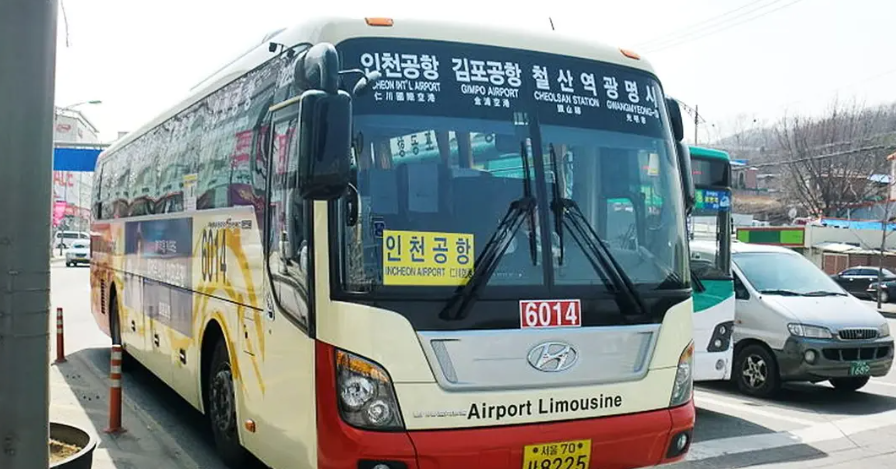
There’s a direct airport limousine bus that runs from Incheon to Gimpo International Airport (김포국제공항). Look for the airport limousine bus counters in the arrivals hall – staff can point you to the right bus stop and route number.
The bus is more comfortable than it sounds. These aren’t city buses, they’re coach-style with luggage bays. You’ll have a seat and you can relax.
About the stops: The bus makes limited stops between the two airports. If you’re departing from Incheon Terminal 2, it will stop at Incheon Terminal 1 first. At Gimpo, it stops at the International Terminal before arriving at the Domestic Terminal (where you need to be for your Jeju flight). So you’re looking at 1–2 stops total depending on which Incheon terminal you start from. It’s still much faster than navigating transfers yourself.
Travel time depends on traffic conditions. During off-peak hours, you’re looking at closer to 50 minutes. During rush hour, expect 60–70 minutes.
Option 3: Airport Railroad All-Stop Train (일반열차) - For predictable Travel Times
Cost: Around ₩4,500
Travel time: Around 40 minutes (consistent, no traffic), excluding walking to and from the train stations.
Best for: Anyone with a connection time under 3 hours, budget travelers, people who don’t want to gamble on rush hour traffic
For most people, especially those with a connection under 3 hours, the train is the right call.
The train runs on its own dedicated tracks underground, completely immune to whatever’s happening on the roads above. No traffic, no delays, no surprises.
Plus, if you’re the kind of traveler who likes knowing exactly when you’ll arrive, the train delivers.
A quick note on naming: The “All-Stop Train” (일반열차, ilban-yeolcha) is a bit of a misnomer. It doesn’t actually stop at every station. It just makes more stops than the AREX (Airport Railroad Express, 공항철도 급행), which is the premium non-stop service that runs directly from Incheon to Seoul Station. The All-Stop train is still an express compared to regular subway lines, but it stops at key stations including Gimpo Airport. The AREX does NOT stop at Gimpo, which is why you don’t want it.
Here’s how to do it, step by step.
Taking The All-Stop Train to Gimpo: A Cheat Sheet
Step 1: Getting to the Train Station at Incheon Airport
After you clear immigration and customs, you’ll find yourself in the arrivals hall. Both Incheon Terminal 1 and Terminal 2 are crescent-shaped, and depending on which immigration lane you went through, you might be funneled into different parts of that crescent. Don’t worry. All paths lead to the train station, which is about a 10-minute walk.
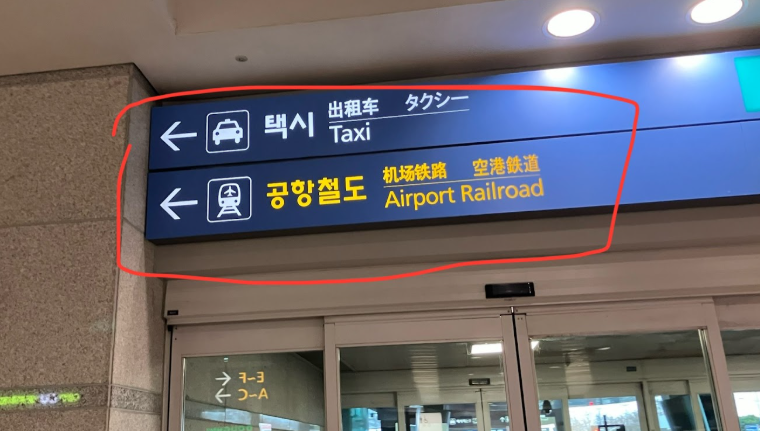
Look for signs pointing to “Airport Railroad” or “공항철도”. Depending on which part of the arrivals hall you’re in, and which Terminal you arrive at, these signs might point left OR right. Just follow them. Eventually, they’ll lead you downstairs.
Once you head down, you’ll walk through one of several connecting hallways that bring you to the underground station. Keep following the signs.
Step 2: Finding the Right Train Platform
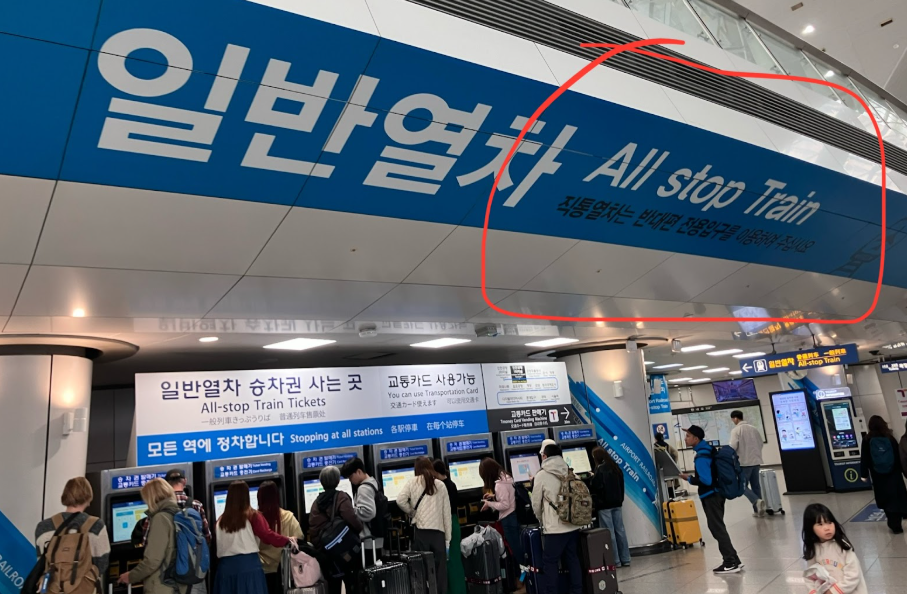
As you get closer to the station, you’ll start seeing the signs split into two options:
- Blue signs = All-Stop Train (일반열차, ilban-yeolcha – literally “regular train”)
- Orange signs = Airport Railroad Express (AREX) Train (공항철도 급행, gonghang-cheoldo geuphaeng)
You want the BLUE signs. The All-Stop Train. The orange AREX is the non-stop service that shoots straight to Seoul Station. It does NOT stop at Gimpo, so ignore it completely if you need to get to Gimpo.
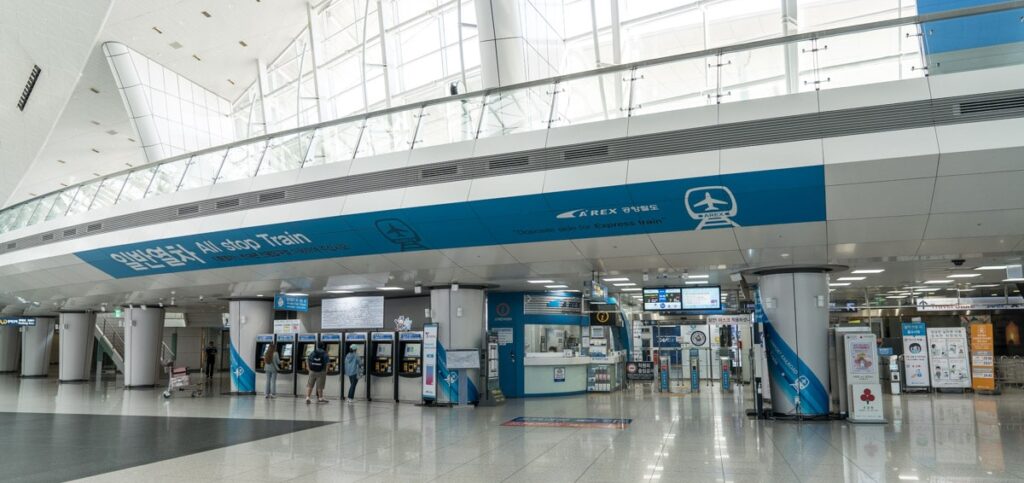
The All-Stop station entrance will be across the hall from the AREX entrance. Once you find it, look for the ticket gates right under the words “All-Stop Train” in English.
Before you tap in: You’ll need either a single-journey ticket or a T-money card (티머니 카드). Here’s what I recommend:
- If you’re heading to Jeju and plan to use buses there: Get a T-money card. You can buy one using a credit card at the convenience store (GS25, CU, 7-Eleven) or at vending machines near the gates. The card itself costs about ₩2,500–4,000. To top it up, you will need cash. Start with at least ₩10,000 cash – you’ll use it for this train ride and for Jeju’s buses later.
- If you only need it for this one trip: Buy a single-journey ticket at the ticket machines using cash. To avoid confusion, the Orange AREX non-stop train accepts credit cards, but since that is not your train, it’s cash only for the blue All-Stop Train.
Once you’ve got your ticket or card, tap in at the gates and head downstairs to the platform.
You’ll be taking the train towards Seoul Station (서울역) on Platform 2, but you’ll be getting off at Gimpo International Airport Station (김포공항역). Hard to go the wrong way, the signage is pretty clear.
Step 3: On the Train
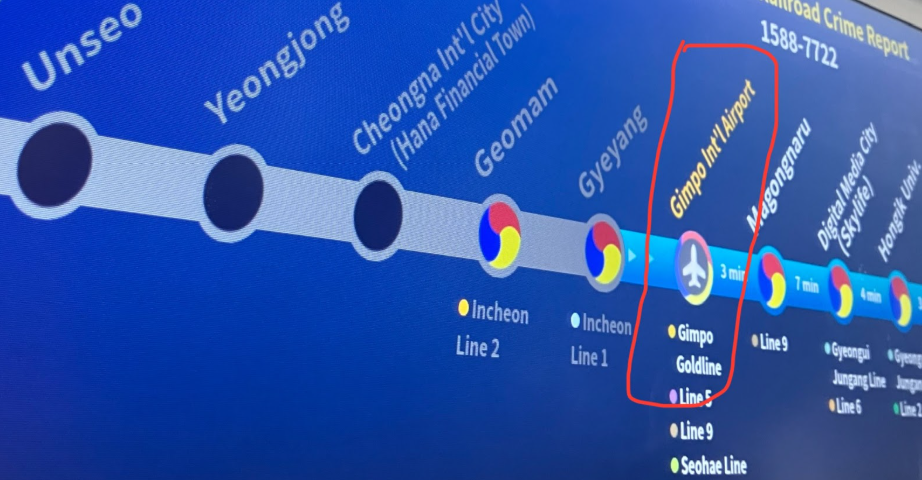
Hopefully you’ll snag a seat. The train can get crowded, especially during rush hours, and it’s about a 40-minute ride. Try to position yourself somewhere you can see the electronic signs above the doors. They rotate through different languages and show you how many stops until your destination.
When you get to Gimpo International Airport Station (김포공항역), get off and prepare to go UP.
Step 4: Exiting Gimpo International Airport Station (Don't Take the Wrong Exit!)
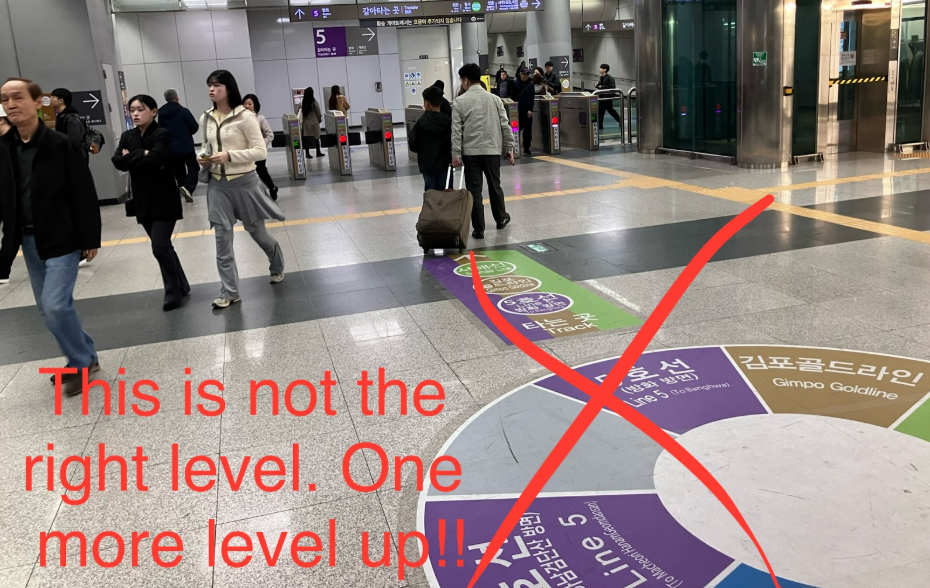
Here’s where people sometimes get confused. After you get off the train, you need to go up three levels to reach the domestic terminal. You can take the escalator or the elevator.
IMPORTANT: If you take the escalator, be aware that two levels up, there’s a major exit. This is NOT your exit, that’s the connection to the Seoul subway system for people heading into the city. Your exit is one more level up.
If you see floor signs pointing to the subway transfer, just remember: keep going up one more level. You’ll see signs on the floor and walls pointing to “Domestic Terminal” (국내선). Follow those.
Eventually you’ll reach the final ticket gates where you tap out of the train system. Tap out, then continue following signs to the domestic terminal.
Step 5: From the Station to Gimpo Domestic Terminal
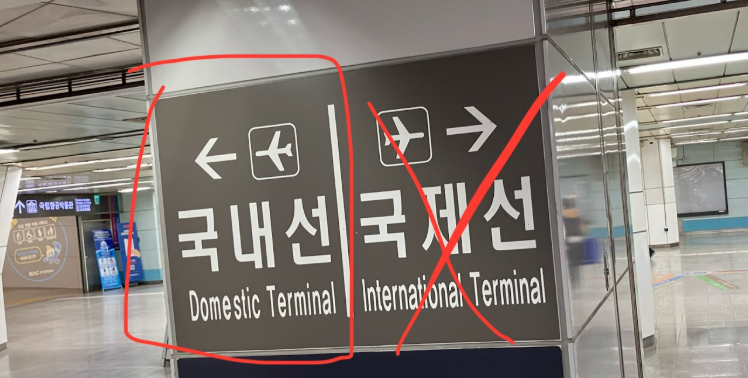
Here’s the second place people sometimes head the wrong way.
After you exit the ticket gates, you’ll see signs pointing in opposite directions:
- Left → Domestic Terminal (국내선, Gungnae-seon)
- Right → International Terminal (국제선, Gukje-seon)
Go LEFT. Heading right will take you to Gimpo’s international terminal, which is a completely different building. If you go the wrong way, you’re looking at a 30-minute detour to get back on track.
Follow the long walkway toward the domestic terminal. It’s well-marked but it is a bit of a walk, so just keep going. At the end of the hallway, you’ll turn right and find escalators and elevators that take you up into the airport proper.
Step 6: Getting to Your Departure Gate
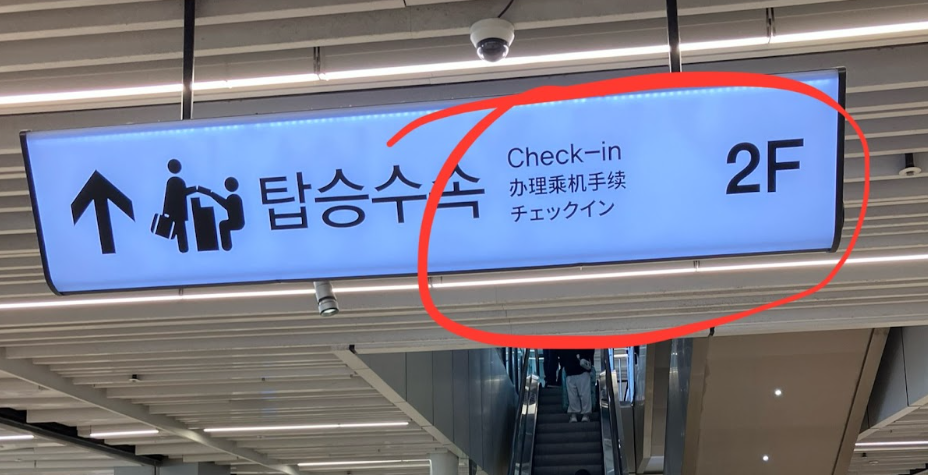
The escalators or elevators will bring you to Level 2, where the check-in counters are.
Important: Korea recently made it mandatory for overseas visitors to present their passports at check-in counters for domestic flights, even if you’ve already checked in online. You’ll need to stop at your airline’s counter to show your passport and get your boarding pass printed before heading to security. This is a quick process, but factor in a few extra minutes.
Once you have your boarding pass and your bags are checked, head up to Level 3 where the departure gates are.
Look for signs pointing to “Departure” (출발, Chulbal) or “Gates” (탑승구, Tapseung-gu). You’ll find two security checkpoints, so have your boarding pass and passport ready.
Note: There are special lanes marked on the floor for people with biometric clearance. Unless you’re a Korean citizen enrolled in the automated system, avoid those lanes and queue in the regular ones.
After a staff member checks your ID and scans your boarding pass, you’ll go through security. Unlike in the U.S., Korea allows liquids on domestic flights, so you don’t need to worry about tossing your water bottle.
Once you’re through security, the terminal splits in two directions. Check your boarding pass for your gate number and follow the signs.
What If You're Coming from Downtown Seoul?
Maybe you did spend a few days in Seoul first and now you’re heading to Jeju from the city. Here’s how to get to Gimpo from downtown:
From Seoul Station (서울역), Hongdae University Station (홍대입구역), or Digital Media City Station (디지털미디어시티역): Take the Airport Railroad All-Stop Train (일반열차) directly to Gimpo International Airport Station (김포공항역). This is the same blue-line train service that runs from Incheon, just boarding from different stations along the route. Travel time is about 30 minutes from Seoul Station, 18 minutes from Digital Media City Station, and around 22–25 minutes from Hongdae. Fare is around ₩1,500–2,000.
From other subway lines: Gimpo International Airport Station is also served by Seoul Subway Line 5 (purple line) and Line 9 (gold line). If you’re anywhere along those lines, you can take the subway directly to the airport. Check your route on Naver Map or KakaoMap. Both apps are excellent for Seoul public transit.
From Gangnam or other southern areas: Line 9 is your fastest option. It’s an express line and will get you to Gimpo International Airport in about 30–40 minutes depending on where you’re starting.
Once you arrive at Gimpo International Airport Station via any of these methods, follow the same instructions above: go up three levels, exit toward the Domestic Terminal (left, not right), and follow signs to departures.
Final Tips
Buffer time: If you’re connecting from an international flight at Incheon to a domestic Jeju flight at Gimpo International Airport, give yourself at least 3 hours minimum. That accounts for immigration, baggage claim, travel time, and getting through security again at Gimpo. If your Incheon arrival is during peak hours or if you’re not confident with the navigation, add another 30–60 minutes of buffer.
T-money card optional?: We’ve already discussed how clutch the T-Money card is. Here is one exception: In 2025, Visa Contactless terminals were installed on the blue mainline Jeju buses serving the main cities and tourist areas. If you really do not want to buy a T-Money card, and do not plan on exploring Jeju outside of the main tourist areas, you may be able to get away with just buying a Single Journey Ticket for the All Stop Train to Gimpo.
And then, on Jeju, just using your phone, watch, or contactless credit card. Do note that if you do go to Seoul, you’d want to have the T-Money card. FWIW, I would say, just get the T-Money card!
Download useful apps: Before you leave home (or while you’re waiting for your luggage), download Naver Map or KakaoMap for navigation, and get a translation app like Google Translate or DeepL. The camera translation feature in these apps is incredibly useful for reading signs, menus, or ticket machine instructions when you’re stuck.
Luggage considerations: If you’re traveling with a lot of bags, the taxi or bus might be worth the extra cost just for the convenience. The train requires a bit more walking and navigating stairs/escalators.
Most importantly, don’t stress. Thousands of people make this connection every day. The signs are in English, the staff at both airports generally speak some English, and even if you take a wrong turn, you’ll figure it out. Just give yourself enough time, and you’ll be fine.
Now go catch that flight. Jeju is waiting, so start planning your own trip!
