What You'll Find in This Article
Welcome to Email 10!
So far you’ve learned about:
- Seongsan (volcanic crater you can climb)
- Butcher BBQ (how locals eat)
- Dolphins & Coast (natural beauty)
- Hallasan (the volcano that created everything)
- Haenyeo (disappearing sea women tradition)
- Manjanggul (walk inside the volcano)
- Green Tea (tea culture and plantations)
- Seasonal Highlights (when to visit)
- Oreums (368 mini-volcanoes)
Today: Traditional rotating markets where locals shop and tourists almost never go.
PART 1: Why You Shouldn’t Miss This
5-Day Markets (오일장) – Jeju’s Rotating Market Tradition
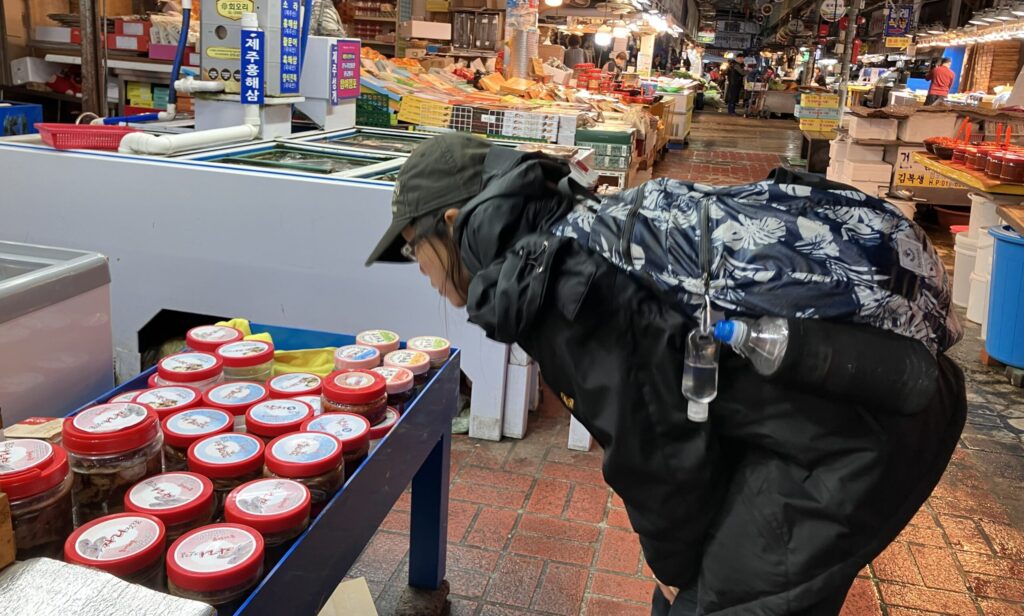
Every five days, vendors pack up their goods, load their trucks, and move to a different town. Fresh produce, seafood straight off boats, homemade kimchi, handmade goods, street food from grandmas who’ve been cooking the same recipes for 40 years.
This is how Jeju people actually buy food and household goods. And if your timing works out, it’s one of the most authentic cultural experiences available on the island.
What Are 5-Day Markets?
The concept dates back to Korea’s Joseon Dynasty (before the 15th century). Back then, people traveled on foot. Markets needed to be spaced far enough apart that vendors could walk from one to the next, and close enough that customers could reach them.
The solution: Each market opens every fifth day on a fixed schedule. Same vendors rotate through multiple towns. Customers know which day their local market operates.
The system still works today. Nine 5-day markets operate across Jeju on a rotating schedule. Jeju City 5-day market opens on dates ending in 2 and 7 (2nd, 7th, 12th, 17th, 22nd, 27th of each month). Hallim market opens on dates ending in 5 and 10. And so on.
Why 5-Day Markets Beat Tourist Markets
Jeju has two big daily markets aimed at tourists: Dongmun Market in Jeju City and Seogwipo Olle Daily Market in the south. Both are fine if you want a quick market experience and don’t care about authenticity.
The difference between tourist markets and 5-day markets:
Tourist markets have fixed locations, prices inflated for visitors, vendors who expect foreigners, souvenirs mixed with produce, and a performative feel.
5-Day markets have rotating locations, local prices, vendors who rarely see foreigners, pure functionality, and feel completely real.
If you want the experience locals have, skip Dongmun and Seogwipo Olle Daily Market. Hit a 5-day market instead.
What You’ll Find
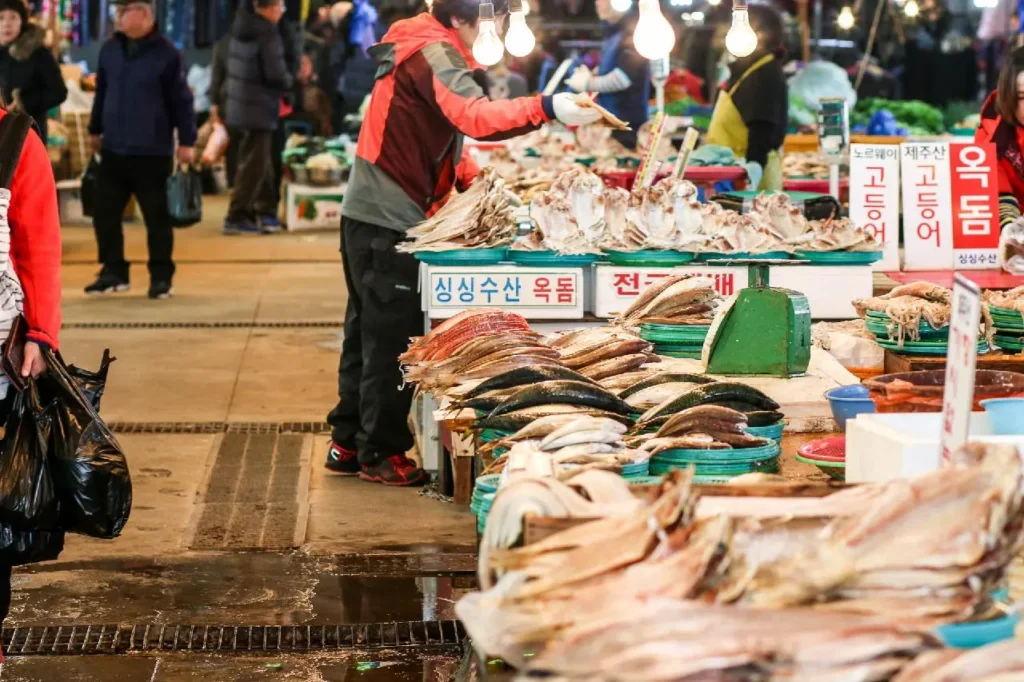
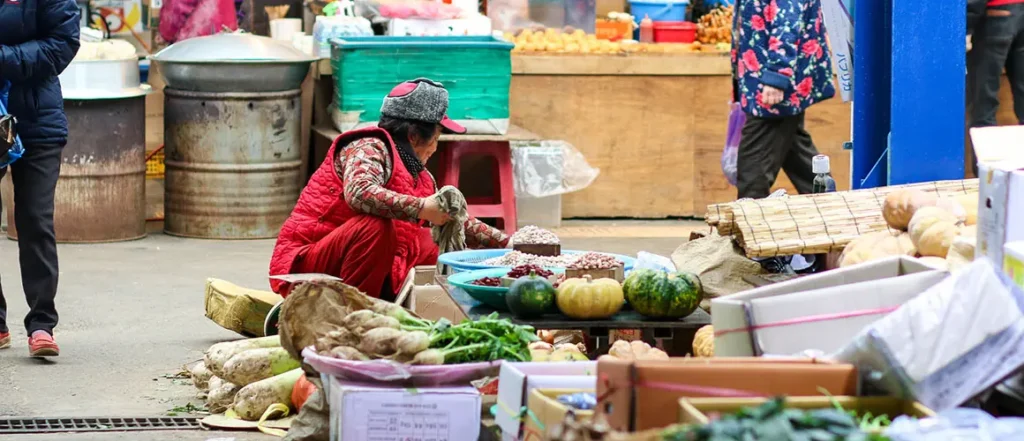
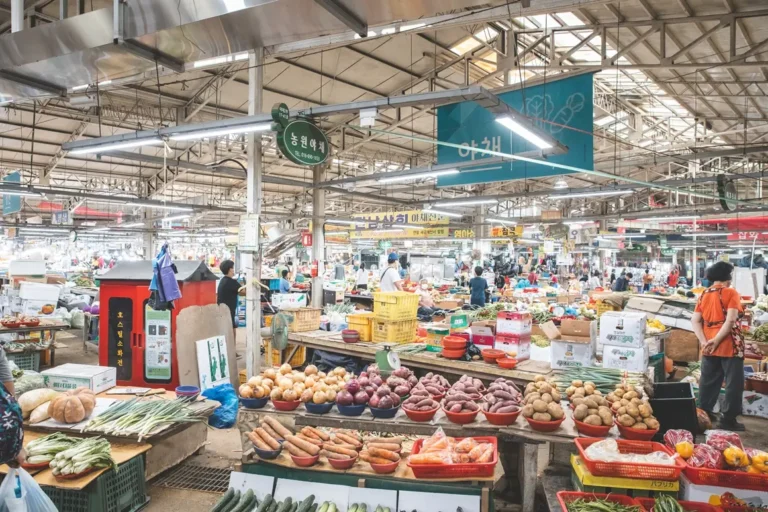
Fresh produce: Vegetables and fruits harvested that morning. Jeju tangerines (in season). Sweet potatoes. Mushrooms. Everything grown locally.
Seafood: Fish and shellfish caught hours earlier. Octopus. Mackerel. Sea urchin. Abalone. Haenyeo sometimes sell their daily catch here.
Prepared foods: Gimbap (seaweed rice rolls). Tteokbokki (spicy rice cakes). Hotteok (sweet pancakes). Bindaetteok (mung bean pancakes). Sundae (Korean blood sausage). Fried snacks.
Household goods: Grandmother vests (halmoni vests) that are trendy now. Kitchen tools. Farming supplies. Clothing. Almost anything you might need.
The food vendors aren’t running restaurants. They’re grandmas and grandpas who wake up at 4 AM, prep their ingredients, drive to the market, and serve until they sell out or get tired. Usually by 3-4 PM they start packing up.
The Social Function
Markets aren’t just commerce. They’re social hubs.
Grandmas gossip while buying vegetables. Friends meet for lunch at food stalls. Haenyeo unions coordinate. Village news spreads. This is where community happens.
You’ll hear elderly women bargaining loudly in Jeju dialect (제주 방언). To outsiders it sounds like arguing. It’s not. It’s just how things work. Animated negotiation is normal. Expected. Part of the culture.
The Famous Gimbap Lady
Sora mentions this in the podcast. At Hallim 5-day market, one vendor sells gimbap so popular that you need to order it, then browse the market for an hour while you wait for your turn.
Is her gimbap objectively the best in Korea? Who knows. But it’s her gimbap. Made her way. And locals wait an hour for it.
This kind of thing doesn’t happen at Dongmun Market.
Understanding the Schedule
Each market opens every five days on specific dates. Here’s how it works:
Jeju City 5-Day Market (제주시 오일시장): Opens on dates ending in 2 and 7
- Example: March 2, 7, 12, 17, 22, 27
Hallim Market (한림시장): Opens on dates ending in 5 and 10
- Example: March 5, 10, 15, 20, 25, 30
Sehwa Market (세화시장): Opens on dates ending in 1 and 6
- Example: March 1, 6, 11, 16, 21, 26
Seogwipo 5-Day Market (서귀포 오일시장): Opens on dates ending in 4 and 9
- Example: March 4, 9, 14, 19, 24, 29
Goseong Market (고성시장): Near Seongsan. Opens on dates ending in 2 and 7
- Example: March 2, 7, 12, 17, 22, 27
Other markets follow similar patterns. Check specific dates before visiting.
Official vs Reality: Operating Hours
Official hours: Often listed as 8 AM to 8 PM
Reality: Vendors arrive as early as 6 AM. They pack up whenever business slows, usually by 3-4 PM.
Grandmas and grandpas run most stalls. They’re not sitting there until 8 PM. When they’re tired or sold out, they leave.
Best visiting window: 9 AM to 2 PM for full selection and energy.
Checking the Schedule
Before visiting:
- Check which day of the month you’ll be in Jeju
- Look up which 5-day markets operate on that date
- Choose one that fits your itinerary
- Arrive between 9 AM and 2 PM
The Markets Worth Visiting
Hallim Market (한림시장)
Location: Western Jeju
Why Sora loves it: She lived nearby for a month. Excellent produce quality. Fresh seafood. The famous gimbap lady. Small enough to explore thoroughly in an hour. Parking lot gets crowded but you’ll find space.
Sehwa Market (세화시장)
Location: Northeast coast, near Haenyeo Museum
Why it’s special: This market played a significant role in Jeju history. The haenyeo resistance movement against Japanese occupation started here. There’s a statue commemorating the haenyeo who organized the protests.
How to combine: Visit Haenyeo Museum, walk Sumbisori Gil, then hit Sehwa 5-day market if dates align. Complete haenyeo cultural experience in one trip.
Goseong Market (고성시장)
Location: Near Seongsan Ilchulbong
Why it’s worth visiting: Small. Authentic. Real village life. If you watched the K-drama “Our Blues,” this market was featured. Combine with Seongsan visit if the market dates line up.
Seogwipo 5-Day Market (서귀포 오일시장)
Location: Seogwipo City
What makes it work: If you’re based in Seogwipo and the dates align, this gives you an authentic market experience without driving far. Larger than village markets but smaller than tourist markets.
Jeju City 5-Day Market (제주시 오일시장)
Location: Jeju City
Practical consideration: If you’re staying in Jeju City and dates work out, this is convenient. Not as charming as village markets but still authentic.
Getting There
By bus: Possible for markets in Jeju City and Seogwipo. Check Kakao Maps or Naver Maps for current routes.
By car: Recommended for village markets (Hallim, Sehwa, Goseong). Parking gets tight but you’ll find space if you’re patient.
What to Do There
Browse: Walk the entire market first. See what’s available. Note what interests you.
Eat: Find a food stall. Sit down. Order something you’ve never tried. Watch the vendor prepare it. This is the best lunch you’ll have in Jeju.
Buy produce (if practical): Fresh tangerines, sweet potatoes, or dried seafood make good purchases. Vegetables require cooking facilities.
People watch: Observe how locals shop. How they negotiate. How they greet vendors they’ve known for decades. This is Jeju life unfiltered.
Take photos (politely): Don’t shove cameras in people’s faces. Ask permission. Smile. Most vendors don’t mind if you’re respectful.
Don’t expect English: These markets serve locals. English is rare. Korean phrases help (see Part 3).
Cost
Eating: ₩5,000-10,000 for a filling meal at a food stall
Produce: Prices vary but generally cheaper than supermarkets. Bargaining is acceptable but not expected for small purchases.
How Much Time to Budget
Quick visit: 1 hour
- Walk through
- Eat at one stall
- Leave
Thorough exploration: 2-3 hours
- Browse entire market
- Eat at multiple stalls
- Shop for items
- People watch
- Chat with vendors (if you speak Korean)
Parking
Lots fill up during peak hours (10 AM to 1 PM). Arrive early or be patient finding spots. Parking is usually free but crowded.
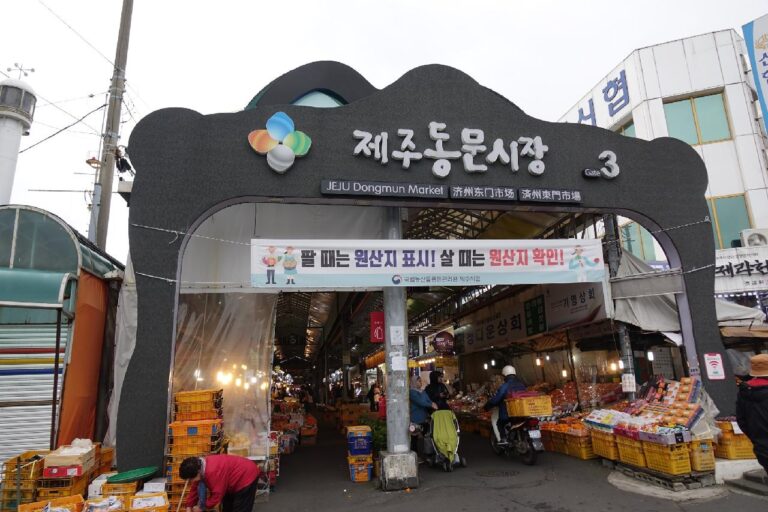
What About Dongmun and Seogwipo Olle Daily Markets?
If 5-day market timing doesn’t work for your trip, the tourist markets are acceptable backups.
Dongmun Market (동문시장): Large, permanent, in Jeju City. Mix of produce, souvenirs, prepared foods. Prices higher than 5-day markets. More English spoken. Convenient but less authentic.
Seogwipo Olle Daily Market (서귀포 매일올레시장): Permanent market in Seogwipo. Similar vibe to Dongmun. Tourist-oriented. Convenient for accommodation shopping but not a cultural experience.
Bottom line: If 5-day market timing works, choose that. If not, the daily markets serve a functional purpose but don’t expect the authentic atmosphere.
PART 3: Korean You’ll Actually Use
At Food Stalls
This please: “이거 주세요” Romanization: I-geo ju-se-yo When: Point at what you want and say this
How much is it?: “얼마예요?” Romanization: Eol-ma-ye-yo?
It’s delicious: “맛있어요!” Romanization: Ma-shi-sseo-yo! When: Say this to the vendor. They’ll love it.
Buying Produce
How much for one kilogram?: “일 킬로에 얼마예요?” Romanization: Il kil-lo-e eol-ma-ye-yo?
Can you make it a little cheaper?: “좀 깎아 주세요” Romanization: Jom kka-kka ju-se-yo Note: Use sparingly and politely. Not every vendor will negotiate.
I’ll take this: “이거 살게요” Romanization: I-geo sal-ge-yo
General Market Phrases
Where is the bathroom?: “화장실 어디예요?” Romanization: Hwa-jang-sil eo-di-ye-yo?
Is this fresh?: “이거 신선해요?” Romanization: I-geo sin-seon-hae-yo?
Do you have…?: “[Item] 있어요?” Romanization: [Item] i-sseo-yo?
Thank you: “감사합니다” Romanization: Gam-sa-ham-ni-da Alternative: “고맙습니다” (Go-map-seup-ni-da)
Market Vocabulary
오일장 (O-il-jang) = 5-day market
시장 (Si-jang) = Market
과일 (Gwa-il) = Fruit
야채 (Ya-chae) = Vegetables
생선 (Saeng-seon) = Fish
해산물 (Hae-san-mul) = Seafood
김밥 (Gim-bap) = Seaweed rice rolls
떡볶이 (Tteok-bok-i) = Spicy rice cakes
순대 (Sun-dae) = Korean blood sausage
Understanding Market Dialogue
You’ll hear loud, animated conversations between vendors and customers. This is normal bargaining and social interaction in Jeju dialect. It’s not arguing. It’s just how business and gossip happen simultaneously.
Don’t be intimidated by the volume or energy. That’s market culture.
Why 5-Day Markets Complete Your Jeju Experience
You’ve climbed volcanic craters. You’ve eaten at butcher shops. You’ve watched dolphins. You’ve walked through lava tubes.
Now watch Jeju people live their daily lives.
Markets show you what doesn’t appear in tourist brochures. Grandmothers selling vegetables they grew themselves. Haenyeo selling sea urchin they harvested that morning. Vendors who’ve occupied the same spot for thirty years. Communities maintaining traditions that predate modern tourism.
This is Jeju without performance. Without English menus. Without accommodation for foreigners.
You’re the outsider here. The guest. The observer of something that exists entirely independent of your presence.
What’s Next
In 2 days, Email 11 takes you walking. The Jeju Olleh Trail. 437 kilometers. 27 routes. Coastal paths. Villages. Volcanic landscapes. History. You don’t need to walk all of it. We’ll show you which sections are worth your time.
But first: check your Jeju dates against the 5-day market schedule. If the timing aligns, add it to your itinerary. Wake up early. Skip the hotel breakfast. Eat gimbap from a grandmother who’s been making it the same way since 1985.
You won’t regret it.
— Ed
