Play Episode
Episode Summary
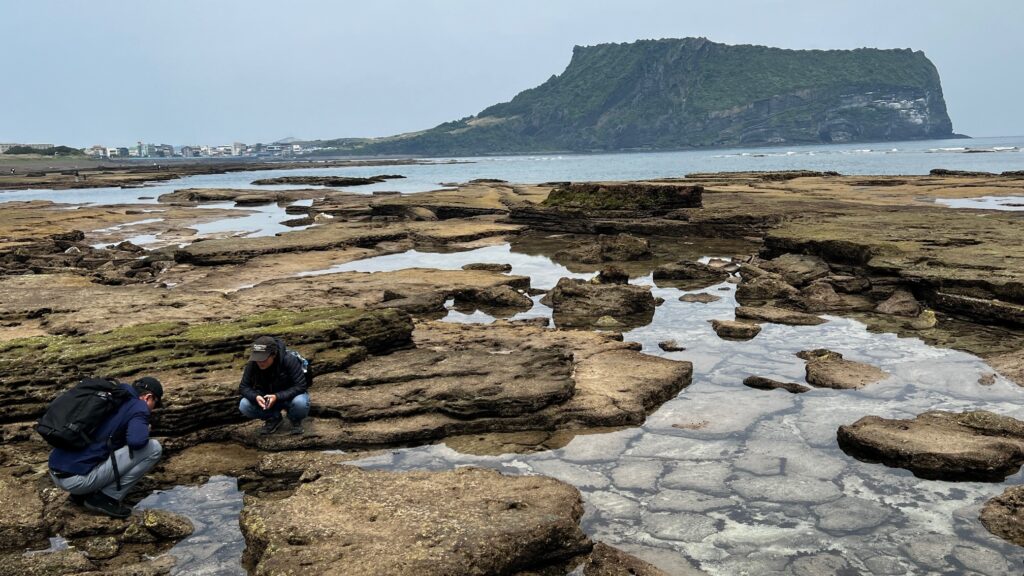
Seongsan Ilchulbong is Jeju’s second most iconic landmark after Hallasan—and for many visitors, the most accessible and memorable natural experience on the island. This episode gives you everything you need to plan your visit: what the peak actually is (a 5,000-year-old hydrovolcano with a massive crater), how long the climb takes (about 30 minutes up, 15-20 down), how to avoid crowds (early morning, late afternoon, or weekdays outside of school field trip season), and what you can do for free versus the 5,000 won paid entrance. Ed and Soraya also discuss the daily haenyeo diving demonstration at 2pm—including Ed’s candid take on its authenticity—and explain why the peak earned its place among the New Seven Wonders of Nature.
Key Takeaways
- Seongsan Ilchulbong (성산일출봉) means “Castle Mountain Sunrise Peak”—named for its castle-like shape and famous sunrise views
- The climb takes about 30 minutes up, 15-20 minutes down; it’s paved with stairs and railings, manageable for most fitness levels
- Entrance fee: 5,000 won (~$3 USD) to climb to the peak; the coastal trail and haenyeo show are free
- Avoid crowds by going early morning (for sunrise), late afternoon, or on weekdays—especially outside May and October when school field trips flood the site
- The free haenyeo demonstration happens daily at 2pm near the beach; you can also eat fresh seafood at the haenyeo restaurant there
- Jeju Island (including Seongsan Ilchulbong) is one of the New Seven Wonders of Nature, alongside places like the Amazon, Ha Long Bay, and Iguazu Falls
- At the top: a green crater (no water—volcanic rock is too porous), panoramic views of Hallasan, dozens of oreums, and Udo island; no shelter, so bring sun protection
Handy Korean with Sora Ssaem (쌤)
얼마예요 (eolmayeyo) — “How much is it?”
- Structure: [thing] + 얼마예요?
- 아메리카노 얼마예요? (amerikano eolmayeyo?) — “How much is an Americano?”
- 오렌지 얼마예요? (orenji eolmayeyo?) — “How much is an orange?”
- 티켓 얼마예요? (ticket eolmayeyo?) — “How much is a ticket?”
이거 얼마예요? (igeo eolmayeyo?) — “How much is this?”
- 이거 (igeo) means “this thing”—use it when you don’t know the Korean word for something
- Pro tip: Have a calculator app ready on your phone; shopkeepers will punch in the price if you can’t understand the number
Next Steps
- Sign up for the 14-part email series at vamosajeju.com/start
- Follow Vamos a Jeju on Instagram, TikTok, or YouTube.
- Share the episode with friends to help the podcast grow
- Visit vamosajeju.com for articles, videos, and resources
Episode Transcript
What is Seongsan Ilchulbong?
Ed (00:19)
So welcome to today’s episode of the Vamos a Jeju podcast. And my name is Ed and with me is the fabulous…
Soraya (00:27)
Sola!
Ed (00:29)
Absolutely. And Sora, I can’t help but notice that your background has again changed. Like, where are you right now in the world?
Soraya (00:38)
Now I’m in Oaxaca, Mexico. I’m also doing a tour for Korean groups here.
Ed (00:45)
Gotcha and I was actually in Oaxaca recently with my wife Michele and I if I remember correctly Oaxaca is like in a valley and is surrounded by like really tall mountains Have you had a chance to climb those mountains because I wanted to but my wife does not like to climb so I did not go
Soraya (01:06)
I can imagine. Okay. So once I did climb to one of the mountain around Oaxaca with my friends and yeah, it was very nice. It was like just three hours going back and it was not too hard. Just like beautiful walk inside the forest.
Ed (01:14)
Okay, and Well, I guess that’s a really great way to kind of like pivot to what our topic is today for today’s episode, which is like the three hour hike up to the mountains around Oaxaca really reminds me of hiking up one of our favorite places, both for you and I in Jeju, which is Seongsan Ilchubong. So yeah, since you are the one who takes guests there all the time, maybe you can kick off this conversation on Seongsan Ilchu
Ed (02:00)
bong
Soraya (02:01)
so Seongsan Ilchulbong is a hydrovolcano which was formed 5,000 years ago. This is quite young one. And maybe you might think what is the meaning of Seongsan Ilchulbong? Because Seongsan is the name of the region because of this peak. Because this peak looks like a castle. So we call it Castle Mountain. Seong means castle. San mountain. Ilchul sunrise. Bong peak. So originally its name was just Seongsan. But it became famous because of the beautiful sunrise. So now we call it Seongsan sunrise peak. And it is, yes, this is really beautiful. So… I think this can be like the most memorable nature that you remember after all of the Jeju trip.
Ed (03:00)
Yeah, think, like honestly for me, like the most recognizable, most dominant feature on Jeju is of course, Halasan, which is the main volcano in the middle, but a close number two will be Seongsan Ilchubong. Especially like when you’re hiking the Olle Trail, which is the trail around the whole of Jeju Island, once you get past the southern point and heading up towards a bit more north, That’s the thing you see from a distance. So it’s really fantastic. Like you will see Halasan almost all the time, but then once you clear a certain point and start heading towards the eastern part of Jeju, you see Seongsan Ilchubong from far away. And it’s like, yeah, it’s just fantastic. It’s beautiful. And so those are definitely the two most recognizable features, Halasan and Seongsan Ilchubong.
Soraya (03:57)
368 orem, the small volcanic cone, small peak. But the songsan has the unique shape different from other cones. So you will notice this is special. nature stuff that you can see in Jeju
UNESCO Status & The Climb
Ed (04:19)
What’s special about that peak?
Soraya (04:23)
Because you know, usually the peaks are like this, like, how do I say it? Yeah, pointy, right.
Ed (04:28)
Right, pointy, like a… pointy. Yeah, that is my scientific term, pointy. I know you’re a huge fan of maybe Korea as a whole as a huge fan of like UNESCO this and that and like for me personally I don’t care about UNESCO designations but you’re always telling me like this is UNESCO this and this is UNESCO that so tell us about Seongsan Ilchubong and how it relates to the UNESCO system
Soraya (04:52)
Okay, so the Seongsan Sunrise Peak was designated as UNESCO nature heritage on 2007 and then later it was also designated as UNESCO Geopark and then again with the like it also become Seven New Wonders of Nature. Have you heard of this?
Ed (05:31)
I’ve heard of the seven ancient wonders of the world, but not not the new wonders of nature Okay, so so yes, what you’re telling me is that jeju’s Seongsan Ilchubong is one of the seven just for audience like what are the other six?
Soraya (05:36)
This is new. New wonders of nature. Right. So what are the other six? number one is Amazon, the rainforest and river, South America. And number two is Ha Long Bay, Vietnam. And number three, Iguazu Falls, Argentina, Brazil. And number four is Jeju Island, proudly. And number five is Komodo National Park, Indonesia. Number six. Puerto Princesa, Underground River, Philippine, and number seven, Table Mountain in South Africa. so it was actually voted by people all around the world and you know Koreans, South Koreans, we are like we have to make Jeju as new 7th wonder so we were like okay let’s go vote and then we made it.
Ed (06:34)
It’s a good thing that Koreans are not competitive at all. I cannot imagine the whole national campaign is like, my god. I know, I believe you.
Soraya (06:39)
We are like, go, go, We did, we did. Yeah. And then how many times have you climbed up to Seongsan Sunrise Peak?
Ed (06:57)
two times once with my wife the second time I went with my cousin and you met my cousin that was fast that was fast it’s like I can’t remember
Soraya (07:04)
She’s very fit.
Ed (07:10)
Is 20 minutes very fast? Or slow?
Soraya (07:10)
Because usually, right, uh huh. Yes, yes, yes. Usually it takes like 30 minutes to go up and like 15, 20 minutes go down.
Ed (07:23)
Yeah, so I think we did it in 20 minutes going up.
Soraya (07:28)
going up and then yeah, okay. So it’s like 30, 40 minutes long.
Ed (07:30)
Yeah, because Well, no but we hung out there for a long time because there was nobody. Yeah and so like the second I’ve done it twice how about you Sora?
Soraya (07:44)
For me, think more than hundreds. More than hundreds. Because in spring, autumn, when we have lots of visitors to Jeju, Seongsan Sunrise Peak is the must place to go. So I always take them to this place. So yeah. So during that period, I don’t need to work out. I do this like every week.
Ed (08:01)
Yeah, that’s your workout. Yeah. But honestly, it is not too hard. Yeah, it’s not too hard. it’s a 30 minute climb up and it’s paved and stairs all the way. There’s no like rocky, there’s no sharp rocks to climb on.
Ed (08:30)
so it’s actually very safe. There are railings. So even though, I’m going to say it’s It’s accessible but not accessible
Ed (08:39)
in a sense of like you can do it in a wheelchair. If you’re in a wheelchair, you won’t be able to go up. But I’m saying like even if you’re not the most fit person, talking about my wife, you can still make it. Like just take it slow and there are places to stop and rest. And I remember like just after you leave the beginning, the start of the climb, there’s even a little mart to buy like drinks and food. just in case you need it. Yeah,
Soraya (09:07)
Tangerine juice.
Ed (09:10)
but that is the last stop. Like once you start going further, that’s it. There’s no other place to stop. that’s also where the last public bathroom is, I think, before you start climbing for real. But once you start climbing, it’s going to be just go all the way to the top and it’s one way up, one way down to manage the climbers.
Ed (09:31)
So I’ve never I’ve I always try to climb either very very early in the day or very very late in the day because I don’t like crowds but you unfortunately are the inbound tour guide tell me how crowded it can be climbing up Seongsan Ilchubong.
Soraya (09:40)
It can be full of people up there. in the spring and autumn, we have lots of school field trip, like high school students coming from mainland Korea. Then we’re to have like, I don’t know, 30 big buses at the same time. And then like hundreds of students are going up together.
Soraya (10:15)
then it’s gonna be really, really crowded. So if you want to avoid the crowds like Ed, you can go in early morning for the sunrise or like late afternoon.
Ed (10:16)
Right. Does it make sense to go on a weekday versus a weekend? Is there a difference?
Soraya (10:36)
Of course, weekday is a lot better than weekend because also we have lots of visitors on the weekend. But during the school field trip season especially, the weekday will be crowded as well.
Ed (10:45)
So when is this a field trip season?
Soraya (10:56)
the best season, spring and autumn, usually May and October.
The Free Trail & Haenyeo Show
Ed (11:00)
Okay, gotcha. so one of my strategies was like to try and get it, get, climb the place when it’s quite empty, was like we stayed in Seongsan and it was like a five minute walk to the ticket office. So, Sora, speaking of the ticket office, how much is it to enter the Seongsan Ilchubong Park?
Soraya (11:23)
in general it’s 5 000 korean won it’s about three us dollar but when you arrive there you can choose either going up to the peak or you can go to the near the beach so you can just walk around for free and um for the for The free trail. It is connected to the woman divers show. So you can also have the raw seafood in the woman divers restaurant as well.
Ed (11:59)
Yeah, and I’m sure I’ve told you many times I do not like raw seafood. It’s just… But my wife loves them, so what to So I want to note a few things when I went there on down the free trail. So I’ve done both the free trail and the climb and the paid climb. But for the free trail, I noticed two things. One was that…
Ed (12:22)
When I was there at least, the beach had a lot of litter, like a lot of junk that had drifted in. I think it’s because of the fishing boats maybe, and it just comes in. I’m not sure where it’s coming from, but definitely the beach had more trash on it than I expected. So I picked up a few things and I cleared that but I made no difference that’s the first thing I noticed and then you talk about the Haenyeo show and this is going to be an unpopular opinion and maybe I’ll get banned from going to Jeju but
Ed (12:58)
I saw the… before the show I saw the Hanyeos actually swim out with the seafood and when they came back the net was empty so I was like wait a minute they just put seafood outside for the show and so I was like you know this doesn’t seem very authentic I don’t know like as a tour guide what are your thoughts about that
Soraya (13:29)
I mean, they are old woman divers and they do this performance for free to show their culture to the people like foreigners from all around the world. And they want to show them the best thing that what they do.
Soraya (13:49)
Because if there’s no seafood inside, might think, I mean, they might, they might don’t understand what their job is.
Ed (14:00)
So number one, they do this every day. And number two, in a, now that you mentioned this, like I understand that.
Ed (14:12)
in an actual Haenyeo cooperative, they don’t always harvest from the same place. They harvest from different parts of their, I think they call it a wet
Ed (14:25)
But whereas for this one, because it’s for tourists, it’s like a learning experience, they have to do it very close to the shore, same place every day at two o’clock. So I guess it makes sense for them to like, there’s not going to be anything that’s wild. Everything has to be replaced, I guess, for the tourists to see.
Ed (14:49)
Because if this was a, if they were actually harvesting, they will be harvesting early in the morning at like 7 AM and they’ll be going further out. And that way, if they did that, no one can see anything. So I guess I get it now. Okay. So. All right. So it’s, it’s if I take it from the lens of education and cultural experience. Okay. I guess, I guess it doesn’t sound that bad.
At the Peak
Ed (15:15)
that describes the trail where, you know, you can… Without paying the 5,000 won, you can get great views, you can walk down. It’s quite a, not long walk, but it is a significant walk down to the beach where the Haenyeo restaurant or Haenyeo jib is. And then for the show at two o’clock, all that is great. It’s a great experience. Definitely do that, especially since it’s free. But then the other part, which is the 5,000 won paid entrance to access the peak, But what is it like up there? You’ve been there like over what, a hundred times, Like what is it like up at the peak?
Soraya (15:52)
So up there, there’s a huge crater. And some people ask me if there are water in the crater. But we don’t have water there because as you know,
Soraya (16:08)
huge volcanic rock, right? So the water cannot stay there. The water is gonna go through the
Ed (16:13)
Right. Right. Right, it’s very porous. It’s very porous.
Soraya (16:19)
surface Right So there is no water, but now we have lots of like beautiful trees. So you can see those green crater and then like blue, deep blue ocean together. So it’s refreshing. Like I like to sit there and then like breathe, breathing meditation. It feels really, really good.
Ed (16:27)
okay that’s cool and then I guess if you look around like you’ll see if on a clear day you will see definitely see Hallasan on a clear day and like maybe like what maybe like 50 Oreums you might see like some windmills windmills if you look up into the ocean you’ll see Udo which we’ll talk about in another episode yeah
Ed (17:11)
it’s, and there’s no shelter up top. remember. So if it’s a hot sunny day, you make sure you have like your hat or sunblock or whatever you need to protect yourself from the sun because it can be, yeah, it can be very hot.
Soraya (17:23)
water. I also wanted to tell you that we have the CPR machine on the way going up. So I always tell my people, just make it slow. Do not hurry to going up. Because as Ed said, it’s not like too difficult trail. It’s just 30 minutes. But still, there’s a lot of stairs, steps. So you may.
Soraya (17:56)
don’t have your enough breath. yeah, just catch your.
Ed (17:57)
Yeah, yeah, yeah, your heart if because they made it easy for most people who can walk to climb it you now have people who may not be used to climbing so many stairs attempt to climb so many stairs. so because they made it paradoxically, they made it easier to access it. So more people go and a lot more people who are not used to climbing try it. And so therefore they have the, I think it’s called the AED, the automatic defibrillator machine.
Soraya (18:32)
because some guests when they see that machine they get scared.
Ed (18:42)
Wow. So today we talked about so much about Seongsan Ujibong. It is definitely my number two favorite place in Jeju. Number one being Hallasan.
Handy Korean with Sora Ssaem (쌤)
Ed (19:00)
And finally, here’s the part of the show where we share as always some essential Korean phrases that will be very helpful for your trip to Jeju and of course Korea in general. We call it Handy Korean with Sora Ssaem (쌤)! So Sora, what are we going to share with our audience today?
Soraya (19:12)
Today we’re going to talk about how much is it. How much is it? So you can say the thing noun first and then 얼마예요. 얼마예요. So for example, last time we talked about Americano in the cafe. So you can just say Americano 얼마예요 or like orange.
Ed (19:36)
All my a yo
Soraya (19:50)
Orange 얼마예요
Ed (19:52)
Or ice cream, 얼마예요 Yeah, you can tell I really like my ice cream. So I think this is very handy to know, 얼마예요 Because we talked in this episode about, you know, in Songsan Ilchubong, you can go to the ticket office and buy a ticket. And so you can go like,
Ed (20:15)
Ticket 얼마예요 ? So that will work, right?
Ed (20:18)
And also if you want to like add, build upon that, you can also say like, 이거 얼마예요 as in 이거 literally means this thing. So you can just say this thing, how much is it as, in 이거 얼마예요 instead of, can just switch out the 이거 with the noun. let’s say you see a thing like an apple, but you don’t know how to say apple. You can just say.
Ed (20:41)
이거 얼마예요 or just I guess point to it and say, pointing, 얼마예요 so that will all work right
Soraya (20:45)
Right, But the thing is after you ask 얼마에요 and then you don’t know the number.
Ed (20:55)
Usually they’ll just show you in fingers or calculator. So sometimes when I’m traveling, I like to have my phone out and then I already have like my calculator app open because then usually the Korean boss, like a shopkeepers will already have a calculator nearby. But if not, you can just hand them your phone and they can punch in a number and that will work quite well.
Ed (21:23)
If you would like to see more about the phrase that we covered today, 이거 얼마예요 we have it in our show notes. if today’s show has gotten you thinking like, man, I really need to get myself to Jeju, well, we’ve got great news for you. We’ve taken everything that Sora and I know about Jeju. Jeju and we put it together in a 14 part email series for DIY travelers.
Soraya (22:06)
And finally, the best way for a new podcast like ours to grow is organically. So if you found this episode helpful, please share us with your friends. And who knows, maybe we will Vamos a Jeju together.
Ed (22:19)
And with that, all that’s left for us to say is… Annyeong!
