Play Episode
Episode Summary
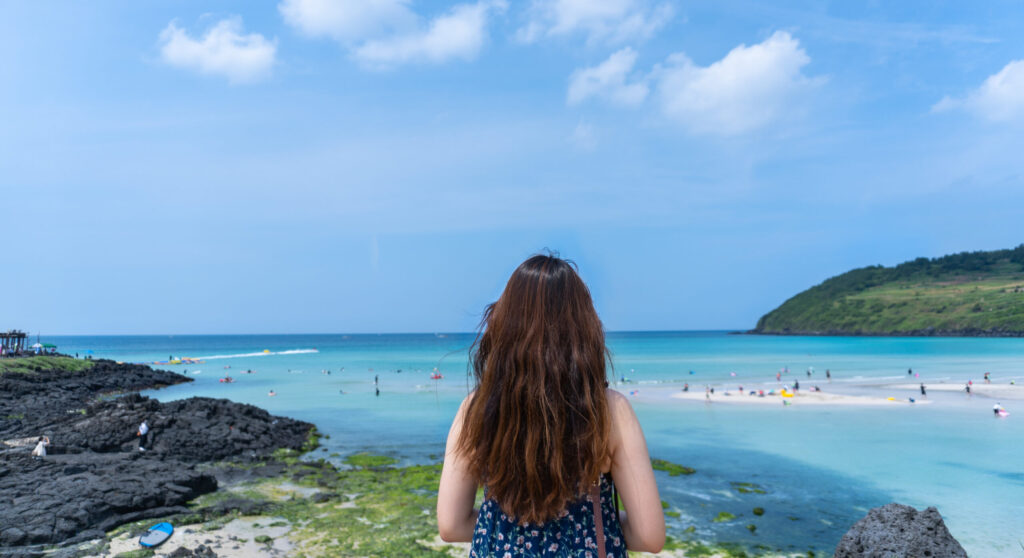
Jeju’s 12 official beaches are just the beginning—this episode covers everything the island’s coastline has to offer. Ed and Soraya share where to spot wild dolphins (the Sunset Coastal Road in the southwest, with 120+ dolphins in residence), the best spots for sunrise (Gwangchigi Beach near Seongsan Ilchulbong) and sunset (Hallim-Hyeopjae with views of Biyangdo island), and why Koreans describe their turquoise beaches as “emerald color.” They cover family-friendly beaches with shallow water (Hamdeok, Pyoseon), the iconic windmill coastal roads, water sports options from scuba diving to transparent kayaks, and what you’ll encounter while hiking the coast: haenyeo drying their wetsuits, ajummas hanging thousands of squid to dry, and over 100 small fishing ports. Plus practical tips on when and where to actually see haenyeo at work.
Key Takeaways
- Wild dolphins: 120+ dolphins live around Jeju, mostly spotted on the west coast; check local cafe Instagram accounts for recent sightings
- Best sunset: Sunset Coastal Road (southwest) or Hallim-Hyeopjae beach (northwest) with views of Biyangdo island
- Best sunrise: Gwangchigi Beach (광치기 해변) near Seongsan Ilchulbong—at low tide you get tide pools and rock formations in the foreground
- Windmills: Sinchang Windmill Coastal Road (신창풍차해안도로) in the northwest is the most famous; also find them near Kimnyeong and Woljeongni beaches
- “Emerald color” = turquoise: When Koreans describe beaches as “emerald,” they mean sparkling light blue, not green
- Family-friendly beaches: Hamdeok (northeast) and Pyoseon (southeast)—both have shallow water; Pyoseon becomes a massive sandy play area at low tide
- Water sports: Scuba/freediving mainly around Seogwipo; transparent kayaks at Woljeongni and Gwakji; surfing at multiple beaches (check wave conditions)
- Seeing haenyeo: Go early morning (they finish before noon); bad weather may cancel diving; late in the day you can still see them harvesting seaweed or clams at low tide
- Coastal cafes: Hundreds of oceanfront cafes, especially in the northwest and northeast—Koreans love to enjoy coffee with a view
- Sun protection: Koreans take it very seriously—expect to see long sleeves, rash guards, and even gloves at the beach
Handy Korean with Sora Ssaem (쌤)
Ordering coffee at a cafe
- Coffee words are Konglish (Korean + English): 아메리카노 (amerikano), 라떼 (latte), 모카 (mocha), 에스프레소 (espresso)
- Korean word order: [item] + [number] + 주세요
- 아메리카노 하나 주세요 (amerikano hana juseyo) = “One Americano, please”
아아 (ah-ah) — Iced Americano
- Koreans shorten “ice Americano” to just 아아 (the first syllable of each word)
- 아아 하나 주세요 (ah-ah hana juseyo) = “One iced Americano, please”
- Most Koreans drink iced Americano—it’s the default coffee order
Next Steps
- Plan your Jeju trip at vamosajeju.com/trip
- Sign up for the 14-part email series at vamosajeju.com/start
- Follow Vamos a Jeju on Instagram, TikTok, or YouTube.
- Share the episode with friends to help the podcast grow
- Visit vamosajeju.com for articles, videos, and resources
- Leave a one-sentence review to help others discover the show
- Related Reading: The complete guide to Jeju’s fabulous coastline
Episode Transcript
Dolphins & Sunsets on the West Coast
Soraya (00:18)
Hello! Today we’re going to talk about the beautiful coastline in Jeju Island. In Jeju we have 12 official beautiful beaches but still of course this is an island so we have a lot more to see around the coastline and there’s a lot to do and among those my favorite thing is watching dolphins. Hey Ed, do you remember the time when we go to dolphin watching together?
Ed (00:51)
Yeah, I actually remember that very clearly because your husband Jaden had brought his drone out and then when he flew the drone, I think he wasn’t paying attention and it flew into maybe telephone wires or power cables and it came crashing down. I don’t think it was too badly damaged, but I know he was not happy about that. But I was very happy looking at the dolphins. It was very beautiful. before that time, I had actually gone with Michele to the same area, the Sunset Coastal Road in the southwest of Jeju and it was quite amazing because we just drove, we saw other cars parked there and so I pulled over and got out and we’re just like, huh, what are they looking at? And then a bunch of dolphins just popped up like 10 meters from us. was…
Ed (01:41)
It was amazing. It’s like, Whoa, it is so close.
Soraya (01:45)
So around the Jeju coastal area, we have more than 120 dolphins And most of the time, they are spotted in the West Coast, but sometimes they’re coming to the East Coast. So usually my husband, Jayden and I always check Instagram for the cafes nearby, or there’s some people who are taking photos of dolphins. So we check them and then like… where is the dolphins and then we drive to there also i like to wait for the sunset while waiting the dolphins because in the west coast we call the road Sunset Coastal Road because the sunset there is beautiful so i recommend you to wait for the dolphin and then sunset at the same time. Jayden’s dream is to take photo with sunset and dolphin together.
Ed (02:43)
Right, and I think he’s taken maybe like 50,000 photos of dolphins at this point. And I guess he’s still trying to find his dream shot where there’s a dolphin jumping out of the water with the sunset at the background.
Ed (02:56)
That’s just one of the many fabulous things that you can do at around the fabulous coast of Jeju. I’ve often talked about how Jeju is like Hawaii but at a fraction of the cost and nothing speaks to this better than the coast of Jeju. I mean around the coast of Jeju obviously you have those beautiful white sandy beaches, but you also have the black sandy beaches You’ve got great water sports all around talking about scuba diving We’re talking about kayaking and windsurfing and of course surfing and we’ve got like beautiful Instagram worthy places and there are special things that are not in Hawaii. We’ve got the Haenyeo we’ve got windmills and
Ed (03:38)
this full spectrum of the amazing things that one can do on the coast of Jeju is what we’re going to talk about today.
Soraya (03:46)
Where was your best sunset coastal area in Jeju
Ed (03:51)
I was trying to think of a different place than the Sunset Coastal Road, but unfortunately I wasn’t able to figure out one. And so I’m going to say the most spectacular sunset I’ve seen in Jeju is where the dolphins are, the Sunset Coastal Road in the Southwest.
Soraya (04:08)
And the other sunset I like a lot is in the northwest area like Halimhyeopjae, because near that beach you can see small islands near Jeju Island. which is Biyangdo. So you can actually see the sunset and the small island together. And it’s really, really beautiful as well.
Ed (04:30)
And so those are great places, I think, to like maybe stop, you know, have a take a photo, maybe have a picnic, maybe eat some squid with beer. But only if the wind is not too strong, because sometimes the wind there can be quite powerful.
Ed (04:48)
And so we talked about sunset, But for the sunrise, we have to move to the eastern part of the island. Where are some good places to see the sunrise?
Sunrise Spots on the East Coast
Soraya (04:59)
So of course, the number one is near Seongsan Sunrise Peak, right? So near the Seongsan Sunrise Peak, there’s one small
Ed (05:03)
Seoongsan Ilchubong
Soraya (05:11)
coastal area like Gwangchigi Haebyeon so there you can take photo with the sunrise peak and the sunrise together it’s really really beautiful
Ed (05:14)
Oh, yes, that. the sun’s coming up behind Seongsan Ilchubong. Yeah, that’s, that is a great, great photo. And if you time it just right, if it’s low tide, the beach, you see at low tide, you see like tide pools and you see that the rocky formations. It is a really great shot.
Ed (05:43)
so where else on the Eastern Shore is a great place to catch a magnificent sunrise, assuming you can wake up in time.
Soraya (05:52)
Right. So in the Northeastern part, Kim Nyeong beach. This is really, really beautiful, a long sandy beach with the black stones and also windmill together. And there is actually a camping place. So you can bring your… camping car to the parking lot and wait for the sunrise. And actually this place is not like too famous for sunrise. So you can have like very quiet, tranquil time for the sunrise.
Ed (06:25)
so I know today we talked about like, wow, we can do like dolphins in the Southwest and we can do like beautiful beaches in the Northeast. It gets pretty confusing. So what we’re gonna do is we’re gonna make a separate blog post to capture all this and and to find out more about the different locations, you can go to VamosaJeju.com forward slash coast. bouncing back to the West coast again. It’s actually in the Northwest part of Jeju. There’s this place where there’s a lot of windmills and then there’s a trail that connects a few of these windmills together. And it’s called, I’m going to say it in a Englishy way, it’s called the Sinchang I think it’s called, What’s it called in Korean? Sora?
Windmills & Iconic Photo Spots
Soraya (07:09)
Shin Chang Pung Cha Hae An Do Ro
Ed (07:13)
Okay, that will be the Sinchang Wind Mill Coastal Road. Yeah. And so…
Soraya (07:18)
You know what it right? And then the car.
Ed (07:21)
Pong is wind and Cha is like… I don’t know what Cha is… A car? A wind car? so in that area, it’s also very spectacular if your time is just right and you go for a walk around the windmills and it takes you right to the base of some of the windmills and you actually hear it go… It’s pretty cool. And…
Ed (07:46)
Yeah, you can rent bicycles there and ride around and this all in all, it’s a very beautiful place to go. You need either a car or a taxi to get there. It’s not well served by buses. But yeah, so I think we’ve covered like East and West Coast, sunset and sunrise. But I’ve noticed we talk about windmills a lot. So maybe this is a good time to talk about
Ed (08:11)
windmills in general, because Jeju has a lot of windmills. at least for me as a visitor, they’re very beautiful to look at. And so those are some places that are very iconic of Jeju. Like you see them on a lot of K-dramas, like Samdari. So I’ve seen a lot of people take selfies in front of these windmills. So where are some places besides Sinchang Windmill Coastal Road that people can see windmills and take photos?
Soraya (08:37)
Actually the windmills are all around Jeju Island. as you mentioned, near Sinchang area, there’s lots of windmill. And also in the east coast, like northeast, near Kimnyeong, Woljeongni, along those coastline, there’s a lot of windmill as well. So especially in Woljeong… beach or Kim Nyeong beach you can take photo with those windmills and the emerald color beautiful beach.
Ed (09:08)
Okay. So the first time I heard you describe the, the beaches as like having an emerald color, I was like, wait, emerald is green. And so when I looked at the beach, it’s like, this isn’t a green, this is a turquoise. It’s like, it’s like a sparkling light blue color.
Ed (09:25)
I just want the audience to know that if you ever hear a Korean describe their beautiful beaches as emerald color, just know that they mean turquoise. So it is not a sparkling green beach. is a sparkling light blue color,
Soraya (09:39)
I think it’s kind of Konglish I don’t know, we just say emerald color beach.
Ed (09:45)
Well, technically you call it Emerald Colors. Emerald color. Gotcha. Yeah. And so those beaches are beautiful to take But if your plan is to go to these beautiful turquoise beaches to suntan Just know that you may be the only one, right Sora?
Beaches, Sun Protection & Family-Friendly Spots
Soraya (10:08)
Yeah, because for Koreans, don’t really like to expose in the sun because sun protection is so important for Koreans. For me, even if go out for just 30 minutes, I need to put my sunscreen. It’s mandatory stuff. So in summer, if we go to the beach, we always wear like long sleeve and like long pants so we can protect from the sun. And then we always stay in the shade.
Ed (10:36)
and if you go into the water you’re wearing rash guards you pretty much cover up as well if you go into the water right you know
Soraya (10:40)
Mm-hmm. Right, Like, long sleeve rash guard. And sometimes, like, ajumma’s wearing a glove because they don’t want the sun coming to their… Uh-huh.
Ed (10:50)
This is under touch. So we should probably explain what ajummas are.
Soraya (10:56)
Ajumma is like, senora.
Ed (10:59)
senora an older woman Is that because of like they don’t want their skin to age too quickly or is it about skin cancer? Like which is it? Is it beauty or is it health?
Soraya (11:10)
I think it’s more beauty. Also health, but I guess it’s more beauty.
Ed (11:16)
Yeah, there’s a reason why there’s a thing called K-Beauty, I guess. So… I see. Okay.
Soraya (11:19)
Uh-huh, uh-huh, right, For Korean, like sunscreen is like always mandatory every day, even in cloudy day, in winter, of course, always.
Ed (11:31)
Gotcha. So we’ve talked about picturesque places like windmills on the coast, beaches on the coast. Another thing that we see on the coast that’s very Insta-worthy and that is at least on the Northern part of the island, all these cafes that just by the shore. Yeah, it’s like, tell us more about these cafes like this. There must be over a hundred.
Soraya (11:52)
I think a lot more than hundreds. Because like in Jeju we have a lot of cafes and if it’s like if it has beautiful view we always have cafe around and especially in the northwest and northeast area we have like cafe streets because you know like Koreans love to be in the cafe, like have coffee, talking to each other and then like enjoy the view. That’s what Koreans really enjoy. So yeah, we always go to the cafe and then also it’s for the photos as well, like to take a Insta-worthy photos.
Ed (12:31)
I think selfies in Korean is called selca, right? Self camera. That actually makes sense. That’s one Konglish word that actually makes sense. And one thing I wanted to point out is that a lot of times, if you come on a weekend, you’ll see families with little kids running around. And so, some of our listeners are going to travel to Jeju with their kids, what are some family friendly beaches that people can go to?
Soraya (13:01)
First of all, think to be family friendly, it should have shallow water. It cannot have like. deeper water, right? Because the kids want to go in the water and then play. So I think the best one in the northeast is Hamdeok beach. So that one has like very shallow water and then lots of restaurants, cafes and hotels, like many facilities that you can use and also like small, oreum small mountain nearby. So you can just take a walk with the sunset. and the other one is in Pyoseon area the white sandy beach is really beautiful shallow water and in the low tide when the water receded you can actually walk around the area and it’s very safe for the kids and also there is a resort nearby so i think those two beaches are the perfect place for family.
Ed (14:02)
Right, and Pyoseon Beach especially, it is a big U-shaped bay. And so when the water has completely receded, it is a huge sandbox. The kids can run around, it’s like a massive, massive play area where the kids can run around, fly kites, and the water stays out for a long time. So it’s not like it’s gonna come gushing back in in a hurry. So like it’s very safe for children. And when the water is in, At best, it’s like up to your knees. It’s not deep at all. So it is perfect for families to bring their children, have a picnic. It’s great.
Ed (14:36)
And so speaking of Pyoseon beach.
Ed (14:39)
I noted when I was there with my wife that when the water was in, in the middle of the bay, so far away from all the little children, very far away from the little children, there were people who were windsurfing and kitesurfing because it was a very windy day. so I think this is a great place for us to talk about sea sports around the coastal area of Jeju. So I’ve mentioned about windsurfing and kitesurfing, but what are some of the other sea sports that people can get to? if they are outdoorsy.
Soraya (15:10)
So usually. What I do is freedive and what you do scuba dive in Jeju we have lots of diving places especially in the southern area like Seogwipo city you can do scuba diving, freediving around that area and also we have lots of place for kayaking like especially in Woljeong or Gwakji like the emerald color beach they have like transparent kayak so you can get in and then you can actually see underneath of your kayak.
Soraya (15:46)
And another thing, we can also surf around Jeju Island. For surfing, we have many different beach almost everywhere. But the thing is for surfing, you really need to pick the right date for the waves.
Ed (16:02)
Earlier you talked about how you do freediving and I do scuba diving and when we were in Seogwipo city I did go out diving with a dive store called Cool Dive and it was a great experience. It was not as cold as I thought it was going to be. I thought it was going to be freezing. one thing I noticed though, when I was walking around the island, I didn’t see as many dive stores. They all seem to be around Seogwipo city. Is that right? Is Seogwipo city the only place to do diving on Jeju?
Soraya (16:31)
It’s not the only place, but the main place for diving is Seogwipo the southern area, But we do have many scuba diving or free diving center in the north. West area as well like Aewol, Halim, like those places we have them.
Coastal Hiking & Spotting Haenyeo
Ed (16:50)
the other thing I like about, Jeju a lot is the hiking. And so a lot of the hiking takes me to the coastal areas around Jeju, like we talked about a lot. And. There three things I wanted to point out. Like if you are hiking along the coast, you’re going to see a lot of traces of the Hanyeo. Now, if you go early enough in the day, you will actually see the Hanyeo gear up and bring the stuff into the water and all that, we talked about in the Hanyeo museum episode. But if you go there later in the day, you will see evidence of them, of their work, which is like they’re hanging out at their modern 불떡 I guess, with modern showers and modern rooms and modern facilities. But you’ll see them hang
Ed (17:33)
hanging out their wetsuits and the orange buoys, their nets and all that kind of stuff. that’s one thing to look forward to if you’re actually walking around the coast. Another thing that caught my attention was you see these older ladies, ajumas, hanging out their squid to dry. imagine like a clothesline, a very long clothesline.
Ed (17:57)
but instead of clothes it’s squid and we’re talking about not one or two squids we’re talking about like thousands of squids Jeju is gonna run out of squid like look at how much they fish the squids out of the water eventually you’re gonna run out of squid I guess but yeah if you’ve never seen it before it is quite a sight to behold rows upon rows of squids drying in the sun so that that’s kind of awesome And also it’s really great to eat the squid with beer, but maybe that’s another episode. And then the third thing is like the ports. if you like seeing boats go in and out of small little ports, there must be over a hundred ports around the coast of Jeju. And the water is always turquoise as well. Not like the beach, but it is like clear blue. If look down, you can see fish swimming around the boats. It’s just fantastic. And yeah, if you like to fish… There are a lot of people often fishing around the ports as
Soraya (18:53)
add is that some tourists ask me where and when can I see the Haenyeo women divers. And I’m like, who knows? Because they usually dive in the morning, but it depends on the weather. So we really don’t know what time or where they’re to start the work. So if you want to spot them, like Ed, maybe you can do like lots of hiking around the coast, then you will see some in the morning.
Ed (19:30)
Yeah, there are some ways to kind of narrow it down like to your point. If you want to see Haenyeo but the weather forecast shows that it’s going to be windy or rainy or just bad weather. There’s a good chance that where you are, the Haenyeo may not go. On the other coast, they may go or in the south part, may go. But like if you’re on the west, they may not go if the weather is not great. So that’s number one. Number two is if you go late in the day, you’re going to miss them already. They will usually be done. before noon. So if you’re planning on like if you’re like if you party late and you wake up at like noon, yeah you’re not gonna see the Haenyeos However there are ways to see Haenyeos doing other things. For instance if you go late in the day sometimes you see like one or two Haenyeos who are not doing actual seafood harvesting they are actually harvesting seaweed and they’re like putting out the seaweed out to dry in the sun by the road.
Ed (20:23)
Or if you are in the bay around Songshan-il-chubong, the bay, where when the tide goes out, you will see Haenyeos actually harvesting clams and other seafood in the sand.
Ed (20:37)
Yeah. So that’s how you can see some Haenyeos if you slept in or if of the weather’s bad
Handy Korean with Sora Ssaem (쌤)
So we’ve reached the part of the show Sora where we as always share some useful Korean phrases with our audience and we call that Handy Korean with Sora Ssaem (샘)!
Soraya (21:03)
Woo.
Ed (21:06)
It’s the first time I’m cheering for you. So, Sara, tell us what are we going to cover today?
Soraya (21:11)
Thank you. So today we were talking about going to a cafe near like beautiful beach. So when you go to the cafe, you need to order something. And it’s actually quite easy. Cause for like coffee menu, we just use English word like Konglish. You just make it sounds like Korean. For example, Americano is Americano. And then latte is latte. What else? mocha? cafe mocha? espresso. Koreans don’t drink espresso a lot so.
Soraya (21:51)
I think most of Koreans drink Americano or latte.
Ed (21:53)
Gotcha. No, actually to be clear, most Koreans drink ice Americano
Soraya (22:00)
A ice americano.
Ed (22:03)
아아 So why are we talking about all these coffees? I’m sure it’s because we’re going to help them order coffee at these cafes on the coast, right?
Soraya (22:14)
Because we have talked about 주세요. Please give me from the previous episode and also 하나 둘 셋 like one two three So the order for Korean is you say the noun first Number and then please give me so for example, it’s gonna be Americano 하나 주세요
Ed (22:42)
Americano Hana Juseyo And if I wanted to order an iced Americano I would say the long version first which is Ice Americano Hana Juseyo Or because Koreans like to keep everything short it would be 아아 Hana Juseyo
Soraya (23:02)
If you say 아아 like most of people understand it is ice americano. 아 아
Ed (23:13)
Yeah. So if you like to see the phrases that we just covered today, check out our show notes. We’ll cover like how to order coffee and we will help you combine the different parts of Korean that you’ve learned with Sora in the last few episodes into a bigger Now if today’s show has got you thinking, huh, I really want to go to Jeju to order a 아아 and sit and watch the dolphins and the sunset and the windmills.
Ed (23:38)
Well, we’ve got something for you. We’ve taken everything that Sora and I know about visiting Jeju as a DIY traveler and we’ve put it into a 14-part email series.
Soraya (23:48)
So to get that email straight to your inbox, can just sign up vamosajeju.com / start. And then for the latest update, you can follow us vamosajeju on Instagram, TikTok and Facebook group. And finally, the best way for a new podcast to grow is organically. So if you found this episode helpful, please share us with your friends. And who knows, maybe we will Vamos a Jeju
Ed (24:21)
left for us to say is…
Soraya (24:24)
Bye!
Ed (24:25)
Bye!
