
Play Episode
Episode Summary
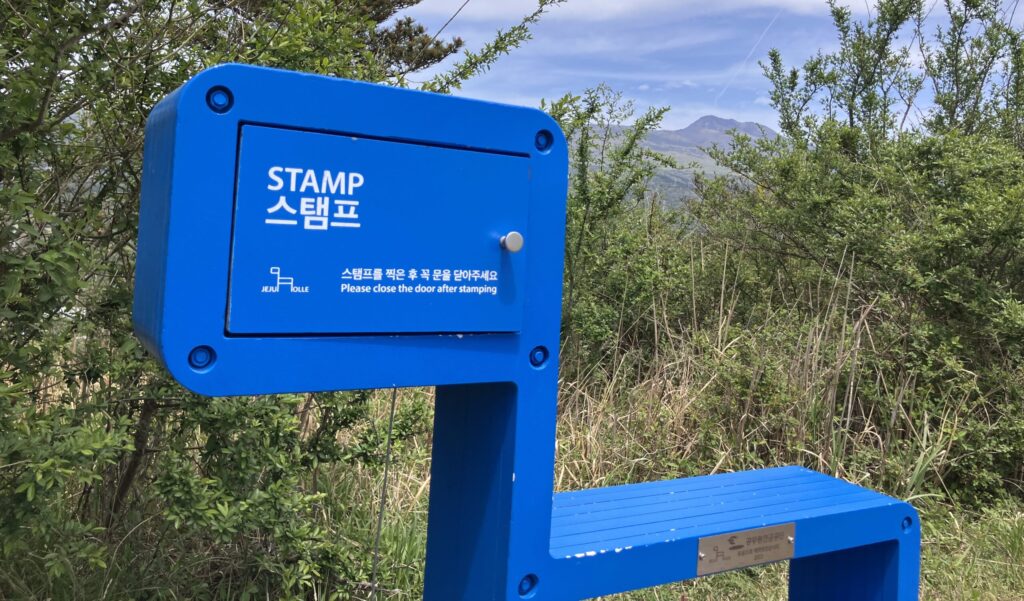
Ed invented the “mini Olleh trail” concept as a secret strategy to get his hiking-averse family members hooked on the Jeju Olleh Trail.
The idea: walk a short, easy section that includes at least one stamping station, get them a passport with a few stamps, take them to the gift shop, and hope they come back to finish the rest someday.
This episode maps out mini trails across the island, all under 90 minutes, close to bus stops, and featuring at least one passport stamp.
Key Takeaways
- Mini Olleh standards: under 90 minutes, not too difficult, within 15 minutes of bus stops on both ends, includes at least one stamping station
- North coast (Jeju City): Sarabong Oreum (Trail 18 start, under 1 hour, murals, harbor views); Dodubong + Rainbow Coastal Road (Trail 17 midpoint at Eoyong Park, 1-1.5 hours, cafes, plane views)
- Northeast coast: Haengwon to Gimnyeong Beach (Trail 20 midpoint near Camel Coffee and windmills, flat walk, emerald beaches, K-drama location, bus 201 nearby)
- East coast: Gwangchigi Beach to Seongsan port (Trail 1 endpoint, walk through town, cross bridge for Iceland-like views, bus 201 serves both ends)
- East coast: Sehwa Beach and Haenyeo Museum (Trail 21 start, Sumbisori Gil loop through farmlands, Byeolbangjin fortress with canola flowers, optional push to midpoint for two stamps, kalguksu restaurant with money on the walls)
- South coast (Seogwipo): Olleh HQ is the stamping station for Trail 6 end / Trail 7 start; east fork goes to Jeongbang and Sojeongbang waterfalls (60-75 min); west fork goes past Jeju’s only rice field to a temple and coastal road (45-60 min)
- More mini trails in the blog post: vamosajeju.com/hike
Next Steps
- Plan your Jeju trip http://vamosajeju.com/comfortat vamosajeju.com/trip
- Sign up for the 14-part email series at vamosajeju.com/start
- Follow Vamos a Jeju on Instagram, TikTok, or YouTube.
- Share the episode with friends to help the podcast grow
- Visit vamosajeju.com for articles, videos, and resources
- Leave a one-sentence review to help others discover the show
- Related Reading: The Jeju Olleh Trail: Everything You Need to Know
Episode Transcript
What Is a Mini Olleh Trail?
Sora (00:18) Hello everyone! Welcome to our podcast, Vamos a Jeju! So last week we have talked about the overview of Jeju Olleh trail and today we’re going to talk about mini Olleh trail. But actually there’s no such thing like mini Olleh trail and then my co-host Ed invented this mini Olleh trail. Hey Ed, what is mini Olleh trail?
Ed (00:45) A few episodes ago, we talked about hikes for hike haters. And back then it was something that I did for my family. Yes, everything I’m doing is for my family’s trip to Jeju at the end of the year. And so I really wanted to try and get some of my family members to come with me on the Olleh Trail because I’ve had such a great experience on it.
And so I figured, okay, it is not realistic for them to do the whole trail because that’s like six to eight hours every day. But maybe, maybe I can get them to like come for part of the trail. And maybe if I get them the Jeju Olleh Trail passport and then I can get them to one, two, three or four different stamping stations where they can put the stamp of the trail number in their passport. Maybe in the future they’ll come back again and walk the rest of the trail with me.
So this is actually just a very sad way of me to try and get my family members to join me to do the whole Olleh trail in the future. But for now, in the short term, I’m just hoping that having an opportunity to get a taste of the Olleh trail, they will get hooked and then we will be able to come back and do the full trail.
Sora (02:01) So this is your secret strategy for your family.
Ed (02:04) It was a secret until I told the whole world about it on this podcast.
Sora (02:08) Now everyone knows.
Ed (02:11) That’s right.
Sora (02:12) So when you made up this mini-Olleh trail, what was the standards of mini-Olleh trail?
Ed (02:19) Well, in keeping with the spirit of, you know, hikes for hike haters, it shares some similar considerations. Number one, it cannot take too long. So it’s going to be longer than the hikes for hike haters. It’s going to be like three, four hours, maybe not six to eight hours. But it’s not the full length Olleh trail. So that’s number one.
Number two, it cannot be too difficult. No major, you know, Gunsan Oreums or anything like that.
And then number three is, it’s got to be really close to bus stops because like we talked about last time, you cannot, if you drive, then you got to walk all the way back to your car. So ideally both start and stop locations are going to be within 15 minutes walking to a bus stop.
And finally, it has to have at least one stamping station. So it could be a starting point of an actual Olleh Trail course or a midpoint or an endpoint. But the whole idea is to at least get my family and I guess our listeners to at least have one stamp in their passport.
North Coast — Sarabong & Dodubong
Sora (03:23) Yeah, yeah, I think with all this standard, I can think of one or two places, which is my favorite. And next to my apartment again, I think we’ve been talking about Sarabong Oreum like many, many times. I think our listeners all know about this.
Ed (03:42) By now, you’ve talked about Sarabong so much, I think we should have a national campaign to change the name to Sorabong. We can do it. All our listeners should petition the Korean government to change the name of Sarabong to Sorabong. Let’s do this, everybody.
Sora (03:50) Could be. We have like many many petitions.
So actually this trail is the starting point of trail 18, Olleh Trail Number 18. It’s gonna take around like less than one hour and you’re gonna see all these murals and like the harbour from top of Sarabong. And since Sarabong is in the city, still in the city, so there’s like mini bus coming near the bus stop, so you can just walk like around 10-15 minutes to the bus stop and then get those buses to go to the city or outside the city.
I can think of right now is Dodubong. Dodubong is very popular because it’s near the airport and also near the Rainbow Coastal Road. So you can just take some photos in the Rainbow Coastal Road and then go up to Dodubong. It’s not too far. It’s going to take around like one hour. And of course, along that Rainbow Coastal Road, you’re going to see like many, many cafes and restaurants. So you can take some time there as well.
Ed (05:02) So the stamping station is going to be at the Eoyong Gongwon, which is close to the airport runway actually. And that park has great views along the Rainbow Coastal Road. That whole thing is going to be about one hour to walk, one hour to one and half hours and you would stamp the Jeju Olleh Trail Passport, trail 17. And just be aware that there’s local buses here, but they are not as frequent as the one in Sarabong, like Sora was talking about. So just check the schedules and maybe it’s going to be like every one hour or so, it will be the green buses, the green local buses.
Northeast Coast — Haengwon to Gimnyeong
Sora (05:39) Okay, so this was near the airport, Jeju city, north coast. Then let’s go to the east, right? Like northeast first.
Ed (05:50) Yeah, and so the northeast coast, we have another one that is something that I think we’ll cover in the future when we talk about K-drama shooting locations. But this one is going to be the Northeast coast from Haengwon to Gimnyeong Beach. And so this one is going to be part of the Jeju Olleh Trail 20 and the place where you’ll stamp your passport, your Jeju Olleh Trail passport is the midpoint.
The midpoint stamping area is going to be very close to a windmill generator. And it’s going to be in the area of the Abebe bakery and Camel Coffee. They’re actually built over lava rock. And there’s going to be a nice little lava rock path that will take you from the cafe to the wind generator where the stamping station is.
And then from there you will head west along Woljeongni beach. That’s a beautiful walk and one of the things to look out for is a windmill generator complex where you can go and learn about windmills and all of that. And so that’s a very interesting place to stop over as well.
So you will pass Woljeongni Beach and there’s lots of cafes and you will end at Gimnyeong Beach, which also has a lot of cafes. So this stretch is going to be flat walking, great views, windmills. It’s a K-drama shooting location near the Abebe bakery and lots of things to eat and on both ends the buses are less than 10 minutes away. In fact, on Gimnyeong Beach, you can take bus 201 from Jeju City, the walk from the bus stop to Gimnyeong Beach it’s just three to five minutes.
So Sora, you’ve walked this route before, right?
Sora (07:29) Right, not all of the trail but I’ve been to like many places here like Woljeongni, Gimnyeong, Haengwon, all of these places and it is beautiful. If the weather is nice, we have, we call it Emerald color beach. You’re gonna see like blue sparkling water. It’s beautiful. And then with those beautiful color, you’re gonna see the wind power generator, the wind turbine. So a lot of Koreans like to go there, take photos and of course having time in the cafe.
Ed (08:03) Yeah, when I was walking this stretch with my cousin Dar, we had actually started late in the day and so two things I remember. One was this couple taking their wedding photos. And then they’ll take photos, we’ll pass them, we’ll say, Annyeonghaseyo, we’ll keep walking and walking. And then they pass us and then they stop at the next place and then they get out and take photos and then we pass them again. And so we’re like basically leapfrogging each other. I think on that stretch, we met them like three to four times. And finally the last time they said hi to us before we said hi to them which is unusual because Koreans usually don’t care about strangers. But I guess we’ve stopped becoming strangers.
So that’s the first thing. The second thing was when we kept walking the sun was setting and wow the sunset. I didn’t expect to see a great sunset on the Northeast part but it was beautiful. The sunset was amazing. So yeah we lucked out on that one.
Sora (08:36) Right. It’s also beautiful in summer to swim and snorkel around. It’s also like famous place for snorkeling as well because it’s beautiful and the water is not too deep and you’re gonna see like many fishes in the water.
East Coast — Gwangchigi Beach
Ed (09:03) Mm-hmm.
Sora (09:10) So we talked about North East, so let’s go to further East. So of course, East Coast the most popular place is Seongsan Sunrise Peak. For me, rather than Seongsan Sunrise Peak, I like Gwangchigi Beach. It’s the end of trail number one and start of trail two. And from this beach, you’re going to see Seongsan Sunrise Peak with all these backgrounds of beaches and the waters and the mountain itself.
Ed (09:40) And so the stretch here, you’re going to be starting from the end point of trail one, where you can get your stamp. And then you’re going to walk towards Seongsan Ilchulbong. You’re going to go through the town of Seongsan Ilchulbong. And then it will take you across, around to the port of Seongsan, which is Seongsan Pohang.
You’re gonna walk over a bridge and if you stop and look back, great view of the town of Seongsan Ilchulbong with Seongsan Ilchulbong in the background. Beautiful, beautiful, beautiful shot. I took a photo of this one time Sora, I sent it back to my son and he said is this Iceland?
I said no it’s not Iceland, it’s Jeju. Because from a distance you cannot tell that the buildings are not Icelandic buildings but from a distance it almost looks like Iceland. Keyword being almost.
Sora (10:30) But also like when I planned to travel Iceland, I felt like it’s so similar to Jeju. So I was like, should we really need to go to Iceland? Because we’re living in Jeju, it’s so similar. Similar? No?
Ed (10:37) The answer is you should. It’s like, you know how I always say that Jeju is like 80% of Hawaii, but 30% of the cost. Iceland is going to be like more expensive than Hawaii.
Ed (10:51) So this one is really great for those members of my family who don’t like to walk too much because the same bus number 201 serves both the start and end points of this mini trail. So it’s really easy, literally less than five minute walks from both bus stops and the same bus will take you back and forth within like five, ten minutes.
East Coast — Sehwa Beach & Haenyeo Museum
Sora (11:11) And another one I really like is Sehwa beach. It’s the start point of trail 21. And the reason why I like this place is because the beach is beautiful but also there’s history of like Haenyeo woman diver. We have museum there and also Bulteok which was the community center of the Haenyeo. And of course, you’re gonna see like beautiful beach and farms, also like inshore route.
One of my favorite part is Byeolbangjin fortress. So right in front of Hado beach, you will see like small fortress wall and you can actually go up to the wall to see those beach. And in the winter and spring we have full of canola flower inside. So a lot of people come to take photos with canola flower and then the fortress as well. It’s really beautiful.
Ed (12:07) Right. And we’ve talked about the Haenyeo Museum multiple times. And so the stamping station for trail 21 is actually across the street from the Haenyeo museum. And then we’ve also mentioned how there’s a Sumbisori Gil. Sumbisori Gil is a walk that starts from the Haenyeo museum and ends at the Haenyeo museum in a loop.
But part of the loop actually takes you through the farmlands of that area and that is actually part of the Jeju Olleh Trail 21 as well. So basically you will walk out towards the Byeolbangjin fortress and then you can walk in a loop back towards the Haenyeo museum.
Here’s a bonus: if you want to get two stamps on this route, the good news is just 15, 20 minutes east of the fortress is the midpoint stamping station. And so if you decide to get two stamps for Route 21, then you could actually push another 15 minutes and then if you’re tired, you can take a bus back to the Haenyeo Museum or you can continue to walk back towards the Haenyeo Museum.
One thing I would note about the midpoint for Olleh Trail 21 is that there is this place that sells kalguksu that Jaden took me to. And so we had a seafood kalguksu. Kalguksu is, I’m sorry…
Sora (13:30) What is Kalguksu?
Ed (13:32) Yeah, so kalguksu is knife cut noodles in a broth. And the one that Jayden ordered had like sea urchins and maybe abalone and some other stuff. I didn’t want to tell him that I didn’t like seafood, so I ate it. It was good. I just didn’t eat the seafood.
And if you do go to this one, which is just like I said, across the street from the midpoint stamping station, bring some dollar bill or whatever. You can stick it on the wall or the ceiling because there’s money from all over the world on the walls and the ceiling so you can just add to that.
South Coast — Seogwipo City
Sora (14:05) So in the south we have Seogwipo city, the second biggest city in Jeju island. And actually the headquarter of Olleh trail is in Seogwipo city, not in Jeju city. There’s a big gift shop across the headquarter. Did you buy something from there?
Ed (14:21) Yeah, of course I did. I bought like scarves and stuff, not for myself, for somebody else. The whole evil genius plan is like, if I can get people in my family to do a few of the trails, get some stamps into the passports and then go to the gift shop, they will feel more excited about the Jeju Olleh trail.
Right outside the Jeju Olleh trail headquarters is going to be the stamping station, the beginning of trail number seven or the end of trail number six. It is the same place. And so depending on which way you want to go, if you head one way you’re gonna walk towards the Seogwipo daily market as well as Jeongbang waterfall and Lee Jung Seop street. We mentioned a few of these places already in the hikes for hike haters. But in this case we’ve extended it a little bit more to include the opportunity to do shopping at the Jeju Olleh Trail Foundation, as well as getting that at the HQ itself.
If you recall, Sora had talked about how she really liked the small Jeongbang waterfall, the Sojeongbang waterfall. That’s the Jeongbang waterfall and then you keep walking, there’s the Sojeongbang waterfall, which is the small Jeongbang waterfall. That is all part of the Jeju Olleh Trail 6. And so, if you want to take a bus back to Seogwipo City, it’s just a 10 minute walk to the bus stop. So that’s all very manageable.
And the route if you choose to walk eastwards on the Jeju Olleh Trail 6. Now imagine you’ve teleported back to the Jeju Olleh Trail headquarters again. If you want to go west, which is on Jeju Olleh Trail 7, you’ll see a very unique site in Jeju and that’s rice fields.
Sora (16:07) So for the rice field in Jeju, actually this is the only one rice field we have in Jeju. I mean nowadays we have a little, a few more, but this was the only one because Jeju is a volcanic island. So those volcanic stone, volcanic surface, when the rain comes, the water gonna go through the surfaces. So the ground cannot hold the water in it because you know rice field we need to keep the water in the ground so that the rice can grow well. But in Jeju it’s not possible to hold water in the ground. So it was not possible to grow rice here. But only this place could have rice field because it has like special different surface.
Ed (16:57) So this route is going to take you out of Seogwipo city. So you’re going to walk past the rice fields that Sora talked about and you’re going to pass a temple as well and if you look back you see the rice fields and see Seogwipo city. And then if you keep going you’ll hit the main coastal road and then you can call it quits when you see the Renault Korea dealership. From there you can take a bus back to Seogwipo city. It’s like a five, ten minute bus ride.
This western fork is going to be about 45 minutes or 60 minutes. The eastern fork towards the Sojeongbang waterfall is about 60 minutes or 75 minutes. So you can choose one or the other, or you can choose both.
So those are some of the mini Jeju Olleh trails that I invented for my family. Sora, what do you think about my invention?
Wrap-up & Next Steps
Sora (17:46) I think it’s really good because I mean, for my guests, also they want to try a part of Olleh Trail, but actually I don’t know much about Olleh Trail. I need to do it this year. I guess one hour is really good for looking around and then enjoy this experience. So I think I will bring some of my guests to this mini Olleh Trail.
Ed (18:13) I have good news for you Sora because there’s a few more mini Olleh trails that we’ve put on the blog post on our website. I just didn’t want to cover it because it’s, I felt a bit much for this episode, but it’s definitely included on the blog post and it’s actually going to be part of the same blog post that is on hikes for hike haters.
And so you can access that on vamosajeju.com/hike. That is v-a-m-o-s-a-j-e-j-u.com/hike. And there you will see not just all the mini Olleh trails that I cooked up, you also see the hike for hike haters that we talked about a couple of episodes ago. And some of these are going to overlap. That is by design. It’s not an accident. Basically, the hike for hike haters tends to be a bit shorter. The mini Olleh trails tend to be a bit longer. And the main difference is that with the mini Olleh trails, you get a chance to stamp your passport if you really want to.
I was thinking like maybe some of your guests might be quite interested in getting the Jeju Olleh Trail passport and having a few stamps in it. It makes a great souvenir, doesn’t it?
Sora (19:25) Yeah, of course, yes, yes. And then they will come back again, so it’s great.
Ed (19:29) Yeah, exactly.
Sora (19:31) We are able to add mini Jeju Olleh trail as an activity on the trip planner that we made at vamosajeju.com/trip.
And one more thing, if you found our podcast helpful, please share with your friends. It’s really easy. Just tap on the horizontal three dots on the top right corner and then tap on the share show icon on Apple Podcasts. And for the Spotify, also you can find the three horizontal dots near the top right under our show art. You can also share from there.
Ed (20:07) And with that, I guess all that’s left for us to say is… Annyeong!
Sora (20:12) Bye!
Ed (20:14) Mini Olleh Trail!
