Lo que encontrarás en este artículo
Most first-time visitors to Korea eat at the restaurants that show up first on Google Maps, or the ones with photos on the front window and English on the menu. That is fine. It works.
But there is a whole category of Korean eating that most visitors never get to, not because it is hidden, but because it looks a little intimidating from the outside.
Local places with signs and menus all in Korean, staff who speak no English, and a clientele that is 100% Korean and in a hurry.
This post is about that category.
Specifically: comfort food, the Korean concept of anju, and how the two overlap.
Because once you understand how Koreans think about food as a social and emotional experience, the individual dishes start to make a lot more sense.
First: What Is Anju (안주)?
Anju is one of those words that sounds like it should have a simple translation and does not. Look it up in the dictionary and you get something like “hold down the alcohol”—the characters 안 (hold down) and 주 (alcohol)—which is a clue about its original meaning: food you eat while drinking, to slow the absorption of alcohol and keep the session going.
These days anju means something broader. It is the food you pair with a specific drink, in a specific social context, for a specific length of time. It is as much a cultural practice as a menu category.
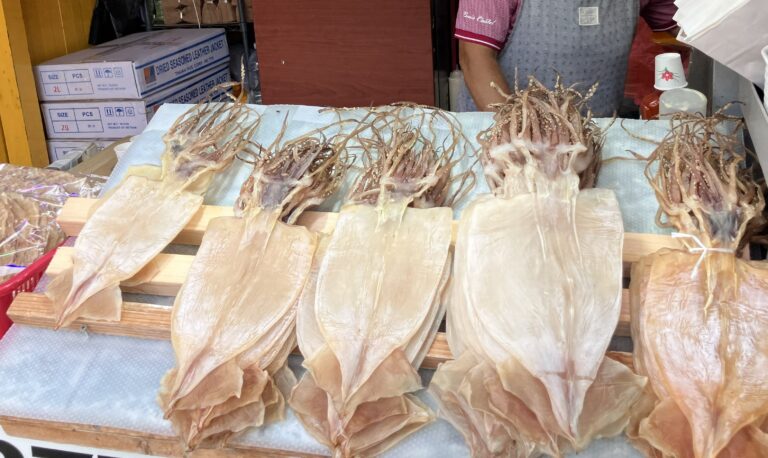
Here is how Sora explained it: a typical Korean night out with friends moves in rounds. First round (일차, il-cha): real food, usually something like samgyeopsal (grilled pork belly) with soju. Second round (이차, i-cha): maybe fried chicken and beer. Third round (삼차, sam-cha): you are full but nobody wants to go home yet, so you order dried squid or fish jerky or nuts and stay another hour or two.
That third-round dried snack—the thing that tells the evening it is not over yet—is anju in its most classic form. But so is the samgyeopsal in the first round. And the cheese platter you have with wine. And the pizza you eat with beer.
If there is a drink involved, the food next to it is anju.
BTW: Sora confirmed that yes, wine and cheese is anju. Pizza and beer is anju. If you have eaten a meal with a drink next to it, you have done anju without knowing it.
The Pairings Worth Knowing
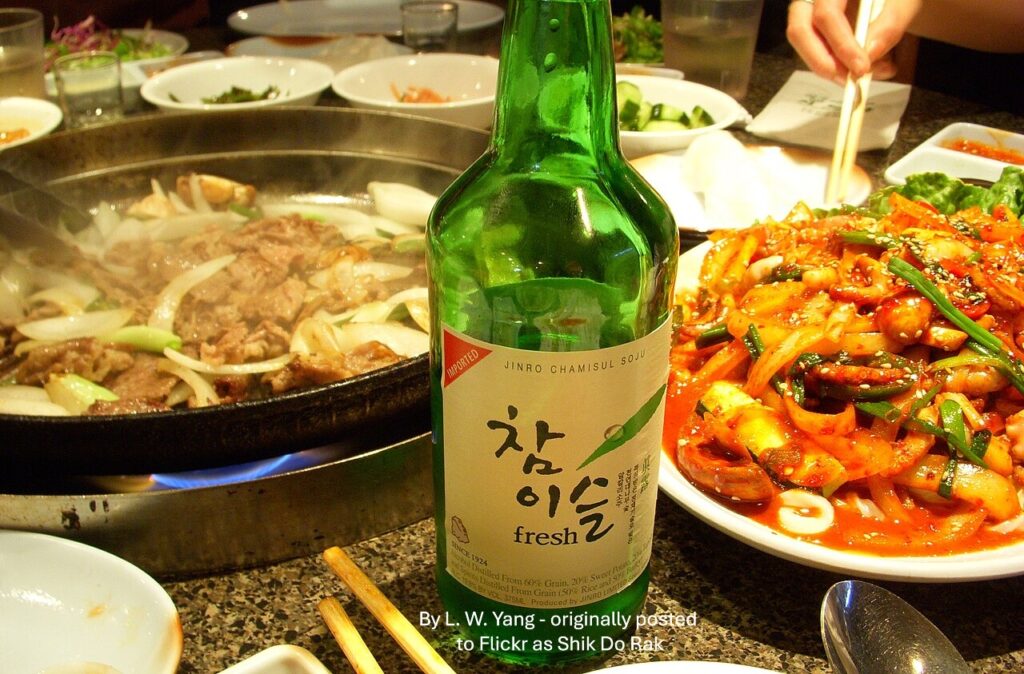
Soju goes with spicy and salty food. Samgyeopsal (grilled pork belly), dakbal (spicy chicken feet), jokbal (pig’s trotters), bossam (boiled pork). The logic, per Sora: spicy food calls for something to wash it down with, and soju is that thing.
Maekju (beer) goes with chimaek—fried chicken and beer, the combination that has its own portmanteau name. Also dried squid, fish jerky, nuts, potato chips from a convenience store. Anything you can tear apart and eat slowly over a long conversation.
Makgeolli (the traditional milky rice wine) goes with jeon—Korean savory pancakes. Kimchi jeon, seafood jeon, green onion jeon. This pairing is so standard that if you order makgeolli at a restaurant, they will often assume you want jeon without you asking. Also good: tofu kimchi (dubu-kimchi).
Convenience store anju is its own subcategory. You buy a beer or a soju, pick up dried snacks from the same fridge section, and eat at the little outdoor tables that every Korean convenience store has. This is not a lesser version of anju. It is just anju at a different price point.
Anju on Jeju vs the Mainland
Most of the anju culture on Jeju is the same as the mainland. The difference is that Jeju has more fresh and raw seafood available, which becomes its own anju category. Raw seafood (회, hwae) with soju, eaten at a seaside pocha (포차)—a temporary pop-up bar that sets up tables and plastic chairs after dark, sometimes right in front of the ocean—is as Jeju as it gets.
The pop-up bar culture on Jeju is worth knowing about. During the day, certain spots near the coast are just open space. At night, folding tables, plastic chairs, and a makeshift kitchen appear. You order soju and whatever raw seafood came in that day. You eat with the ocean twenty meters away. It is not fancy. It is very good.
Now: Comfort Food (and Why It Is Hard to Get To)
The formula I tried on Sora was: anju minus the alcohol equals comfort food. She said this was mostly wrong but partially right, which is probably the most accurate possible response.
The real distinction: comfort food is not about the social session around a drink. It is about the food itself making you feel better—something you grew up eating, something you reach for when the weather is bad or the day was rough or you just want to feel like you are home.
The overlap with anju is real. Kimchi jjigae with soju is anju. The same kimchi jjigae without alcohol, eaten alone on a rainy evening, is comfort food. Same dish. Different context.
The harder part, if you are a visitor, is actually getting to these places. The restaurants that serve real comfort food are not designed for tourists. No English menus, no Instagram lighting, no bilingual staff. They are neighborhood places where the clientele is entirely local and the signage is in Korean. They are also some of the best-value, most satisfying eating you can do in Korea.
Sora’s advice for getting past the intimidation: just go in. The menus at these places usually have three to five items. Order the first one—it is always the best one, because that is how Korean restaurants work. If you want to know what you are ordering before you commit, take a photo of the sign outside, walk around the corner, and run it through Google Translate before you go back in. You can also check KakaoMap before you arrive—the photos tab often includes the menu, which you can screenshot and translate at home.
One practical note on restaurant etiquette: service bells (the little buttons you press at the table to call the staff) are common in Seoul but not so much in Jeju. In Jeju, you will need to actually call out or make eye contact. If you need a fork instead of chopsticks, just ask—they have them (포크, po-keu). And if you hear the word “service” said to you by a staff member, it means they are giving you a complimentary extra, not that they are about to hand you a bill.
The Comfort Foods Worth Knowing
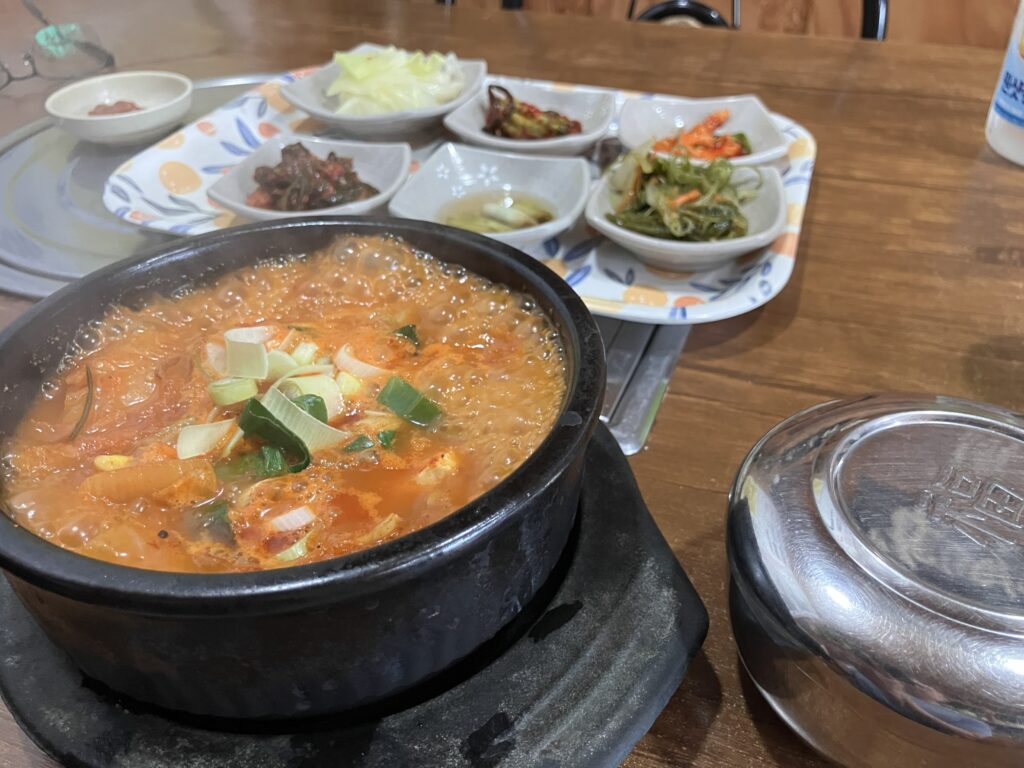
Soondubu Jjigae (순두부찌개) — Soft Tofu Stew
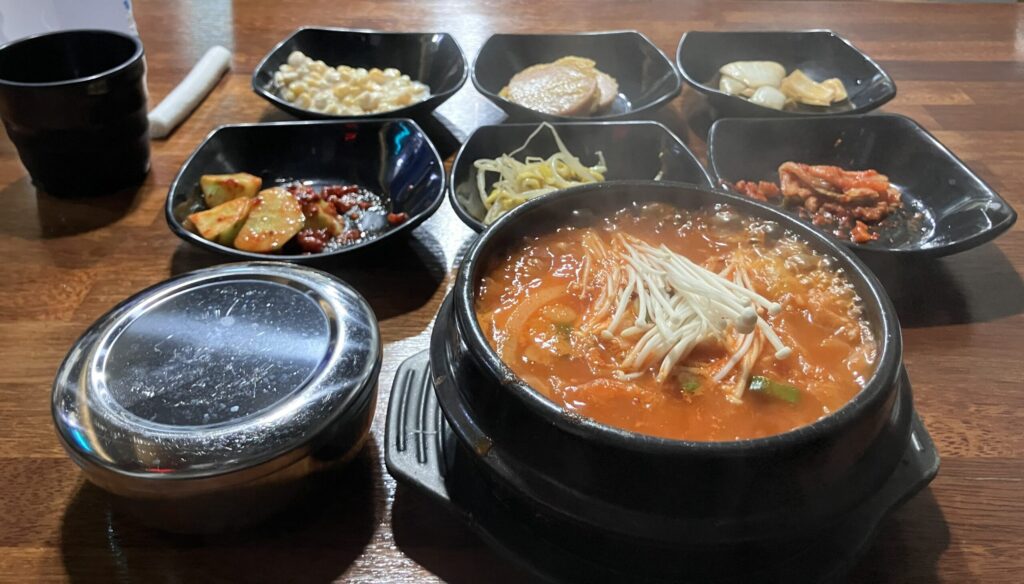
Hot, spicy, silky. Soft tofu in a peppery broth with your choice of protein: seafood, beef, pork, mushroom. Served in a stone bowl that keeps it boiling at the table.
This is one of the few comfort foods where I will actually name a chain: Il-Poom Soondubu (일품순두부), a Jeju-native franchise with more than ten locations on the island. The soondubu is solid, but the real reason to go is the all-you-can-eat banchan buffet that comes with it. Depending on the branch, you might get twenty to thirty side dishes: spicy pork stir fry, fried corvina, soy sauce crab, tteokbokki, Korean fried chicken at the branch west of Jeju City. Around 10,000 to 12,000 won total.
Pro tip on the rice: the rice arrives in a superhot stone bowl, still sizzling. Do not eat it all out of the bowl. Scoop most of it into a second bowl, then pour hot water into the thin layer of scorched rice (누룽지, nurungji) left on the bottom and put the lid back on. By the time you finish your meal, that scorched rice has turned into a light, slightly toasty broth called sungnyung (숭늉). You drink it at the end as a palate cleanser. It is not on the menu. It is just what you do.
Full details on Il-Poom Soondubu, including what to order and where to find branches, are in the Six Food Experiences article.
Haejangguk (해장국) — Hangover Soup
Do not let the name put you off. Yes, Koreans eat this the morning after a night of drinking. But Sora and Jaden also eat it for brunch on regular days, because it is a deeply satisfying bowl of soup regardless of your relationship with alcohol the previous evening.
There are several varieties. The beef version has a rich, clear broth with beef and vegetables. Bean sprout haejangguk is lighter and more refreshing. Pollock haejangguk is clean and slightly sweet. There is also a blood block version (선지, seonji)—chunks of congealed blood in the broth—which is an acquired taste.
Comes with rice. Obviously. It is Korea.
Kimchi Jjigae (김치찌개) and Doenjang Jjigae (된장찌개)
The two stews that appear on almost every table in Korea at some point. Kimchi jjigae is spicy and pungent, made with aged kimchi that has fermented to the point of sourness. Doenjang jjigae is earthier, made from fermented soybean paste, usually with tofu and vegetables.
Both are staples of baekban (백반)—the Korean set meal concept, basically a full home-style spread of rice, one main soup or stew, and several banchan. If you see a small local restaurant advertising baekban, that is what you are getting: a complete Korean home meal for around 8,000 to 10,000 won.
Gogi Guksu (고기국수) — Jeju’s Own Noodle Soup
This one is specific to Jeju. Thin noodles in a clear pork broth, with slices of boiled pork on top. The broth is made from pork meat rather than pork bones, which makes it lighter and slightly sweeter than a Japanese tonkotsu. There is a whole street dedicated to it in Jeju City, close to the Jeju Natural History Museum—the same noodle street near Samseonghyeol mentioned in the cherry blossoms article. On a cold day, this is a very good bowl of noodles.
Spicy Food as Stress Relief
Sora’s observation, which I found genuinely useful: when Koreans are stressed, they tend to reach for aggressively spicy food. Dakbal (닭발, spicy chicken feet), Buldak Bokkeumyeon (the frighteningly spicy instant noodle), tteokbokki turned up to a higher heat level than usual.
The logic, when I pushed her on it: eating something that spicy demands your full attention. You cannot be thinking about whatever is stressing you out because the chili is requiring all available cognitive resources. After it’s over, you feel a kind of relief. Whether this is a genuine endorphin response or just a very effective distraction is, apparently, beside the point. It works.
If you want to try dakbal on Jeju, it is also an anju item—spicy chicken feet with soju is a legitimate pairing. Just know what you are getting into.
How These Two Things Connect
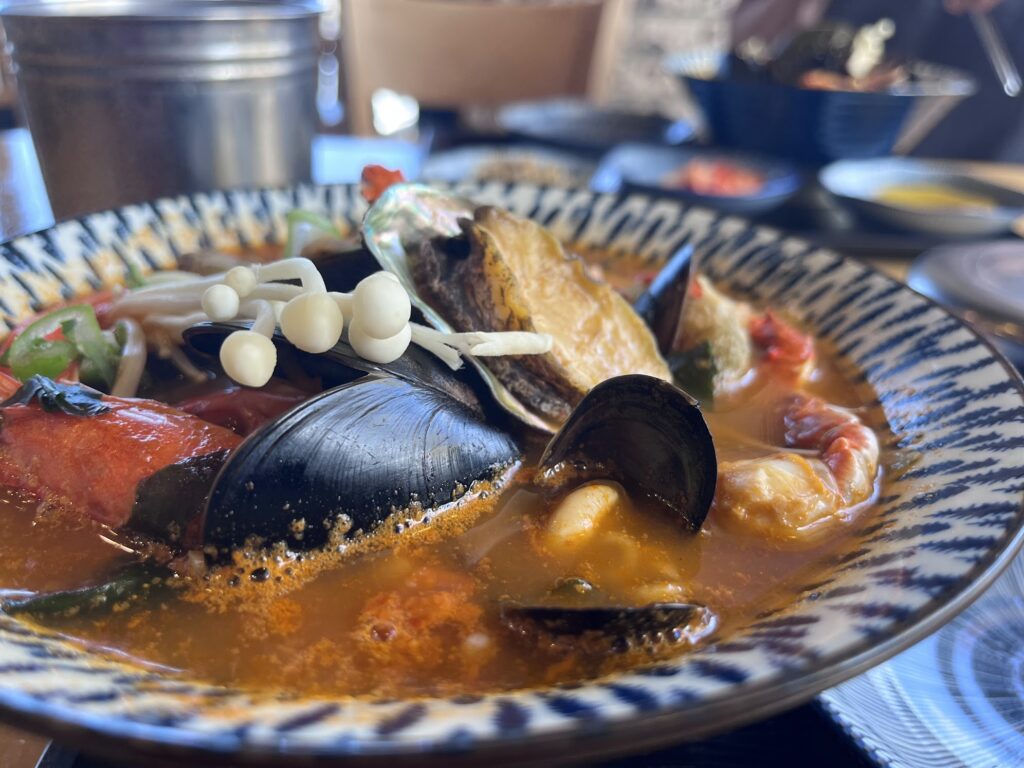
Anju and comfort food are not the same thing, but they share a common root: both are about food doing something more than feeding you. Anju is food that extends a social evening, facilitates connection, and maps to specific drinks and relationships. Comfort food is food that makes a bad day better or takes you back to something familiar.
The places where these categories overlap—kimchi jjigae on a rainy night, makgeolli and pajeon with an old friend, a bowl of gogi guksu at a counter restaurant in Jeju City—are where Korean food culture is at its most honest. Not the Instagrammable stuff. Not the tourist market food.
The stuff people actually eat.
Anju is covered in detail in Episode 25 of the Vamos a Jeju podcast. Korean comfort food is Episode 26. Korean fast food and street food is Episode 24. For the six food experiences specific to Jeju—including the butcher shop BBQ, haenyeo restaurants, and dried squid by the coast—see the Six Food Experiences article.
